The development of artificial intelligence (AI) is unstoppable. It is increasingly permeating all areas of public life – including the arts.
As early as 2017, an Oxford study that nearly half of all jobs would be replaced by computers within the next 25 years. Jobs involving analysis and routine tasks would be most affected. Creative professions were therefore long considered irreplaceable. According to the 2018 Future of Jobs Report, creativity is one of the most important skills for employees and managers.
Jack Ma , founder of Alibaba, reiterated this in a 2018 interview and recommended that we promote skills that cannot be replaced by machines:
I think we should teach our children art […] to make sure they are different.”
Six years later, creativity as one of the last great human disciplines is no longer as unchallenged as Jack Ma claimed back then. Computers are quite "creative" these days.
This leads both to new opportunities and to great concern about whether art created by humans could soon become obsolete.
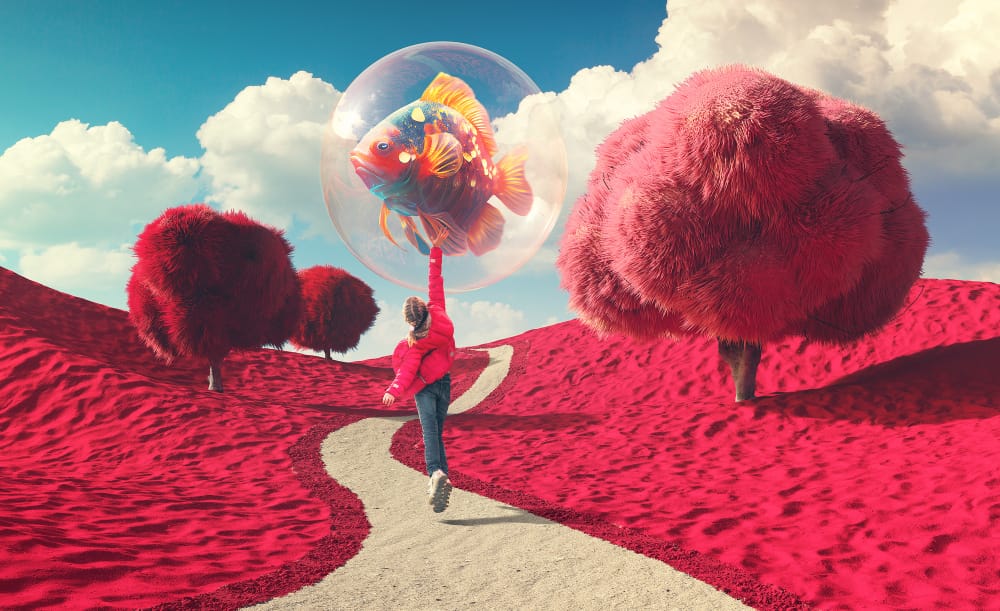
Surreal landscape with a child holding a bubble – AI-generated image. Image source: Freepik
The fusion of artificial intelligence (AI) and art is undoubtedly a fascinating and highly topical subject, but it comes with numerous challenges and novel questions.
The rapid advances in AI technology raise such important ethical questions :
Does AI impair traditional forms of creativity or does it open up new avenues for previously undiscovered artistic expressions?
What does it actually mean to be "creative"?
Can machines truly be considered artists?
How does automation through AI affect different areas of work?
In what ways does the use of AI affect our interpersonal relationships and society in general?
What adjustments should education systems make to prepare children for a world increasingly shaped by AI?
What long-term consequences will the development of AI have on the economy, politics, and everyday life?
And how can we ensure that AI is used as an inspiring tool and not misused for manipulation or surveillance?
Let us explore together which perspectives and arguments can provide insights or even initial answers. Furthermore, let us consider compelling reasons why human creativity will continue to surpass AI due to its (current) limitations and weaknesses, and why AI should be viewed as a tool rather than a threat.
Artificial intelligence in art – both a hope and a threat
Our human desire to express ourselves creatively is virtually limitless and multifaceted. We feel a deep longing to bring our ideas and visions to life in various forms.
However, unless we are trained artists, designers, architects or musicians, our lack of skills often places strict limits on us.
Artificial intelligence (AI) now possesses the unique ability to perform tasks for which we lack the skills. By analyzing our text-based suggestions—known as prompts—it can create inspiring works of art of breathtaking beauty. Using algorithms and machine learning, AI is able to effortlessly bring our ideas to life.
She is able to create paintings that reflect the depth of our emotions and inner thoughts. She also designs fashion collections that give expression to our individual imagination and personal style. Writing musical pieces and composing melodies are also part of her diverse repertoire.
AI programs like Midjourney and DALL-E are now capable of creating images within seconds , some of which can be quite impressive. The user simply needs a prompt, in which they tell the AI what to create in just a few words. Music, sounds, voices, and videos can also be created this way.
These seemingly endless possibilities have led to widespread fear among artists that AI could soon render them obsolete. Who would pay a human artist when they could have the same work done by an AI for less money and in a much shorter time?
One of the most prominent fears is that artificial intelligence could render human creativity obsolete. After all, creativity is based on human experience, emotions, and imagination—qualities that have so far been considered uniquely human. Another concern is that artistic AI could displace authentic, analog art.
However, as progressive as these programs may seem at first glance, they have their limitations and security concerns, which will not make the demand for artists disappear so quickly.”
Artificial intelligence and its creative use in art is not a new phenomenon
Artificial intelligence (AI) already played a role in many areas of the creative industries in the 2010s. Therefore, some examples from the fields of film, design, art, and music will be mentioned.
The following examples of artificial creativity spanned various areas of the media landscape and were based on neural networks and deep learning . An artificial neural network (ANN) connects nodes that are hierarchically arranged and transmit signals from an input layer to an output layer.
In deep learning, the weights are adjusted in multiple passes to precisely meet the requirements of the KNN (Kinky-Nearest Neighbors). Artificial intelligence is based on KNNs and requires a large amount of data during the training process. Artificial creativity, therefore, consists of reinterpreting existing data rather than creating something truly new.
film
The artificial intelligence Watson was already used in 2016 to create the trailer for the science fiction film “Morgan” . For this purpose, 100 trailers from various horror films were visually and audibly analyzed, divided into sections and systematically categorized.
Based on this analysis, a template for an appealing film trailer was developed. Using these findings, the AI selected suitable segments for “Morgan”, which were then compiled into a complete trailer by a film crew.
The Kunstplaza Magazine places special emphasis on a critical examination of works and themes. The articles are thoroughly researched and provide readers with a deep insight into the background of the artworks and their social significance.
Deep Dream was an innovative pattern recognition software developed by Google to improve image search. First introduced in 2015, the algorithm was based on a sophisticated neural network . This network was specifically trained to accurately identify faces, dogs, and other objects.
By cleverly adapting the code, it was possible not only to recognize patterns but also to highlight specific areas of an image, resulting in fascinating computer art. With each iteration, the desired pattern was artificially enhanced, leading to impressive results that were sometimes psychedelic and occasionally unexpected.
Deep Art was an innovative software developed by Leon Gatys at the renowned University of Tübingen . Through the application of advanced artificial intelligence, the individual style of a work of art was precisely analyzed and replicated in an execution-oriented manner.
The impressive results were so authentic at the time that even a demanding visual Turing test overwhelmed most users, with only a few able to provide correct answers. Deep Art allowed users to upload their own images and transform them in the style of a selected artwork. The high-resolution version of the transformed image could also be purchased to create unique works of art.
Design
In aircraft manufacturing, in addition to aesthetics and functionality, specific parameters such as weight, size, and stability in the event of a crash are crucial for interior design. The development of the partition in the new Airbus A320 a generative design process , supported by artificial intelligence, which the design team used.
They were inspired by the lattice-like structure of a slime mold and a mammalian bone. Numerous possibilities arose for constructing this lattice structure, depending on the number of connection points. Using artificial intelligence, the load-bearing capacity and efficiency of these structures were virtually calculated and tested. The design team chose a favorite, which was then manufactured 3D printing
This innovative partition has been installed in A320 series aircraft since 2018.
Music
With AIVAVirtual Artist 's innovative artificial intelligence , you could compose unlimited music – fully automatically by AI. The neural network was trained on over 30,000 scores of various styles and analyzed their characteristic features, taking into account the emotional impact of each composition.
The developers emphasized that AIVA was not designed to replace human composers, but rather to efficiently create high-quality soundtracks in large quantities. This technology is particularly in demand in the video game industry , for example, where extensive musical scores are needed to accompany up to one hundred hours of gameplay.
A fascinating project, funded by Deutsche Telekom, planned the completion of Beethoven's Tenth Symphony – also known as "the Unfinished" due to the fact that only sketches exist. Using artificial intelligence, this legendary symphony was to be completed and performed for the first time in the Beethoven anniversary year of 2020.
The composition will consist of two movements, and none of those involved know what the final result will be.”
so says Matthias Röder.
The world premiere of this unique symphony took place in early 2022 and was able to duly celebrate Beethoven's 250th birthday.
Latest iteration step: Generative AI
Generative AI and Artificial Intelligence instead of Neural Networks and Deep Learning
Generative AI explained in 2 minutes
According to the definition of AI giant Google, generative AI uses artificial intelligence to create new content such as text, images, music, audio, and video. This generative AI is based on extensive foundational models that are capable of multitasking and can perform various predefined tasks such as summarizing, question-and-answer sessions, classifications, and more.
Furthermore, these foundational models can be adapted to specific use cases with minimal training, even with a limited amount of sample data.
How does generative AI work?
The use of generative artificial intelligence relies on a machine learning to recognize the structures and relationships within a dataset of artificially created content. New content is then generated based on these identified patterns.
The most common method for training a generative AI model is supervised learning . The model is given a collection of artificially created content and associated labels.
Based on this, it learns to generate similar content and label it with the same tags as the artificially created content.
Real creativity through machines?
By definition and due to its internal logic, artificial intelligence is still not capable of creating something truly new, but merely of reinterpreting what already exists.
But what about human creativity? Can humans truly create original works? Or does their creation merely consist of reinterpreting existing works of art?
Human creativity
The concept of creativity as an outstanding personal characteristic only emerged in the late 19th century. In the 18th century, it was referred to as discoveries , while in the Middle Ages , it was attributed to divine inspiration
All these terms describe “the ability to overcome traditional ways of thinking and acting and to develop new, original ideas, methods or things.”
From a psychological perspective, five key elements are required to unleash creativity: talent, knowledge, motivation, a specific personality, and the right environmental conditions.
Some people are naturally blessed with creative abilities and possess sufficient diligence and knowledge to solve complex problems with creative freedom. In all these aspects, humans are on par with computers.
The neurobiological definition of creativity is more precise: creativity means the “restructuring of existing information” .
All experiences are stored and linked in neural structures. This stored information is constantly reviewed and recombined. Therefore, it is advisable to "take your time and think about something calmly ." During creative phases, the acquired content is relinked, leading to the formation of new neural networks and ultimately to "new, original ideas, methods, or things ," according to psychiatrist R. Holm-Hadulla, scientist J. Moeser, and author K. Morr.
Limitations and disadvantages of generative AI
AI can certainly analyze massive datasets in a short time, something a human could never do. But it still makes mistakes , such as extra fingers on each hand or a double mouth. Furthermore, the result is often predictable , and a high degree of precision in the prompts is necessary to achieve the desired outcome.
A new profession, "prompt creator," will certainly emerge in the near future, specializing in creating suitable prompts for clients.
Artificial intelligence lacks a central driving force for the creation of significant art. Image source: vecstock, via Freepik
Human creativity and uniqueness remain elusive in art and literature despite advances in AI. While generative AI can support and improve upon some tasks, it cannot reproduce the individual artistic vision or writing style of a person who has developed and refined it over years or decades.
The ability of artists and authors to bring their unique voice (based on countless learning experiences, thought processes, reflections, emotional conflicts and highs) remains crucial for creating works that cannot be replicated by AI.
Furthermore, AI lacks awarenessof social, emotional, or societal factors – and thus a key driving force in the creation of art.
Although AI algorithms can create impressive works, the question of the deeply human experience and the genuine expression of emotions remains. Generative AI and its algorithms are merely tools and cannot fully replace the creative vision and expressiveness of an artist. True analog art possesses a special quality, a “spiritual depth ,” that is difficult to imitate. Artificial art remains artificial.
Analog artworks remain unique objects with a physical presence that AI cannot completely replace. Instead, we can use AI as a new form of artistic expression to expand our own creative boundaries and renew our horizons. AI helps us generate new ideas, find unconventional approaches, and improve our artistic skills.
Then there's the question of authorship. If an artist creates a painting, a song, or a video, the matter is fairly clear. But who owns the image if AI created it? The programmers of the software or the person who fed the AI the prompt?
Will artificial intelligence replace human artists?
The previous sections all lead us to this one question that is so pressing for the artists among us: is the human artist a dying breed?
It becomes clear that a person's creative process is not so different from how KNNs, deep learning, machine learning, and generative AI work. No creative person invents something completely new out of thin air.
Even though it may seem that songs like “Yesterday” were written in a sleep, or that figures like Bill Gates, Steve Jobs, or Elon Musk changed the world overnight, ultimately all innovative ideas and works of art are based on a long process of reinterpreting and combining stored experiences and events.
Creativity is not a magical ability reserved for only a lucky few.”
It is therefore not surprising that AIs are becoming increasingly inventive with technological advancements and more powerful computing capabilities. However, instead of giving up and completely relinquishing artistic work, it makes more sense to view artificial creativity as a tool and use it for one's own purposes.
Although AI theoretically has access to all the world's knowledge, it is precisely the limited, individual perspective on the world that defines an artist. Their own life story and sometimes limited knowledge make art unique and personal.
Everything else could be done by AI in the future.
My own personal view is that AI will continue its evolution, thereby further shifting the boundaries in the creative industries and for all those involved. However, a dirge for human art is an exaggeration. As we have seen, artificial intelligence has existed alongside human art for many years and has not led to the much-feared apocalypse among artists.
In my opinion, we will continue to see existing business and earning models for creative professionals come under attack and be rethought or at least adapted. This will lead to many hybrid forms of semi-artificial creativity.
Instead of clinging to the old ways, those in charge in government and institutions should ensure fair rules and transparent conditions for all participants (keyword: copyright and fair remuneration for their own creations and their use by large AI corporations such as OpenAI, Google, and others).
AI and cybersecurity
AI raises many security questions because it is not immune to manipulation and bias.controversy surrounding Google's Gemini AI program demonstrated the latter
Hackers could also infiltrate the AI and manipulate it for their own purposes or steal user data.
If you use AI regularly, countless data points can accumulate in your account – whether personal information, financial data, or the history of prompts and results within the AI programstrong login credentials at all times . If you use a weak password, it's easy for hackers to gain access to your account.
A password manager like NordPass can help you create strong passwords, not just for AI programs. In addition, you can store and manage your login credentials in its virtual vault and access them remotely.
Furthermore, for artists who use AI as a tool in their creative process, adherence to strict security measures is of utmost importance.
This includes:
A strong authentication method such as two-factor authentication (2FA);
The use of a VPN and an antivirus program for greater cybersecurity in general;
Regular updates to eliminate potential vulnerabilities
Beware of dubious programs that pose the risk of data sales or malware;
careful when sharing sensitive information or collaborating with AI platforms and ensure they adhere to strictPrivacyguidelines and regulations.
Sources:
Kausch, BA on einfallsReich:AI – ARTIFICIAL INTELLIGENCE AND ART, https://einfallsreichblog.de/2023/08/ki-kuenstliche-intelligenz-und-die-kunst/
Kilper, B .: Whitepaper on Artificial Creativity: Can Artificial Intelligence Replace an Artist?; Stuttgart Media University; submitted to Prof. Dr. Andreas Koch (2020)
IVA.Pricing . From AIVA: https://www.aiva.ai
Biesler, J. on Deutschlandfunk : Classical Music and Computer Science: AI to write Beethoven Symphony , https://www.deutschlandfunk.de/klassik-undinformatik-ki-soll-beethoven-sinfonieschreiben.691.de.html?dram:article_id=465428
Binsch, J. in Süddeutsche Zeitung : Artificial Intelligence: This computer is almost as beautiful as a human , https://www.sueddeutsche.de/digital/kuenstliche-intelligenz-dieser-computermalt-fast-so-schoen-wie-ein-mensch-1.2856388 accessed on 07.01.20
Catsoulis, J. in New York Times : Review: In 'Morgan,' a Snow White With Lips Stained Red, https://www.nytimes.com/2016/09/02/movies/morgan-review.html accessed January 7, 20
Coach, CK in Creative Kid College Coach : Jack Ma on Education in the Age of Artificial Intelligence, https://creativekcc.com/blog/2018/1/30/jack-ma-on-education-in-the-age-ofartificial-intelligence accessed January 8, 2020
Süddeutsche Zeitung : Computer Art: When Google Stares at the Clouds , https://www.sueddeutsche.de/kultur/kunstvon-computern-wenn-google-in-die-wolken-starrt-1.2559161
Google Cloud : Use cases for generative AI, https://cloud.google.com/use-cases/generative-ai?hl=de
Holm-Hadulla, R .: What does creativity mean? Fundamentals and their practical consequences; Television, pp. 4-8.
Moeser, J. in Jaai : AI Basics: Artificial Neural Networks – Structure and Function, https://jaai.de/kuenstliche-neuronale-netze-aufbaufunktion-291/
Mordvintsev, A. in Google Research Blog : DeepDream – a code example for visualizing Neural Networks , https://web.archive.org/web/20150708233542/https://googleresearch.blogspot.c o.uk/2015/07/deepdream-code-example-for-visualizing.html
Morr, K. on 99designs : What is creativity? The ultimate guide to understanding the most important skill of our time, https://99designs.de/blog/kreatives-denken/was-ist-kreativitaet/
Pluta, W. on Golem : The airplane from the 3D printer , https://www.golem.de/news/airbus-das-flugzeug-aus-dem-3d-drucker-1610123924-3.html
Owner and Managing Director of Kunstplaza. Journalist, editor, and passionate blogger in the field of art, design, and creativity since 2011. Successful completion of a degree in web design as part of a university study (2008). Further development of creativity techniques through courses in free drawing, expressive painting, and theatre/acting. Profound knowledge of the art market through years of journalistic research and numerous collaborations with actors/institutions from art and culture.
A fundamental need for every artistically creative person is likely to be the ability to live off their art.
In order to secure your own existence, it is essential to make money with art . In fact, contrary to the majority perception, many artists can live well from their creative work these days. Nevertheless, a vast majority of all freelance artists are dependent on further sources of income (e.g. giving courses, order work, part -time jobs, etc.).
Recognition as an artist often does not bring immediate financial security. Therefore, artists are often also life artists.
The opportunities to make a living from one's own art have, however, grown significantly due to the internet and social media. As an artist, however, you must be versatile and flexible to succeed. A certain degree of perseverance is also essential.
Customer care and self -marketing are also important pillars for success as an artist .
In this section, we compile numerous articles, information, tips, and advice to help you make a living from your art.
AI Art - Art and Artificial Intelligence
In this magazine section, you will find numerous reports and articles about the use of artificial intelligence (AI) in art,design and architecture.
It's not just about the question of how AI can be used in these areas, but also about the impact this has on creative creation.
For while some experts believe that the use of AI will lead to a revolution in art and design, there are also voices from within the industry itself that are skeptical of AI art and AI-powered image generators.
An early example from 2016 of the use of AI in art is the project “The Next Rembrandt” . Here, software was developed that created a new painting in the style of the Dutch painter based on data analysis – without human intervention.
The result was surprisingly realistic and clearly demonstrated the potential of this technology even back then.
What does this development mean for traditional crafts? Will they become obsolete or can new opportunities be created?
These questions occupy many people both within and outside the industry alike.
In any case, the connection between art and artificial intelligence offers us exciting insights into possible future scenarios.
We warmly invite you to embark on an adventure of discovery with us!
We use technologies like cookies to store and/or access device information. We do this to improve the browsing experience and to show (non-)personalized ads. If you agree to these technologies, we can process data such as browsing behavior or unique IDs on this website. The refusal or withdrawal of consent may adversely affect certain features and functions.
The technical storage or access is necessary for the legitimate purpose of storing preferences that are not requested by the subscriber or user.
Always active
Die technische Speicherung oder der Zugang ist unbedingt erforderlich für den rechtmäßigen Zweck, die Nutzung eines bestimmten Dienstes zu ermöglichen, der vom Teilnehmer oder Nutzer ausdrücklich gewünscht wird, oder für den alleinigen Zweck, die Übertragung einer Nachricht über ein elektronisches Kommunikationsnetz durchzuführen.
Vorlieben
Technical storage or access is required for the lawful purpose of storing preferences that have not been requested by the subscriber or user.
Statistiken
The technical storage or access that is used exclusively for statistical purposes. The technical storage or access that is used exclusively for anonymous statistical purposes. Without a subpoena, voluntary compliance by your internet service provider, or additional records from third parties, information stored or retrieved for this purpose alone cannot usually be used to identify you.
Marketing
Die technische Speicherung oder der Zugriff ist erforderlich, um Nutzerprofile zu erstellen, um Werbung zu versenden oder um den Nutzer auf einer Website oder über mehrere Websites hinweg zu ähnlichen Marketingzwecken zu verfolgen.



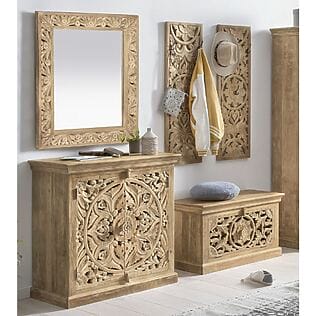
 5-piece floorboard set "Carvings" with elaborate carvings, mango wood, warm natural wood tone
The original price was: €1,799.001.599,00 €The current price is: €1,599.00.
5-piece floorboard set "Carvings" with elaborate carvings, mango wood, warm natural wood tone
The original price was: €1,799.001.599,00 €The current price is: €1,599.00.