Many events commemorate the first act on the road to German reunification , in many places along the entire former border, with Berlin being a focal point of the festivities.
This focus is located in this city for a number of reasons:
Berlin was the German capital for 244 years , although it was the capital of varying numbers of Germans. From 1701, Berlin was the Prussian capital, from 1871 the capital of the German Empire, from 1918 the capital of the Weimar Republic, and from 1933 the capital of the Third Reich. Then, on May 8, 1945, it was suddenly no longer the capital, due to a world war that also led to the division of Germany.
The division, which began with Germany under Allied administration, was actually completed on May 26, 1952. From that day on, West Berliners were no longer allowed to freely enter the territory of the German Democratic Republic due to a decree by the GDR government. However, they could still move freely within all parts of Berlin until August 13, 1961, when the sealing off of the eastern part began, quickly becoming the "Berlin Wall" and thus a reality.
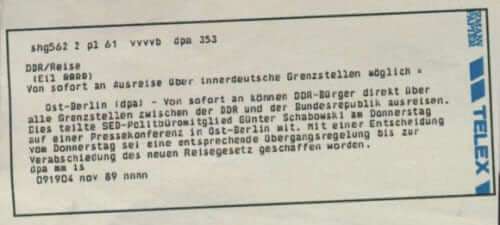
dpa breaking news report on the fall of the Berlin Wall on November 9, 1989 by Writtenby [CC-BY-SA-3.0], via Wikimedia Commons
This division across Berlin and across Germany was to last for 28 years and 88 days, until on November 9, 1989, the citizens of the eastern part of the city, in the truest sense of the word, “took to the barricades”… and made Germany one country again; the city of Berlin gained an old/new and rather dilapidated half of the city from one day to the next.
Dilapidated but exciting – Berlin became the capital of a Germany that was undergoing a complete reorganization, and it didn't take long for a continuous stream of energetic creative people, willing to make a great effort and invest, to move to Berlin, including many, many artists.
Berlin boasts tens of thousands of artists; since the fall of the Wall, the capital has developed into a center of the art world of our century, like Paris in the 19th century and New York in the second half of the 20th century. In Berlin, more and more art has been created, including works about the Wall and its opening.
For the anniversary, even more will be added; some artworks are currently being worked on and will only be presented at or after the anniversary; some artworks are created around the anniversary of the opening of the Berlin Wall with the observation or participation of citizens.
Whether the fact that the creator of what is probably the most sensational art project for the 25th anniversary of the fall of the Berlin Wall is using 8,000 balloons for his light installations has anything to do with the fact that he is 28 years and 88 days old is doubtful; Christopher Bauder just did the math: the inhumane mega-structure that separated Berliners for almost three decades measured a good 12 kilometers, which equates to one balloon every one and a half meters.
Or rather, a balloon stele, on which the balloons rest when the former wall line becomes the “border of light” from November 7th to 9th, 2014 :
8,000 white balloons with a mighty diameter of 60 centimeters, on 8,000 3.40 meter high white light steles, illuminated by 8,000 LEDs installed in the steles, powered by 60,000 batteries in the feet of the balloon steles – a superlative light installation that promises extraordinary beauty.
On Christopher Bauder's website www.christopherbauder.com you can view a beautiful preview visualization and some zoomable images of the light boundary on different sections of the route.
This preview was created by Christopher Bauder's brother Marc, the second creative in the family and the second man involved in the "Lichtgrenze" project; a well-known filmmaker who has already produced several award-winning documentaries and feature films.
Marc Bauder takes us on an emotional journey along the Light Border, from the construction of the Berlin Wall to its fall: He has compiled films from vast amounts of documentary material, featuring historical events and perspectives around the Wall, which are shown on giant video screens at six prominent locations along the Light Border.
The light columns, consisting of 40 individual parts, were designed by Christopher Bauder's lighting design company Whitevoid ( www.whitevoid.com ). The balloons are made of natural rubber, a biodegradable material, as are the balloon closure clips – a research project was specifically launched at the University of Hanover for their design and production.
If they have fulfilled their purpose, the balloons would decompose somewhere on Berlin soil at about the same rate as an oak leaf – if Berliners even give the balloons a chance to decompose, which is rather doubtful considering the further determination of the balloons initiated on the evening of November 9th:
Each balloon has a Berlin citizen as its sponsor, who fills their balloon with helium and attaches a small card with experiences, thoughts and wishes about the wall and its fall.
On November 9th at 7:30 pm, the balloon will be sent into the Berlin sky . The entire 12.6 km long light wall will rise into the air, momentarily revealing the monstrous wall before dissolving, much like in Udo Lindenberg's East-West love song "Beyond the Horizon It Goes On"... until the balloon drifts back to earth somewhere and is sure to be picked up by someone who keeps the balloon and card as souvenirs and perhaps one day tracks down the author of the attached message...
The wall before the eye
Artists Justin Allen and Adel Motamedi developed a temporary installation that makes the wall appear when the viewer moves far enough away:
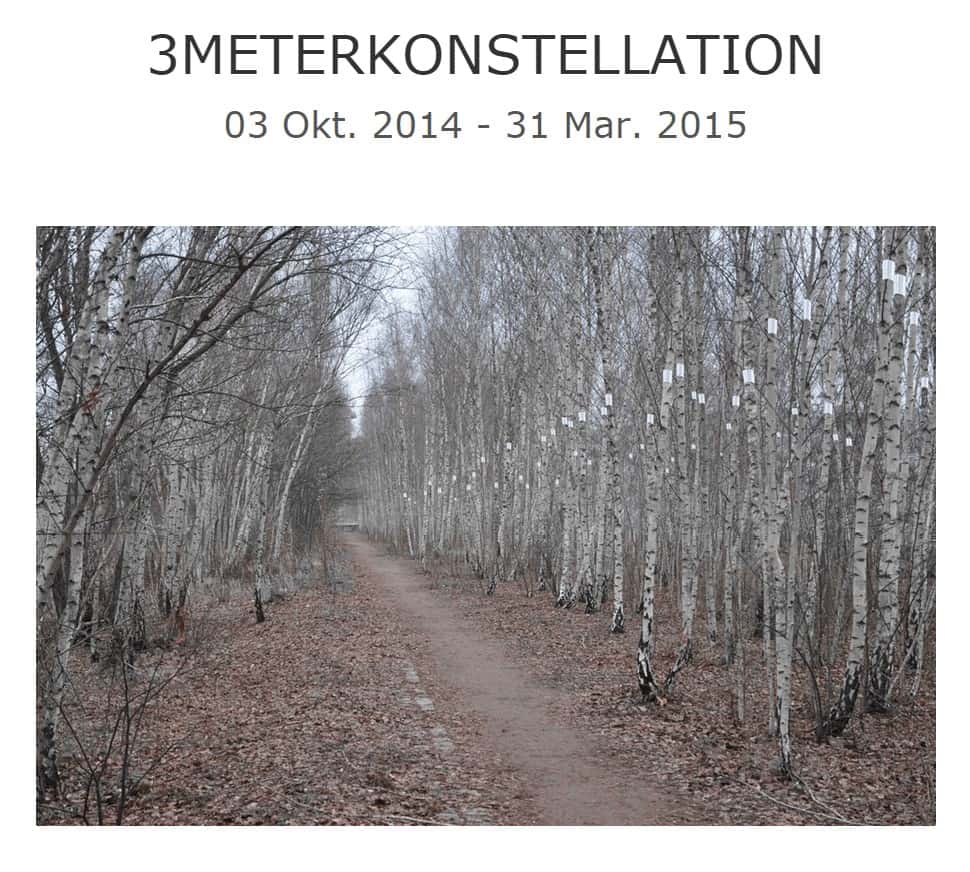
In the park near the North Station, they have attached reflective foil to 562 birch trees along the path that was once the Berlin Wall. Close together, three meters high, they appear up close to be a harmless collection of notes on trees.
It has a hidden depth that only becomes visible to the viewer when they are far enough away and have a clear view:
Then the seemingly random arrangement dissolves and simultaneously condenses into a perfectly straight horizontal line – a sketch of a wall crown at the height of the wall that stood exactly below this line 25 years ago.
The surprising installation “3METERKONSTELLATION” in Nordbahnhofpark has been open to visitors since the beginning of October 2014, and can be previewed 3meterkonstellation.tumblr.com
The wall beneath our feet
Hamish Fulton, the “Walking Artist” , presented his contribution to the anniversary of the fall of the Berlin Wall slightly ahead of schedule as part of “Art Week Berlin” on September 21, 2014 :
The performance “Walking East – Walking West” invited Berliners to experience the feeling of the Berlin Wall by walking very, very slowly along Straße des 17. Juni, the street leading to the Brandenburg Gate. 800 Berliners moved in the opposite direction, each covering 100 meters in 60 minutes, from east to west and from west to east.
100 meters in an hour – a tremendous deceleration, time for many thoughts about the construction and fall of the Berlin Wall, life in Berlin, art, and life in general… Entirely in keeping with the spirit of the “walking artist” Hamish Fulton, who has made it his art since 1967 to explore our planet with his own steps, alone and with invited “fellow walkers” (not followers).
Fulton documents these hikes, both on film and sometimes photographically; perhaps a few pictures of the Berlin anniversary wanderers will appear in the exhibition “Landscape in my Mind. Landscape photography today. From Hamish Fulton to Andreas Gursky”, which will be on display at the Bank Austria Kunstforum in Vienna from February 11 to April 26, 2015 (information: www.kunstforumwien.at ).
dizzinessofreality.de
The artistic hike took place as part of a project by the Academy of Arts entitled “Vertigo of Reality” . You can find out more about the art project, which runs until December 14, 2014 and includes an exhibition and symposia, at schwindelderwirklichkeit.de .
A photo series with some impressions of the contemplative stroll can be found at www.art-in-berlin.de/incbmeld.php?id=3352 , more about Hamish Fulton will soon be available to read Kunstplaza
The wall in the media
“Borderless – 25h Fall of the Wall” is rbb (Radio Berlin Brandenburg) is running, in which rbb television, rbb radio and rbb-online will report live from various locations along the former wall line from November 9th, 9:00 am to November 10th, 10:00 am, broadcasting documentaries and background information.
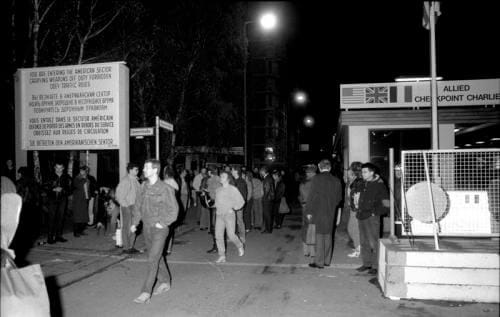
Checkpoint Charlie in Berlin, night of the fall of the Berlin Wall. Source: German Federal Archives, image 183-1989-1110-018 / Colonel, Klaus [CC-BY-SA-3.0-de], via Wikimedia Commons
The rbb broadcasts from world-famous locations such as Checkpoint Charlie, Brandenburg Gate, Glienicke Bridge and from places with mysterious names like Entenschnabel, Enklave and Engelbecken, it talks to famous and unknown people about their day the Berlin Wall fell, it brings this historic day back to life in its entirety.
The TV channel ARTE will broadcast a real treat on Sunday, November 9, 2014, at 10:10 p.m., in its German and French premiere: “1989” .
A film from 2013 and the young filmmaker Erzsébet Rácz,
The Wall and the “Events”
Around November 9th, there will be many events in Berlin:
The large “Citizens’ Festival” at the Brandenburg Gate with the motto “Courage for Freedom” will feature a comprehensive program and a rich lineup of stars on November 9, 2014:
It begins at noon with a public rehearsal of the Staatskapelle Berlin, conducted by Daniel Barenboim. From 2:00 to 5:30 p.m. there is a family program with performances by Beat'n Blow, Clueso, Mine and Otto Normal, a breakdance performance and artist talks on the fall of the Berlin Wall.
at 6 p.m. with a joint commemoration of the victims of the Berlin Wall, followed by a stage program staged by the Berlin artist company “phase7” with performances by Die Fantastischen Vier, Peter Gabriel and Paul Kalkbrenner, the band Silly and Udo Lindenberg, and talks with contemporary witnesses, such as Wolf Biermann, Freya Klier, and Ulrike Poppe.
Then the Berlin State Opera Orchestra, conducted by Daniel Barenboim, plays the 4th movement of Beethoven's 9th Symphony, the Ode to Joy, and the "light boundary" rises towards the sky…
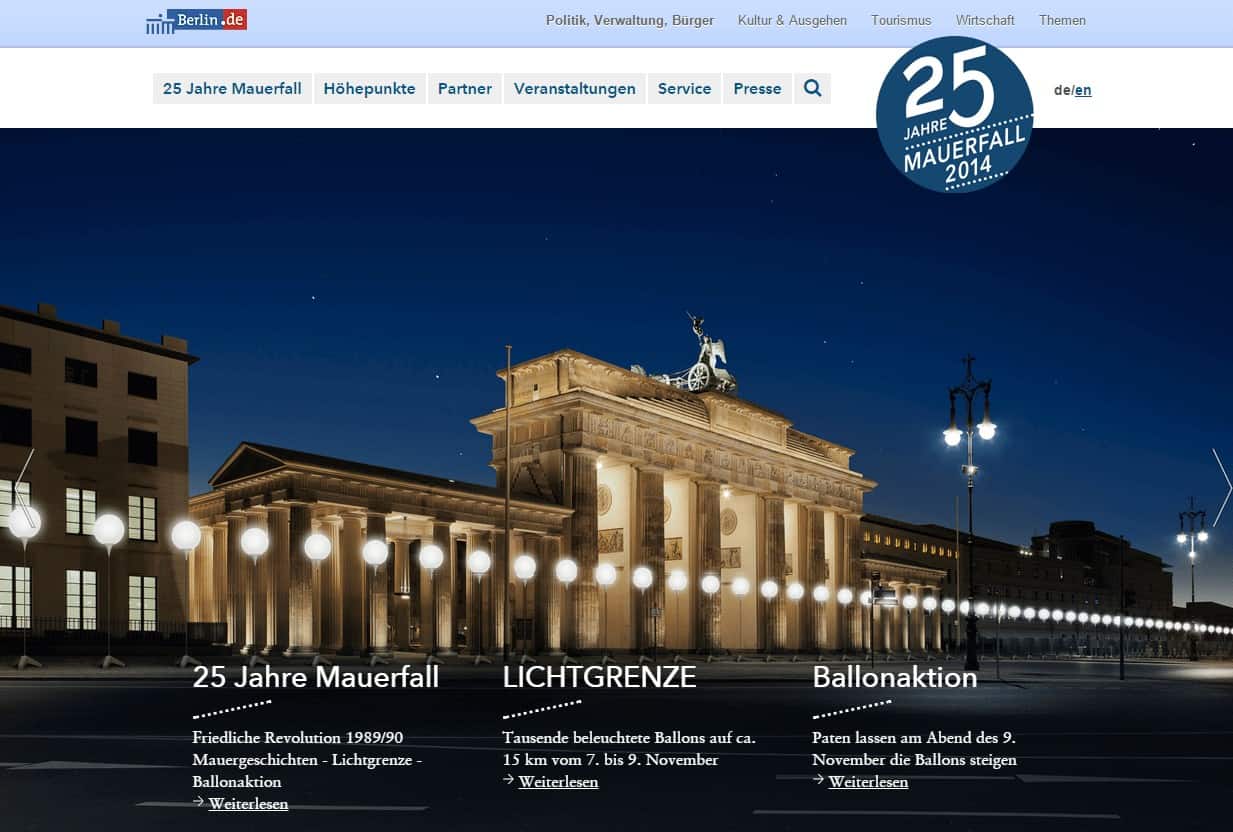
25th Anniversary of the Fall of the Berlin Wall 2014 on berlin.de
An overview of the events can be found at www.berlin.de/mauerfall2014 (click directly on the menu item “Events” in the menu bar, do not pay attention to the drop-down tabs, these are only for providers).
Note: In the event calendar on the page, you have to select a “district” to narrow down the location of an event, whereby the selection list contains districts (“Mitte District”, “Lichtenberg”), parts of districts (“Kreuzberg”, “Zehlendorf”) and neighborhoods (“Rummelsburg”, “Prenzlauer Berg”), in a colorful mix and with a logic that is not even recognizable to a Berliner.
For a tourist's satnav or simply a glance at a map, it will likely be even more difficult, therefore here is a list in which non-Berliners can see in which districts the places on the selection list are located:
Friedrichshain-Kreuzberg district – of course, that's the official district name
Central District – so.
Charlottenburg is located in the Charlottenburg-Wilmersdorf district
Friedrichshain is located in the district of Friedrichshain-Kreuzberg (so, inexplicable duplication)
Hellersdorf is located in the Marzahn-Hellersdorf district
Hohenschönhausen is located in the Lichtenberg district
Kreuzberg is located in the district of Friedrichshain-Kreuzberg (so…)
Lichtenberg is itself a district
Mitte is itself a district (so…)
Pankow is itself a district
Prenzlauer Berg is located in the Pankow district
Rummelsburg is located in the Lichtenberg district, on the west-south border of Friedrichshain-Kreuzberg
Steglitz is located in the Steglitz-Zehlendorf district
Tempelhof is located in the Tempelhof-Schöneberg district
Tiergarten is located in the Mitte district
Treptow is located in the district of Treptow-Köpenick
Wedding is located in the Mitte district
Wilmersdorf is located in the Charlottenburg-Wilmersdorf district
Zehlendorf is located in the Steglitz-Zehlendorf district
The Wall in Art
The artists didn't just discover the wall now; here are some of the most beautiful wall artworks to view :
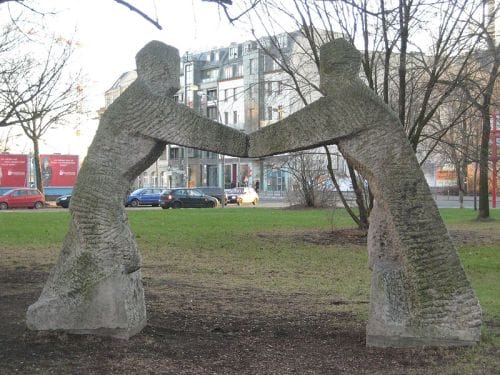
Sculpture Reunification, by Hildegard Leest (1962) Hildegard Leest, via Wikimedia Commons
“Reunification” , a sculpture by Hildegard Leest, located near the former border crossing Chausseestraße in the Mitte district.
“The Day the Wall Came Down” by Veryl Goodnight, a gift from the American people to Berlin, located on Clayallee near the Allied Museum in the Berlin-Zehlendorf district.
Berlin Wall strip “Platz des 9. November 1989” , location Bornholmer Strasse near former border crossing that connected the districts of Pankow and Mitte.
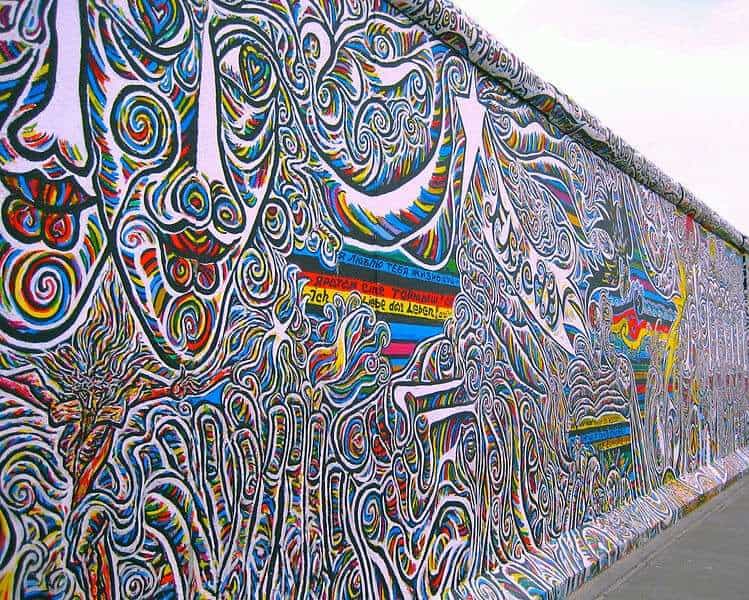
A piece of the hopefully colorfully decorated Berlin Wall from the “East Side Gallery” , location Open-Air Gallery: Berlin-Friedrichshain, Mühlenstraße, between Berlin Ostbahnhof and Oberbaum Bridge along the Spree.
Berlin Wall from the “East Side Gallery”, location: Open-Air Gallery: Berlin-Friedrichshain by Jens K. Müller from Hamburg [CC-BY-3.0], via Wikimedia Commons
The wall of the “East Side Gallery” was painted in the spring of 1990 by 118 artists from 21 countries around the world; a total of 1.316 kilometers were decorated with over 100 paintings in which the artists illustrated the political change since 1989 in very different ways.
The East Side Gallery is no longer fully preserved; the originals from 1990 were replaced by replicas in 2009, and their preservation has been the subject of heated debate in Berlin for some time.
Around November 9th, there will be many events in Berlin; and there will be many more festivals and celebrations around the anniversary of the opening of the Wall, in Wismar and Lübeck, in Wittenberge and Wolfsburg, in Salzgitter and Nordhausen, in Eisenach and Fulda, in Suhl and Coburg, in Hof and Plauen, and certainly in many smaller places closer to the former border, and probably also at a whole series of personal memorial sites along the former border strip.
If you created art on the day of the anniversary, i.e., unique photos or other commemorative documents of these celebrations, Kunstplaza would be delighted to present these unique pieces in the online gallery.
Conceptual art is an artistic style that was coined in the 1960s by the US artist Sol LeWitt (in English-speaking countries: Conceptual Art).
The origins of conceptual art lie in minimalism , and with it the theories and tendencies of abstract painting further developed.
What is special about this style is the fact that the execution of the artwork is of secondary importance and does not have to be carried out by the artist themselves. The focus is on the concept and the idea, which are considered equally important for the artistic work.
In this section of the art blog you will find numerous articles and content about this topic, as well as about artists, exhibitions and trends.
We use technologies such as cookies to store and/or access device information. We do this to improve your browsing experience and to display (non-)personalized advertising. If you consent to these technologies, we can process data such as browsing behavior or unique IDs on this website. Refusal or withdrawal of consent may adversely affect certain features and functions.
Functional
Always Active
Technical storage or access is strictly necessary for the legitimate purpose of enabling the use of a specific service expressly requested by the subscriber or user, or for the sole purpose of carrying out the transmission of a message over an electronic communications network.
Preferences
The technical storage or access is necessary for the legitimate purpose of storing preferences that were not requested by the subscriber or user.
statistics
Technical storage or access that is solely for statistical purposes.Technical storage or access that is used solely for anonymous statistical purposes. Without a subpoena, the voluntary consent of your internet service provider, or additional recording by third parties, the information stored or retrieved for this purpose cannot generally be used to identify you.
marketing
Technical storage or access is required to create user profiles, to send advertising, or to track the user on one or more websites for similar marketing purposes.






 Lamp suspension for ceiling lights / pendant lights – 3 sockets (black) with jute cable
Original price was: €99.9579,95 €The current price is €79.95.
Lamp suspension for ceiling lights / pendant lights – 3 sockets (black) with jute cable
Original price was: €99.9579,95 €The current price is €79.95.