• Art Magazine
    • Art Magazine > Homepage
    • Architecture
    • Sculpture
    • Design
    • Digital art
    • Fashion Design
    • Photography
    • Freelancing
    • Garden design
    • Graphic design
    • Handmade
    • Interior design
    • AI Art
    • Creativity
    • Art Marketing
    • Art Periods And Movements
    • Art history
    • Art trade
    • Artists
    • Art Market Knowledge
    • Art scene
    • Works of art
    • Painting
    • Music
    • News
    • Product design
    • Street Art / Urban Art
    • Tips for artists
    • Trends
    • Living from art
  • Online Gallery
    • Online Gallery > Homepage
    • Categories
      • Abstract art images
      • Acrylic painting
      • Oil painting
      • Sculptures & Statues
        • Garden sculptures
      • Street art, Graffiti & Urban art
      • Nude Art / Erotic Art
    • Post new artwork
    • Browse art
    • Search for artwork
  • Design & Decor Shop
    • Shop > Homepage
    • Wall decoration
    • Canvas art
    • Metal art
    • Sculptures
    • Furniture
    • Lighting
    • Textile wall hangings
    • Mirrors
    • Home textiles
    • Home accessories
    • Watches
    • Jewelry
    • Outlet / Sale
  • My account
    • Customer area
    • For artists
      • Login
      • Register
The product has been added to your shopping cart.

Art of prehistory and early history: Germanic art; Oseberg style

Lina Sahne
Lina Sahne
Lina Sahne
Saturday, July 5, 2025, 4:18 PM CEST

Want to read new articles immediately? Follow Kunstplaza Magazine on Google News.

The Oseberg style is the first of several overlapping art styles of the Viking Age ; it became widespread throughout Scandinavia from about the end of the 8th century.

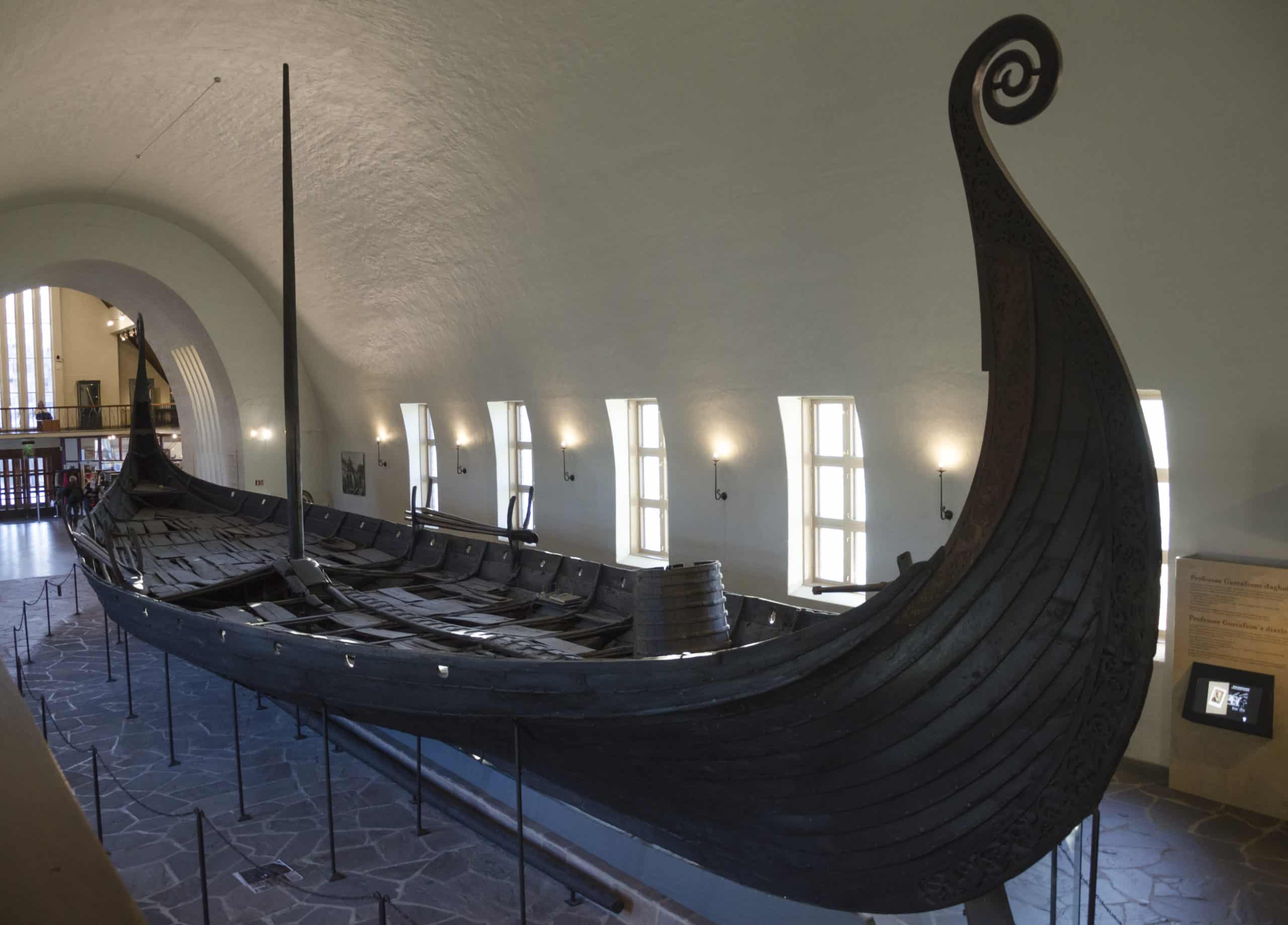
The name refers to an important site: In 1904, a ship burial was discovered on an estate in Oseberg on the Norwegian Oslo Fjord, from which Swedish and Norwegian archaeologists jointly unearthed the “Oseberg Ship”.

It took them two years to unearth the richly furnished Viking Age grave find (because they didn't actually unearth it, but rather free it by painting over it); the relatively well-preserved longship can now be seen in the Viking Ship Museum in Oslo , Norway.

Art of prehistory and early history: Germanic art; Viking ship in the Oseberg style
Art of Prehistory and Early History: Germanic Art; Viking ship in the Oseberg style.
Photo by Petter Ulleland, CC BY-SA 4.0, via Wikimedia Commons

The Oseberg style was used to decorate everyday objects and jewelry made of wood and metal ; its defining motif is the grasping animal .

This video is embedded using YouTube's enhanced Privacy mode, which blocks YouTube cookies until you actively click to play the video. By clicking the play button, you consent to YouTube placing cookies on your device, which may also be used to analyze user behavior for market research and marketing purposes. For more information about YouTube's use of cookies, please see Google's Cookie Policy at https://policies.google.com/technologies/types?hl=de.

While this doesn't actually exist, his appearance has been well-prepared since the second half of the 5th century. At this time, the art of the post-Christian Germanic peoples, which had become rigidly cultic and religious, received strong inspiration from external influences: the spirit of late antique Roman art was still present in western Scandinavia , and the Celts were also slowly developing their own artistic ideas (which Asian steppe peoples like the Scythians and Sarmatians had already possessed and brought with them in every trade encounter).

From all this, a few Irish and Anglo-Saxon influences, and their own traditions, the Germanic peoples developed their animal styles . A wild and colorful collection of stylized animal figures, “anatomically refined” until the proportions perfectly matched the intertwined ornamentation.

Animal Style III (or Vendel E period , after a large field of boat graves found in Uppland, Sweden) was completed towards the end of the 7th century. Afterwards, the original animal forms were just dissolving into exuberant tendrils and sinuous entanglements when the wondrous raptor entered the scene and ushered in the development of the Oseberg style.

This grasping creature was an animal-like being of such adaptability that, according to the art historian himself, he has been unable to define it more precisely. This is not a failure, but rather presumably the very essence of the matter, or a logical consequence, if one assumes that the forms of the grasping creature were fluidly adapted to the respective requirements.

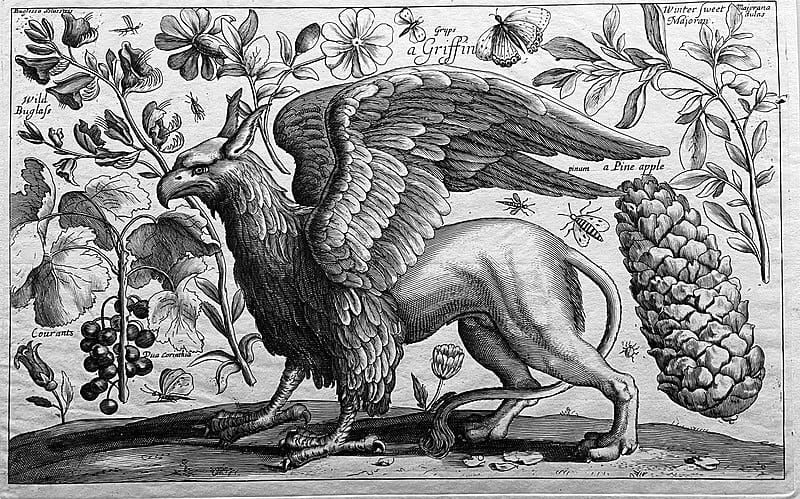
The griffin, from Animalium, Ferarum, & Bestiarum
The griffin, from Animalium,Ferarum, & Bestiarum
Shisma, CC0, via Wikimedia Commons

This mystical yet practical “animal for all occasions” likely takes its inspiration from the lion depictions in Carolingian and Anglo-Saxon art , which were spreading throughout Northern Europe from the Frankish Empire at that time. At least, that is the assumption of most researchers working in this field; other authors see the griffin's origins in the (English) illuminated manuscripts of the time, which frequently depicted squirrel-like animals.

This would discredit the proud, mystical creature of the century as a descendant of the first book illustrations à la cute, fast, cheap (today mostly sexy, fast, cheap), because the book illustrations of that time were teeming with rabbits and other cute little animals – that is probably also a bit short-sighted.

But even if the minority opinion were correct: one can very well imagine how the descendants of the proud early human predatory animal designers would react to the fact that their heraldic animal was supposedly based on a kind of “naked breast substitute”.

Back then, myths and further myths were stylized from every mystical image, and heraldic animals thus assumed almost state-supporting functions: Even in the coat of arms of “Sissi” , two griffins support the shield; the Dukes of Pomerania form the Griffin dynasty; in 1884, Grand Duke Friedrich Franz III founded the Mecklenburg Griffin Order, an award in five classes… No chance; and there are of course many more myths surrounding the legendary “Griffin” , which would then seem somewhat ridiculous.

the Broa style after a bronze-gilt bridle fitting with griffin motifs from a man’s grave near Broa/Gotland , survived until the middle of the 9th century and was replaced by the Borre style.

After that, the Vikings developed several more styles, the Jelling style and the Mammen style , the Ringerike style and the Urnes style , until around 1100 AD the first advanced civilizations flourished in this part of the world.

This video is embedded using YouTube's enhanced Privacy mode, which blocks YouTube cookies until you actively click to play the video. By clicking the play button, you consent to YouTube placing cookies on your device, which may also be used to analyze user behavior for market research and marketing purposes. For more information about YouTube's use of cookies, please see Google's Cookie Policy at https://policies.google.com/technologies/types?hl=de.
Lina Sahne
Lina Sahne

Passionate author with a keen interest in art

www.kunstplaza.de

You might also be interested in:

Art of Prehistory and Early History: Germanic Art; Lombard Art Art of Prehistory and Early History: Germanic Art; Lombard Art Definition of art Art – Definition & Meaning – What is Art? The concept of art and its purpose in society The sculpture "Apollo and Daphne" by Bernini in the Galleria Borghese. Art Periods And Movements – Introduction to the art history of stylistic periods and their characteristics All the works of art in the room, together with the painted ceiling paintings, create a magnificent setting for the Hall of Mirrors of Louis XIV at the Palace of Versailles. Baroque Period – Stylistic features, artists and important works Memento Mori: What transience in art teaches us about life Memento Mori: What transience in art teaches us about life

Seek

Art Dictionary and Glossary

Like any subject area, art also has a wealth of specialised terminology, expressions, abbreviations, and foreign words.

In this section, we would like to introduce you to some of the most important and common terms from time to time.

You will be able to learn and deepen your understanding of a range of information, definitions, liturgical terms, notes, common technical terms and their abbreviations, as well as concepts from art theory, art history, and art philosophy.

In our continuously expanding category "Art Dictionary," we provide answers to questions such as "What is meant by Art Brut , Tape Art , Macramé , Performance Art or Conceptual Art ?"

Art styles and movements

The art style or also the direction in artworks refers to the uniform expression of the artworks and cultural products of an era, an artist or an artist group, an art movement, or an art school.

This is a tool for categorising and systematising the diversity of art. It denotes similarities that distinguish it from others.

The term is thematically related to the Art Movement, but it should not be viewed solely within a temporal framework and is therefore much broader.

In this section, we would like to help you gain a better understanding of styles and movements in art.


Similar posts:

  1. Art of Prehistory and Early History: Germanic Art; Lombard Art
  2. What is art, and what does it mean? The idea of art and its social function
  3. Art Periods and Movements – Introduction to the Art History of Styles and Their Characteristics
  4. Baroque era – stylistic features, artists and important works
  5. Memento Mori: What transience in art teaches us about life

Featured Art

  • Jack Vettriano: "The Singing Butler" (1992), reproduction on canvas
    Jack Vettriano: "The Singing Butler" (1992), reproduction on canvas
  • Abstract mixed media painting “Feeling L” by Xiaoyang Galas
    Abstract mixed media painting “Feeling L” by Xiaoyang Galas
  • "ETHNO II" (2021) - Mixed-media portrait painting by Alina Konyk
    "ETHNO II" (2021) - Mixed-media portrait painting by Alina Konyk
  • Robert Hettich: "At the Entrance" (2004), reproduction on aluminum plate
    Robert Hettich: "At the Entrance" (2004), reproduction on aluminum plate
  • Pop Art masterpiece "Untitled, April" (1985) by Keith Haring, reproduction on paper
    Pop Art masterpiece "Untitled, April" (1985) by Keith Haring, reproduction on paper

Design and Decor Highlights

  • Gold-plated stud earrings "Mini Hearts", 925 sterling rose gold Gold-plated stud earrings "Mini Hearts", 925 sterling rose gold 19,90 €

    VAT included.

    Delivery time: 4-8 working days

  • Metal wall relief "Vine" with leaf motif and black frame Metal wall relief "Vine" with leaf motif and black frame 125,00 €

    VAT included.

    Delivery time: 3-5 working days

  • Palm mirror with cowrie shells (natural) Palm mirror with cowrie shells (natural) 169,95 €

    VAT included.

    Delivery time: 2-4 working days

  • Mystical gemstone necklace "Spring Leaf" with Peridot Mystical gemstone necklace "Spring Leaf" with Peridot 29,90 €

    VAT included.

    Delivery time: 1-3 working days

  • Concrete planter "The Charcoal Low" on a teak wood base (black) Concrete planter "The Charcoal Low" on a teak wood base (black) 87,95 €

    VAT included.

    Delivery time: 1-3 working days

  • Relief canvas print "Pour Madeleine", minimalist wall decoration in white Relief canvas print "Pour Madeleine", minimalist wall decoration in white 109,00 €

    VAT included.

    Delivery time: 3-4 working days

  • J-Line table lamp “Arc” – Minimalist design in matte black J-Line table lamp “Arc” – Minimalist design in matte black 254,00 € Original price was: €254.00169,00 €The current price is: €169.00.

    VAT included.

    Delivery time: 2-4 working days

Kunstplaza

  • About us
  • Legal notice
  • Accessibility
  • Press Area / Mediakit
  • Advertising on Kunstplaza
  • FAQ – Frequently Asked Questions
  • Get in touch

Languages

Art Magazine

  • About our magazine
  • Editorial Policy / Editorial Standards
  • Guest contributions / Guest author
  • RSS feeds / Subscribe to news

Online Gallery

  • About our gallery
  • Guidelines & principles
  • Buy Art in 3 Steps

Online Shop

  • About our shop
  • Newsletter & deals
  • Quality Promise
  • Shipping & Payment
  • Return Policy
  • Affiliate Program
Carossastr. 8d, 94036 Passau, Germany
+49(0)851-96684600
info@kunstplaza.de
LinkedIn
X
Instagram
Pinterest
RSS

Proven Expert Label - Joachim Rodriguez

© 2026 Kunstplaza

Imprint Terms & Conditions Privacy

Prices incl. VAT plus shipping costs

Manage privacy

We use technologies such as cookies to store and/or access device information. We do this to improve your browsing experience and to display (non-)personalized advertising. If you consent to these technologies, we can process data such as browsing behavior or unique IDs on this website. Refusal or withdrawal of consent may adversely affect certain features and functions.

Functional Always Active
Technical storage or access is strictly necessary for the legitimate purpose of enabling the use of a specific service expressly requested by the subscriber or user, or for the sole purpose of carrying out the transmission of a message over an electronic communications network.
Preferences
The technical storage or access is necessary for the legitimate purpose of storing preferences that were not requested by the subscriber or user.
statistics
Technical storage or access that is solely for statistical purposes. Technical storage or access that is used solely for anonymous statistical purposes. Without a subpoena, the voluntary consent of your internet service provider, or additional recording by third parties, the information stored or retrieved for this purpose cannot generally be used to identify you.
marketing
Technical storage or access is required to create user profiles, to send advertising, or to track the user on one or more websites for similar marketing purposes.
  • Manage options
  • Manage services
  • Managing {vendor_count} suppliers
  • Read more about these purposes
Manage options
  • {title}
  • {title}
  • {title}