Architecture is an art form that constantly and noticeably accompanies our everyday lives . People who live near truly impressive architectural works certainly gain a lasting quality of life when they are reminded daily of the treasures they have around them – unlike the tourists who come specifically to see these impressive buildings, they have them at their disposal every day!
In Germany, we can trace the architectural remains of the past antiquity
At the beginning of our era, the then world power, the Roman Empire , had settled parts in the south and west of the land then inhabited by Germanic tribes, and it was they who left us the first architectural works (the Germanic tribes lived in wooden hut settlements and did not pass on any lasting buildings).
Some remnants of the Roman border fortifications, built between 100 and 150 AD, can still be admired today. The Limes bordered the present-day German states of Bavaria, Baden-Württemberg, Rhineland-Palatinate, and Hesse. This complex system of barriers, consisting of palisades, ditches, and ramparts, can still be traced in the landscape today. In 2005, it was UNESCO World Heritage .
Since a barrier, regardless of its construction, does not appear particularly spectacular during an on-site visit, some of the approximately 900 watchtowers and the roughly 120 smaller and larger troop camps or forts have been reconstructed to varying degrees.
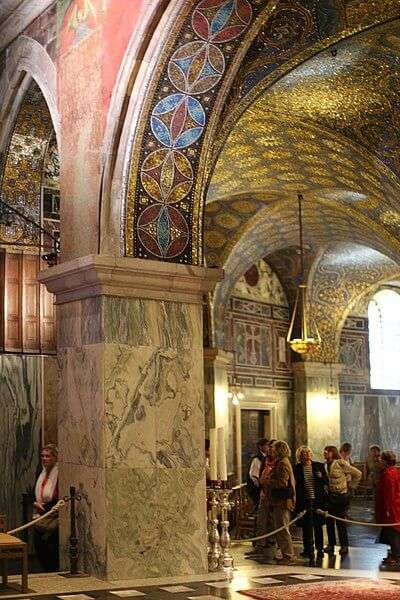
Interior design of the Palatine Chapel in Aachen by HOWI – Horsch, Willy [CC BY-SA 3.0], Wikimedia Commons
Claus te Vehne from 74189 Weinsberg has compiled an admirable list of which of the reconstructions are truly worth a visit website www.limesseiten.de . Here you can now find even more information about the Roman remains along the Limes in Baden-Württemberg, Bavaria, Hesse, North Rhine-Westphalia, Rhineland-Palatinate, and Saarland.
Besides military installations, you'll also discover Roman villas and other finds such as building inscriptions, quarries, and gravestones. Many of these are accompanied by photographs, making even a simple stroll through this website an educational and entertaining journey into the past.
However, if you want to inspire children with this excursion into our origins of architecture, you should choose special days such as the Roman Days at the Roman fort and Roman Museum in Aalen (demonstrations, mock battles, fashion shows, Roman food) or one of the activity days at the completely reconstructed Saalburg fort near Bad Homburg, which include many exciting topics.
The Romans also had a civilian life, for which they built bridges, thermal baths, amphitheaters, and city gates, for example the Porta Nigra , probably the best-preserved city gate of antiquity , which is now located on the edge of Trier's city center.
In the ancient Roman city, the ruins of various thermal baths, a reconstructed basilica (Constantine's Basilica), the Roman bridge, and an amphitheater can also be visited, and the first walls of the cathedral also date back to Roman times, as do the beginnings of Cologne Cathedral . Roman structures can also be found in the original Roman cities of Augusta Vindelicorum (Augsburg) and Cambodunum (Kempten), as well as in some other locations in Bavaria, Hesse, and Baden-Württemberg.
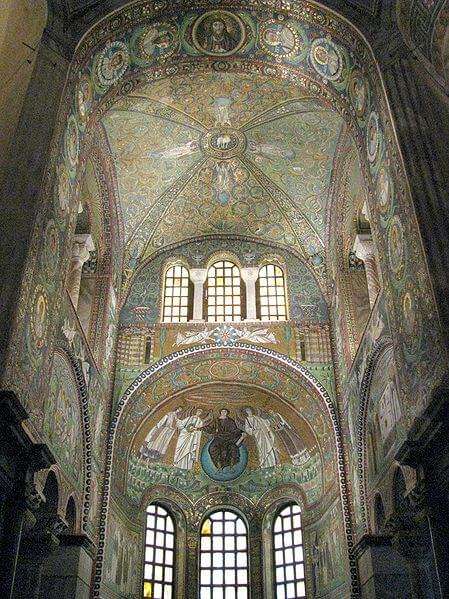
Magnificent mosaic in the Romanesque Basilica of San Vitale in Ravenna by Testus [CC BY-SA 3.0], Wikimedia Commons
From the time of their greatest expansion, the Romans were slowly pushed back by the various Germanic tribes; with them, urban culture and progress in architecture disappeared for quite some time; only with Charlemagne did the Frankish Empire, , produce a ruler who had the means to undertake significant building projects.
In architecture, we have now the 8th century , the period known in art history as the Pre-Romanesque , which primarily encompasses architectural works and includes the transition from Late Antiquity to Romanesque , i.e., roughly the period from the 5th to the 11th century.
Charlemagne , or rather his master builder Odo of Metz, left us the Palatine Chapel in Aachen, which was probably built from the year 793 onwards in a work that took several years (it was consecrated in 798).
This chapel of the former imperial palace, which today forms the center of Aachen Cathedral, was designed as an octagon and thus probably modeled after the most famous buildings of that time.
A similar form can be found in San Vitale in Ravenna and the Church of Saints Sergius and Bacchus in Constantinople (the “Little Hagia Sophia”), important Byzantine church buildings from the 6th century; even late antique stately buildings such as St. Gereon and the Praetorium in Cologne boasted octagonal domes.
These buildings embodied the highest architectural art of the time, to which the Frankish Odo of Metz could add no new knowledge even some 150 years later; the Emperor's Palatine Chapel remained the tallest and most expansive building north of the Alps for more than another 200 years.
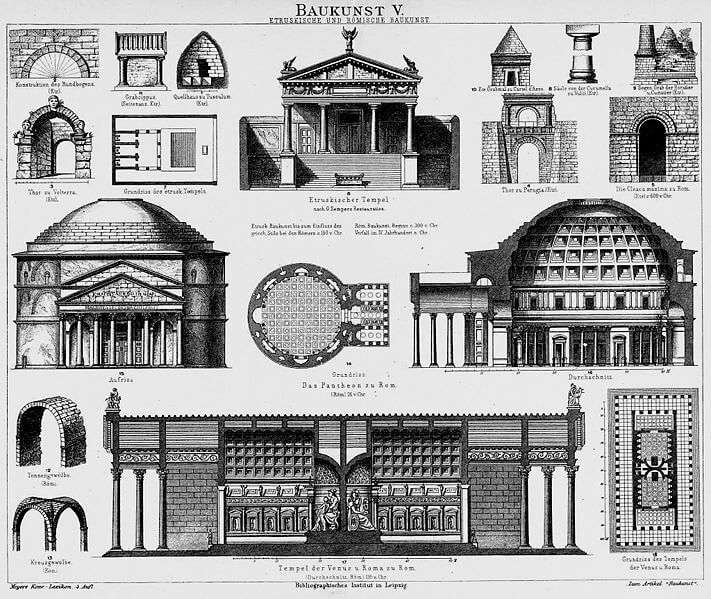
Roman and Etruscan architecture (illustration from Meyers Konversationslexikon, fourth edition)
Explanation of the illustration:
Fig. 1: Spring house at Tusculum (Etr.)
Fig. 2: Construction of the round arch (Etr.)
Fig. 3: Thor to Volterra (Etr.)
Fig. 4: Thor to Perugia (Etr.)
Fig. 5: The Cloaca Maxima in Rome (Etr.). Circa 600 BC.
Fig. 6: Etruscan temple. After G. Semper's reconstruction.
Fig. 7: Ground plan of the Etruscan temple
Fig. 8: Column from the cucumella to the vulci (Etr.)
Fig. 9: So-called tomb of the Horatii and Curiatii (Etr.)
Fig. 10: Etr. Tomb at Castell d'Asso
Fig. 11: Grabcippus (Seitenans. Etr.)
Fig. 12: Barrel vault (Roman)
Fig. 13: Cross vault (Roman)
Fig. 14: Ground plan of the Pantheon (Roman). 26 BC.
Fig. 15: Elevation of the Pantheon
Fig. 16: Cross-section of the Pantheon
Fig. 17: Temple of Venus and Roma in Rome
Fig. 18: Ground plan of the Temple of Venus and Roma
of these pre-Romanesque Carolingian buildings survive. Those that were not demolished to make way for new construction or had fallen into disrepair were further developed and often completely covered over by later architectural styles. The monastery on Reichenau Island and the monasteries of Fulda and Lorsch are among the surviving examples of Carolingian architecture, although only small parts of the original structures remain, such as the gatehouse or royal hall of Lorsch Abbey, or no immediately visible remains at all.
The monastery church of St. Michael in Hildesheim was built between 1010 and 1030, thus initiating the first major European Art Movement : the Romanesque .
Romanesque architecture is the first art historical period after antiquity in which buildings in Europe once again achieved a level of artistry worthy of its own name. The distinctive style, recognizable by walls with massive stone blocks, columns with block-like capitals, round arches, and arched windows, developed simultaneously across Europe around the turn of the first millennium.
Many interesting buildings from this period have been preserved for us; numerous churches and monasteries were founded during this era, and the construction of many castles was begun. Evidence of Romanesque architecture can now be found throughout Germany: the Romanesque Road stretches across Saxony-Anhalt, Wartburg Castle towers above the Thuringian town of Eisenach, and Romanesque buildings include the Collegiate Church of St. Servatius in Quedlinburg, Brunswick Cathedral, and Lübeck Cathedral.
Architecture in the south was more vibrant than ever before, as we can see from Trier Cathedral, Worms Cathedral, Mainz Cathedral, and above all, Speyer Cathedralthe largest building in the Christian world in the 11th century .
The Imperial and Mariendom of Speyer is the most important Romanesque building in Germany; with the almost complete destruction of Cluny Abbey in the French Revolution, the “Cathedral Church of St. Mary and St. Stephen” (official name) became the largest preserved Romanesque church in the world.
The Rhenish Romanesque style also produced beautiful, often colorfully painted buildings, such as the Church of St. Peter in Bacharach or Limburg Cathedral.
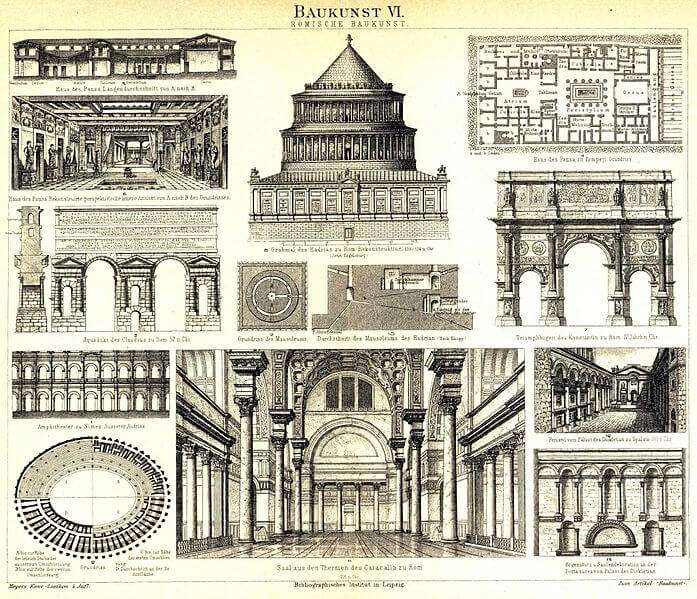
Plate Architecture VI – Roman Architecture (Illustration from Meyers Konversationslexikon. Second Edition)
Explanation of the illustration:
Fig. 5. House of Pansa, length average from A to B (vestibulum, ostium, atrium, tablinum, peristyle, oecus)
Fig. 6. House of Pansa, reconstructed perspective interior view from A to B of the floor plan
Fig. 3. Claudius' Aqueduct in Rome, 52 AD.
Fig. 8. Tomb of Hadrian in Rome (reconstruction) 135/136 AD (now Castel Sant'Angelo)
Fig. 9. Ground plan of the mausoleum
Fig. 10. Cross-section of Hadrian's Mausoleum (after Knapp) – exhaust duct, central chamber – burial chamber, air vents, ascending corridor, entrance with the statue of Hadrian
Fig. 4. House of Pansa at Pompeii. Ground plan
Fig. 7. Arch of Constantine in Rome. 4th century AD.
Fig. 1. Amphitheater at Nîmes. Exterior elevation
Fig. 2. Floor plan
A to the height of the last step of the outermost enclosure
B up to the height of the second enclosure
C up to the height of the first enclosure
D average across the ground area
Fig. 11. Hall from the Baths of Caracalla in Rome, 216 AD.
Fig. 12. Peristyle of Diocletian's Palace at Spalato, 305 AD.
Fig. 13. Arch lintel and column decoration at the Porta Aurea of Diocletian's Palace
Many buildings were begun in the Romanesque style and only completed in the subsequent Gothic period , which emerged in Spain, Italy and north of the Alps at the beginning of the 13th century (in France, buildings from about 1130 onwards bear Gothic features).
Thus, Nuremberg Castle and Wartburg Castle were begun in the 11th century and later expanded in the Gothic style, the last construction phase of Bamberg Cathedral already falls into the Gothic era, and Maulbronn Monastery was built by the Cistercians from the 12th to the 15th century, it therefore contains many Gothic elements.
If you are interested in the buildings around you, it usually doesn't have to stop at a simple visit to the building.
The people who are called upon to look after these buildings and make them accessible to the public love “their buildings” and usually use a lot of imagination to showcase them properly, which is reflected in a wide variety of exciting activities for visitors.
The art style or also the direction in artworks refers to the uniform expression of the artworks and cultural products of an era, an artist or an artist group, an art movement, or an art school.
This is a tool for categorising and systematising the diversity of art. It denotes similarities that distinguish it from others.
The term is thematically related to the Art Movement, but it should not be viewed solely within a temporal framework and is therefore much broader.
In this section, we would like to help you gain a better understanding of styles and movements in art.
We use technologies such as cookies to store and/or access device information. We do this to improve your browsing experience and to display (non-)personalized advertising. If you consent to these technologies, we can process data such as browsing behavior or unique IDs on this website. Refusal or withdrawal of consent may adversely affect certain features and functions.
Functional
Always Active
Technical storage or access is strictly necessary for the legitimate purpose of enabling the use of a specific service expressly requested by the subscriber or user, or for the sole purpose of carrying out the transmission of a message over an electronic communications network.
Preferences
The technical storage or access is necessary for the legitimate purpose of storing preferences that were not requested by the subscriber or user.
statistics
Technical storage or access that is solely for statistical purposes.Technical storage or access that is used solely for anonymous statistical purposes. Without a subpoena, the voluntary consent of your internet service provider, or additional recording by third parties, the information stored or retrieved for this purpose cannot generally be used to identify you.
marketing
Technical storage or access is required to create user profiles, to send advertising, or to track the user on one or more websites for similar marketing purposes.








 J-Line Relaxing Armchair / Butterfly Chair in leather/metal, color: Cognac
315,00 €
J-Line Relaxing Armchair / Butterfly Chair in leather/metal, color: Cognac
315,00 €