Few other architectural styles have influenced our country as visibly as the architecture that emerged from the Bauhaus art school. For that is what the Bauhaus : an art school that began as an educational institution for art and applied arts, architecture and design.
However, it was precisely this holistic approach that led to the term Bauhaus becoming a colloquial synonym for modernism in architecture and design, or rather, its beginnings.
The original intellectual father of the Bauhaus was indeed an artist-architect. Henry van de Velde is considered one of the most versatile artists of Art Nouveau, who, after his beginnings as a painter, turned to architecture and the applied arts. He had already begun the fundamental renewal of the applied arts in the predecessor organization of the Bauhaus.
The Bauhaus was formed in 1919 from the merger of the Grand Ducal Saxon Art School Weimar with the Grand Ducal Saxon School of Arts and Crafts Weimar, founded by Henry van de Velde: Walter Gropius, , gave the newly formed school the name "State Bauhaus in Weimar" .
Gropius was an industrial designer and architect; he transformed the Bauhaus into an influential educational institution, completely new in its style and concept. In its brief 14-year history, the Bauhaus attracted many important artists as teachers: Lyonel Feininger, Johannes Itten, Josef Albers, Paul Klee, Wassily Kandinsky, Oskar Schlemmer, and László Moholy-Nagy, for example.
Famous buildings and the New Objectivity movement
Several buildings, some of which remain famous to this day, were constructed. The first collaborative project of the Bauhaus school was the Sommerfeld House in Berlin-Lichterfelde. In 1923, the model house "Am Horn" was built in Weimar, the first project whose architecture and furnishings consistently embodied the "New Objectivity " movement.
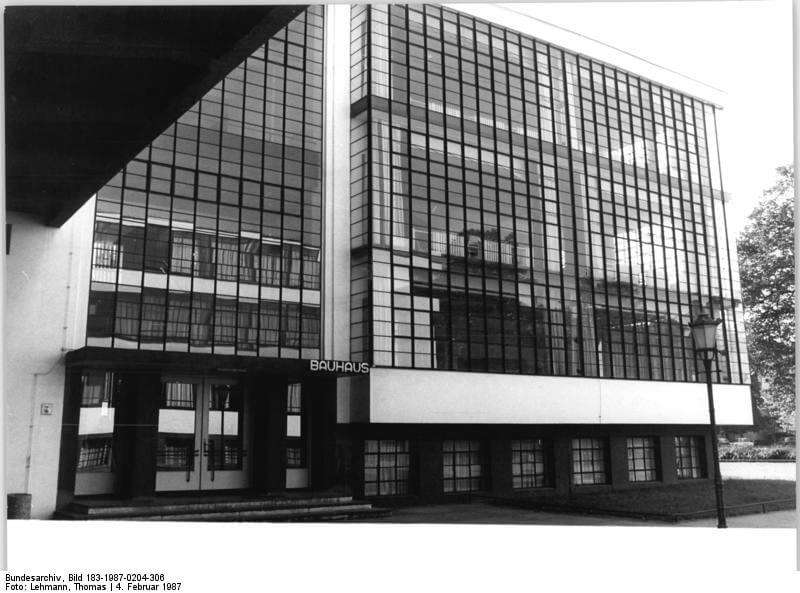
In Dessau, in addition to the Bauhaus building designed by Gropius with its associated Masters' Houses and the Gropius Estate in Dessau-Törten, many other Bauhaus buildings were constructed. Also well-known and famous are the Federal School of the General German Trade Union Federation in Berlin-Bernau, the Mies van der Rohe House in Berlin-Hohenschönhausen, and the House of the People in Probstzella. Former Bauhaus students created Bauhaus buildings in Vienna and Prague, in Budapest and Zurich.
Political classification up to and including closure
Teachers, students, and supporters of the Bauhaus were considered "left-wing" and "internationalist" in the Weimar Republic. In 1924, the right-wing government in Thuringia cut the Bauhaus budget in half, and in 1925 the Masters' Council decided to relocate to Dessau. In 1928, Gropius resigned as director, and at his suggestion, the Swiss architect Hannes Meyer succeeded him. Meyer established a separate department for architecture within the Bauhaus and strengthened the technical disciplines.
Meyer was dismissed without notice in 1930 for political reasons; for the National Socialists, the Bauhaus was a "red cadre training ground". Ludwig Mies van der Rohe, one of the most important modern architects, was recruited as the new director.
But the Nazi Party was on the rise; in 1932 the Bauhaus in Dessau was closed, and Mies van der Rohe's attempts to establish the educational institution in Berlin also failed due to increasing political pressure. In 1933, the pioneering institution was finally forced to dissolve itself by the National Socialists.
The Bauhaus building in Dessau, German Federal Archives, image 183-1987-0204-306 / CC-BY-SA 3.0, via Wikimedia Commons
The Bauhaus building in Dessau, designed by Walter Gropius
To describe Bauhaus architecture as an architectural style is inaccurate; the works of the Bauhaus adherents are more accurately described as part of transnational and long-lasting movements that are now categorized under the terms Classical Modernism, Functionalism, New Objectivity, New Building, and International Style.
One of the most consequential innovations of the Bauhaus remains the unification of the previously strictly separated working methods of fine art, applied art, and performing arts. The resulting way of thinking also had a strong influence on painting, music, and theater.
The Bauhaus design movement also produced numerous design classics , from the first furniture made of the new material tubular steel (Marcel Breuer's cantilever chairs), Max Bill's Junghans kitchen clock, stainless steel functional art by Marianne Brandt, Paul Renner's Futura typeface, to numerous industrial design products by Wilhelm Wagenfeld. Bauhaus work was intended to be objective, perfectly functional, and skillfully designed, and this is precisely how the pieces from that era, or the Bauhaus-style buildings that have been preserved in our cities, look.
After the brief Bauhaus era, more and more buildings in the Bauhaus style emerged, and construction in this style continues to this day. Every designer considered top-tier today has thoroughly studied the principles of the Bauhaus. Even prefabricated houses are offered in Bauhaus architecture, popular with people who, confronted with house designs like "Bel Portale" or "Sanssouci," had almost given up on the idea of building a house altogether.
One can therefore say: the Bauhaus lives on; Mies van der Rohe's "Less is more""Form follows function ," thus completing the principles of classical modernism that are still valid today.
This is not only constantly proven in modern designs, but is also demonstrated by the fact that everyday objects by Bauhaus artists are still highly sought-after and usable collector's items today.
Do you perhaps have a spare Wagenfeld lamp in your basement, or old books in your cupboard containing illustrations of various buildings from the Bauhaus era?
List these treasures on Kunstplaza ; you could make a design lover very happy!
The art style or also the direction in artworks refers to the uniform expression of the artworks and cultural products of an era, an artist or an artist group, an art movement, or an art school.
This is a tool for categorising and systematising the diversity of art. It denotes similarities that distinguish it from others.
The term is thematically related to the Art Movement, but it should not be viewed solely within a temporal framework and is therefore much broader.
In this section, we would like to help you gain a better understanding of styles and movements in art.
We use technologies such as cookies to store and/or access device information. We do this to improve your browsing experience and to display (non-)personalized advertising. If you consent to these technologies, we can process data such as browsing behavior or unique IDs on this website. Refusal or withdrawal of consent may adversely affect certain features and functions.
Functional
Always Active
Technical storage or access is strictly necessary for the legitimate purpose of enabling the use of a specific service expressly requested by the subscriber or user, or for the sole purpose of carrying out the transmission of a message over an electronic communications network.
Preferences
The technical storage or access is necessary for the legitimate purpose of storing preferences that were not requested by the subscriber or user.
statistics
Technical storage or access that is solely for statistical purposes.Technical storage or access that is used solely for anonymous statistical purposes. Without a subpoena, the voluntary consent of your internet service provider, or additional recording by third parties, the information stored or retrieved for this purpose cannot generally be used to identify you.
marketing
Technical storage or access is required to create user profiles, to send advertising, or to track the user on one or more websites for similar marketing purposes.











 Metal art wall decoration "Beviamo Vino", wine bottles and vine branches
51,95 €
Metal art wall decoration "Beviamo Vino", wine bottles and vine branches
51,95 €