Did you stumble upon these pages by chance, and do you not really have a connection to art? Perhaps because you're not surrounded by art every day in your daily life? That's not entirely true for many people in Germany.
Because you are surrounded by art every day , even if it isn't hanging on your living room wall, at least unless you live in a remote museum village and never visit a larger town.
Every day you are surrounded by an art that sometimes dramatically changes our cities, but often simply blends in skillfully and discreetly, but in any case has long been regarded as art: Architecture .
Many of the buildings that shape and change the face of our cities and communities are, by general consensus, clearly considered art. This applies regardless of whether they are buildings that explicitly aim to create art in public spaces or whether they are more about transforming traditional architecture into a contemporary style.
Take, for example, the buildings of architects Jacques Herzog and Pierre de Meuron , which blend beautifully into their surroundings, but also bring striking new constructions to our cities. Both architects were born in 1950, both graduated with diplomas in architecture from the Swiss Federal Institute of Technology Zurich (ETH Zurich) in 1975, and both worked there as assistants. In 1978, Herzog and de Meuron jointly founded their architectural firm in Basel .
The development of their buildings into elements that appear almost organic within their surroundings began slowly, starting in 1979 with private commissions such as a blue facade, followed in the early 1980s by several unusual houses made of plywood or as concrete frame structures. Even in the early days, many of their commissions involved combining living and working spaces, the collection and exhibition of art, or some other special purpose.
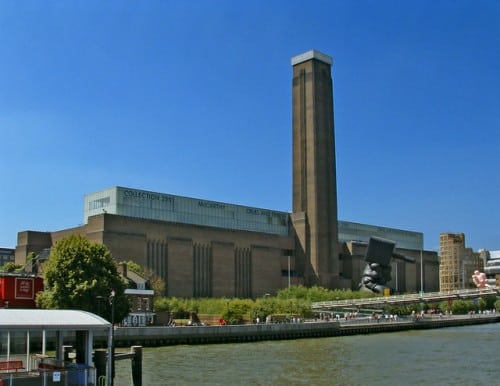
The Tate Modern Museum, photographed from the Thames Pleasure Boat in 2003; by Christine Matthews [CC-BY-SA-2.0], via Wikimedia CommonsFrom 1987 onwards, the first major projects came in: the Pilotengasse residential complex in Vienna (completed in 1991) with around 200 houses grouped in curved rows around its center, and the Goetz Collection gallery building in Munich, an impressive solitary structure that blends seamlessly into the dense tree cover of the building site.
This was followed by various works for public spaces such as a student residence in Antibes, France (1990 – 1992), project work for museum extensions and libraries, and soon the designs developed unusual glass facades, e.g. for the residential and commercial building in Schützenmattstrasse in Basel and the office building of a large insurance company in Basel, which was redesigned with new transparency (both completed in 1993).
buildings surrounding area also benefited from straight forms, light and transparency.
While straightforwardness dominated up to this point, the designs subsequently became freer and more sensational, and commissions came from farther afield. For example, Herzog & de Meuron were commissioned to build a factory for Ricola Europe in Brunstatt, France (1993-94), which featured a highly interesting extension; the facade of a pharmacy in Lucerne received an unusual green glass skin; and in 1994 they were also commissioned to undertake the urban redevelopment of the prefabricated housing estate “Neustädter Feld” in Magdeburg.
The first project work for museum buildings, other art-house buildings, and innovative bank buildings for domestic or foreign clients also dates back to this period.
Between 1994 and 1997, Herzog & de Meuron also realized their first significant cultural buildings : The Caricature and Cartoon Museum in Basel was equipped behind its late Gothic facade with a completely unexpected and modern interior and a new building at the rear that harmonizes with the old building; the equally understated yet extraordinary studio of the painter and conceptual artist Rémy Zaugg in Mulhouse-Pfastatt, France, was newly built according to their design.
Several buildings followed that blend seamlessly into the landscape in terms of design and layout, but are all the more remarkable when viewed in detail: The Dominus Winery building in Yountville, California, with its facade of stone-filled gabions, seems to have always stood in Napa Valley.
This impression, however, is not achieved without some clever manipulation: it is enhanced by the fact that the gabions are filled not only with stones but also with broken glass, which makes the structure translucent. Even the library of the University for Sustainable Development in Eberswalde initially appears from the outside to be simply a very plain cuboid.
Until the viewer takes a closer look at the initially understated facade and discovers the photographs by the artist Thomas Ruff , which were printed on the entire outer skin of the building using a special process, giving him information about what he will find in the library.
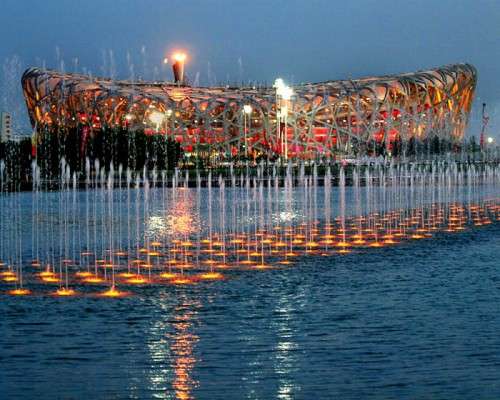
Flame of the 2008 Olympic Games at the Beijing National Stadium; by 沉浮-沉浮 (cc.nphoto.net/view/2008/10327.shtml) [CC-BY-2.5-cn], via Wikimedia CommonsAround the turn of the millennium, more and more clients from many nations became aware of the architects, at the latest with the project for the Tate Modern in LondonThe architectural firm Herzog & de Meuron became internationally renowned.
The aim of this construction project was to make the Bankside Power Station, an oil-fired power station located on the south bank of the Thames, which had been unable to provide energy economically since 1981, suitable for art.
Herzog & de Meuron won the competition in 1995, and in 2000 the Tate Gallery of Modern Art was able to move in; the continued and unexpectedly large influx of visitors has already led to plans for an expansion.
Less dependent on their immediate surroundings, and therefore more spectacular, stadiums be planned. With St. Jakob-Park in Basel, the Allianz Arena in Munich, and the National Stadium in Beijing for the 2008 Olympic Games, Herzog & de Meuron designed three impressive sports arenas. As extraordinary as these stadiums appear, the architects nevertheless succeeded in uniting modern requirements, history, and tradition in these buildings.
Hamburg Elbphilharmonie is similar ; here, as with the Tate Modern, a new ensemble with completely new possibilities for use is to be created by converting and expanding an old building.
In addition to its headquarters in Basel, the architecture firm Herzog & de Meuron now has branches in Munich and London, Barcelona, San Francisco, and Tokyo, employing approximately 330 people. Over time, several additional partners have joined the firm, and the founders, Herzog and de Meuron, also hold teaching positions at ETH Zurich and Harvard University.
We use technologies such as cookies to store and/or access device information. We do this to improve your browsing experience and to display (non-)personalized advertising. If you consent to these technologies, we can process data such as browsing behavior or unique IDs on this website. Refusal or withdrawal of consent may adversely affect certain features and functions.
Functional
Always Active
Technical storage or access is strictly necessary for the legitimate purpose of enabling the use of a specific service expressly requested by the subscriber or user, or for the sole purpose of carrying out the transmission of a message over an electronic communications network.
Preferences
The technical storage or access is necessary for the legitimate purpose of storing preferences that were not requested by the subscriber or user.
statistics
Technical storage or access that is solely for statistical purposes.Technical storage or access that is used solely for anonymous statistical purposes. Without a subpoena, the voluntary consent of your internet service provider, or additional recording by third parties, the information stored or retrieved for this purpose cannot generally be used to identify you.
marketing
Technical storage or access is required to create user profiles, to send advertising, or to track the user on one or more websites for similar marketing purposes.







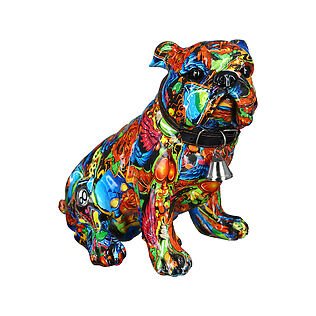
 Urban art animal sculpture "Bulldog", sitting dog with tattoo motifs
58,00 €
Urban art animal sculpture "Bulldog", sitting dog with tattoo motifs
58,00 €