Noise is one of the biggest productivity killers in modern work environments, which is why effective soundproofing is more important than ever. In fact, noise in the office can significantly impair employee productivity and well-being. Particularly alarming: according to occupational health and safety guidelines, the noise level in the office should ideally be below 55 dB, a level frequently exceeded in practice.
Proper soundproofing in the office not only provides peace and quiet, but also combines health aspects with sustainability.”
Modern sound absorbers, for example, are made from 100% recycled material. Impressively, just 74 PET bottles can produce one square meter of sound-absorbing PET fiber. Innovative solutions reduce noise levels by up to 50% while simultaneously meeting fire protection class B1 according to DIN 4102 .
This article explains how intelligent soundproofingSilenti during our research . We also show you the solutions available for different rooms and how proper planning can ensure you benefit from the advantages in the long term – both in your home and in an open-plan office.
In modern living and working environments, the burden of noise is often underestimated. Nevertheless, scientific studies show that approximately 75 percent of people in Germany feel disturbed or bothered by road traffic noise in their residential areas. The question of what intelligent noise protection must achieve today is therefore of great importance for our health, our well-being, and sustainability.
Noise as an underestimated stress factor
The World Health Organization (WHO) identifies noise, alongside air pollution, as the most significant environmental health risk. The German Center for Cardiovascular Research agrees. Numerous studies confirm the considerable health effects: Noise impact research indicates that continuous exposure to 60 to 65 dB(A) constitutes a health impairment.
Particularly alarming is the finding that men living in noisy homes with a daily average noise level above 65 dB(A) have a 20 to 30 percent higher risk of suffering a heart attack than men from quieter environments.
Even if we don't consciously perceive the noise, our bodies react to it. Nighttime noise pollution puts the body into a state of alarm, known as noise stress. In this state, the adrenal glands release stress hormones such as adrenaline and cortisol, leading to an increase in heart rate of three to five beats per minute. Sleep disturbances are possible at nighttime noise levels as low as 45 decibels, which can have a negative impact on health.
Furthermore, chronic noise exposure can lead to other health problems:
Cardiovascular diseases such as high blood pressure and heart attack
Psychological stressors such as depression and anxiety
Concentration problems and reduced performance
Increased risk of diabetes due to hormonal changes
According to the WHO, over 1.3 million healthy years of life are lost annually across Europe due to noise pollution. It is even estimated that around three percent of all heart attacks in Germany are caused by road traffic noise.
Combining tranquility, health and sustainability
Modern sound insulation must do more than simply reduce noise. It combines aspects of health protection, well-being, and ecological sustainability. The Fraunhofer Institute for Building Physics IBP, for example, is working on solutions that absorb sound using sustainably manufactured products, thereby improving the quality of life and work.
Effective sound insulation is crucial for both living spaces and work environments. In our own apartments, houses, or offices, we expect a quiet atmosphere that protects us from disruptive noise. Only in this way are restful, healthy living, peaceful sleep, and productive work possible.
Of particular interest is the development of innovative soundproofing elements that combine optimal sound insulation not only with design aspects but also with ecological considerations. Sustainable absorbers achieve sound insulation class A, thus offering excellent acoustic performance for a wide range of applications. Materials with positive sound absorption properties include, for example, cellulose insulation, wood fiber insulation boards, and hemp insulation. The excellent sound insulation results from the material's mass and porous structure.
In open-plan offices, the link between improved acoustics and health is particularly evident. Businesses that invest in comprehensive soundproofing make a significant contribution to the health and productivity of their employees. According to the European Environment Agency, every euro invested in noise reduction measures generates ten euros in societal benefit.
Therefore, a holistic approach is required for sustainable and effective sound insulation – one that takes into account both health aspects and ecological sustainability, while also meeting aesthetic and functional requirements.
How sound works – and how to control it
How does sound work? Photo by Getty Images @gettyimages, via Unsplash
To achieve effective sound insulation, one must first understand how sound is generated and propagates. Put simply, sound consists of pressure waves that travel through a medium and can be perceived by the human ear.
Airborne sound vs. structure-borne sound
Sound propagation is fundamentally divided into two types: airborne sound and structure-borne sound. This distinction is crucial for planning effective noise control measures.
Airborne sound is sound that travels through the air from a noise source in the form of sound waves. The human ear can perceive this sound in the frequency range of 20 to 20,000 Hz. It propagates through air at 20°C at a speed of approximately 340 meters per second. Typical examples of airborne sound include conversations, music, and traffic noise.
Structure-borne sound, on the other hand, propagates through solid materials such as stone, concrete, steel, or wood. It is generated by the direct acoustic excitation of a building component and is converted into airborne sound at the surface of the material, making it audible to us. Impact noise and the sounds of building services equipment such as heat pumps fall into this category. Transmission through solid materials can occur much faster and more efficiently than through air.
A crucial point in noise reduction: While hard, smooth surfaces reflect sound, soft, porous materials can absorb it. This forms the basis for most soundproofing measures in interiors.
Reverberation time and its significance
Reverberation time is a key parameter in room acoustics. It is defined as the time required for the sound level in a room to decay by 60 decibels (dB) after the sound source has been switched off. It is also frequently referred to as "reverberation time" or "RT60" .
The reverberation time is measured in seconds and depends primarily on two factors:
The volume of the room – large rooms have a longer reverberation time.
Sound absorption by surfaces and objects in the room
Different room types have different recommendations for optimal reverberation times:
Living spaces: 0.3–0.5 seconds
Offices and meeting rooms: 0.4–0.6 seconds
Classroom: 0.4–0.8 seconds
Concert halls: 1.2–2.2 seconds (depending on the music style)
Concert halls typically have particularly intense acoustics – partly due to their long reverberation time. Photo by PT Russell @pt_photos, via Unsplash
The practical significance of these values is considerable. In rooms with excessively long reverberation times, telephone calls and meetings could be difficult to understand and concentration could be impaired, while a room with excessively short reverberation times might sound sterile and uncomfortable.
Typical sound sources in living and working spaces
Modern buildings contain numerous noise sources that can impair acoustic comfort. According to an environmental awareness study from 2024, approximately 58 percent of respondents feel disturbed by noise from their neighbors, and 31 percent by industrial and commercial facilities in their residential environment.
The most common sources of noise include:
In residential areas: noise from neighbors, garden equipment such as lawnmowers, building services such as heat pumps, and personal noise from private parties
In work environments: conversations, phone calls, printers , air conditioning systems, and external noises such as traffic noise.
In both areas: impact sound from floors, noise from water pipes and building services
There are various approaches to controlling these sound sources. To reduce airborne noise, sound-absorbing materials are often installed on walls and ceilings. For structure-borne noise, on the other hand, mechanical breaks or elastic materials between surfaces and load-bearing structures are effective.
In office environments, especially open-plan offices, the main goal is to balance collaboration and concentration. Here, the combination of sound-absorbing materials and targeted room planning can significantly improve sound propagation. For acoustically effective rooms, planning should always begin with calculating the reverberation time.
Solutions for different spaces: apartment, office, open-plan office
Each type of room has its own requirements for effective sound insulation. The right solution depends not only on the room size, but also on its use and the specific sound sources.
Soundproofing in the living room: textiles, furniture, wall panels
Soundproofing in the living room often combines sound-reducing materials with a design-oriented look. Photo by Mohamed Nohassi @coopery, via Unsplash
Your own four walls should be an oasis of peace and quiet, but this is often compromised by disturbing noises from outside and neighboring apartments. Effective soundproofing in the living room starts with the right furnishings. Carpets , curtains, and upholstered furniture act as natural sound absorbers and improve sound insulation with minimal effort.
When placing furniture, keep in mind that cabinets and shelves should not be placed directly against the wall or attached to it. A small gap between the furniture and the wall allows it to act as a sound absorber. Heavy, tall bookshelves are particularly effective against walls shared with neighbors – they form a natural barrier against noise.
For windows, it is recommended to use sealing strips made of rubber or foam to close gaps and cracks. In areas with high noise levels, soundproof windows with multiple panes of glass offer additional protection. Heavy curtains or special noise-reducing curtains made of thick fabrics such as cotton, velvet, wool, or acoustic fabrics also reduce incoming noise.
Acoustic panels or sound-absorbing wall coverings are ideal for apartments in multi-family buildings with thin walls. These easy-to-install elements act as buffers for noise and simultaneously give the room a modern touch.
Soundproofing in the office: partitions, acoustic panels, rules of conduct
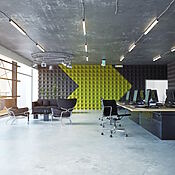
Aesthetically pleasing soundproofing on ceilings and walls in a work environment. Photo by Giulia Squillace @giuliasq, via Unsplash
In the office, a quiet working environment is crucial for concentration and productivity. According to a Harvard study, it takes people up to 23 minutes to get back into their workflow after an acoustic distraction.
Particularly suitable for soundproofing in the office are:
Acoustic ceilings made of sound-absorbing materials such as mineral wool, polyester or special acoustic panels
Partition walls made of sound-insulating materials such as foam, felt or wood with sound-absorbing inserts
Wall absorbers attached directly to the walls to capture sound waves
Modular acoustic rooms are a practical solution for smaller offices or home offices. These self-contained rooms are made of sound-absorbing materials and create an environment free from disruptive noise.
Sound-reducing acoustic elements in a conference room. Photo by Andrej Lišakov @lishakov, via Unsplash
Rules of conduct also contribute significantly to noise reduction. Longer phone calls should be made in separate rooms or phone booths. Conversations between colleagues should be conducted quietly or moved to meeting rooms. Introducing "quiet zones" or "quiet hours," during which work is done particularly quietly, has proven effective in many teams.
Sound insulation in open-plan offices: room-within-a-room systems and zoning
Open-plan offices present a particularly significant acoustic challenge. Up to 54% of office workers report noise as their biggest source of disturbance. Studies show that 99% of respondents experience impaired concentration due to noise.
Room-within-a-room systems offer an innovative solution. These adaptive modules enable flexible zoning within open-plan offices. Without any structural modifications, workspaces with optimal acoustics can be created for phone calls, individual work, or meetings. The freestanding design allows for quick adjustments to changing requirements.
An effective approach to zoning divides the open-plan office into different functional areas:
Quiet zones for focused work
Communication zones for exchange
Telephone zones for undisturbed conversations
Optimal sound insulation in an open-plan office requires a combination of three methods: dampening the room with sound-absorbing materials, acoustically decoupling individual zones using sound barriers, and, if necessary, supplementing the room with sound (masking). Using only one of these methods is usually insufficient.
Sound barriers should be at least 1.5 m high to achieve a sound level reduction of 5-10 dB between adjacent workstations. In practice, large areas are successfully acoustically isolated with barriers at least 1.8 m high, and individual workstations with barriers 1.6 m high.
Materials and products for sustainable sound insulation
Sustainable materials are increasingly coming to the fore in the field of soundproofing. These materials combine excellent acoustic properties with environmentally conscious production, thus forming the basis for modern soundproofing solutions.
Sound absorber made from recycled PET
The use of recycled PET for sound absorbers represents a particularly environmentally friendly alternative. These acoustic elements consist largely of recycled PET bottles and can be recycled again at the end of their life cycle. Compared to the production of new PET, up to 80% of the energy is saved with recycled PET. This significantly reduces CO₂ emissions, which are considerably lower than those of other acoustic elements.
The excellent sound absorption properties of these materials are also impressive, especially in the speech range. The open-pored structure effectively absorbs sound waves before they can be reflected. Furthermore, these materials are flame-retardant, low-odor, and low-emission, and completely safe for indoor use.
Soundproofing panels for ceiling and wall
Modern soundproofing panels for ceilings and walls offer various mounting options. Wall panels are typically attached with self-adhesive Velcro strips or with screws and wall plugs. Ceiling panels, on the other hand, are often equipped with cable management systems whose length can be individually adjusted.
These panels also meet the highest requirements of eco-bau and Minergie-Eco regarding ecological and health standards, achieving an eco-1 rating. Their robustness is particularly noteworthy – they are impact-resistant and moisture-resistant, making them suitable for use in demanding environments such as production halls or even indoor swimming pools.
Design meets function: soundproofing panels as a design element
Modern sound absorbers no longer have to look like egg cartons. Today's acoustic panels combine functionality and aesthetics at the highest level. They are available in a variety of shapes – from classic rectangular panels to creative, geometric patterns.
Over 50 colors are available for the design, ranging from neutral tones like gray and beige to vibrant colors like turquoise and sunny yellow. Accordingly, soundproofing panels can be used as a decorative element to enhance walls or ceilings while simultaneously optimizing room acoustics. Therefore, they are not only functional but also a real eye-catcher that complements any interior design style.
Planning, implementation and long-term impact
Successful implementation of noise control measures requires careful planning and professional execution. Only in this way can the long-term benefits for health and productivity be fully realized.
How much soundproofing surface is needed?
For effective room acoustics, calculating the required sound-absorbing surface area is crucial. Only with the correct amount of absorbers will the volume be audibly reduced and reverberation eliminated. The calculation is performed using a clear formula: Multiply the sound absorption coefficient α of a component by its area S [m²], resulting in the equivalent sound absorption area A = α S [m²].
Since all surfaces of a room have a specific sound absorption coefficient, equivalent sound absorption areas can be calculated for each individual surface. The total absorption area is the sum of all these areas: A = α₁S₁ + α₂S₂ + … = Σ αᵢSᵢ [m²].
The following factors should be taken into account during the planning process:
Room size (length, width, height)
Condition of the wall surfaces (smooth or rough)
Floor covering (hard or soft)
Furnishing level (a lot or a little)
Mounting options: Adhesive, Hanging, Magnetic
The installation of sound absorbers offers various design options. The emission-free acrylate adhesive system STICKY, applied to the back of the acoustic panel, is particularly popular. A liner paper prevents the adhesive from drying prematurely and allows for trouble-free installation without any odor after assembly.
Installation of soundproofing panels. Photo by Getty Images @gettyimages, via Unsplash
Alternatively, magnets integrated into sound absorbers offer a flexible solution for walls and ceilings. The elements are attached with just one click and can be removed just as easily if needed. For ceiling mounting, cable systems are particularly suitable, as they can be attached directly to the ceiling and adjusted to the room size.
Additionally, special frames (upFRAME) can transform the panels into three-dimensional acoustic images that are suspended using hooks. For existing suspended ceilings, the sound-absorbing panels can be easily inserted without any additional accessories.
Long-term benefits for health and productivity
Investing in soundproofing pays off in the long run. Millions of people in Germany are disturbed by noise and fear negative effects on their health. Excessive noise can demonstrably lead to stress, sleep disorders, and even hearing loss.
Furthermore, good room acoustics in offices and educational institutions improve speech intelligibility and concentration, which in turn promotes productivity and learning. In residential buildings, effective sound insulation increases the quality of life through greater privacy and comfort.
Legal requirements should not be overlooked: Compliance with sound insulation standards is legally mandated and helps avoid legal consequences. Overall, well-thought-out acoustic planning contributes to a more pleasant and healthier environment – added value that extends far beyond the initial investment.
Conclusion
Effective sound insulation is undoubtedly more than just a welcome addition to modern buildings. The right combination of sustainably produced materials and thoughtful planning creates spaces that are not only acoustically optimized but also contribute to people's well-being.
Companies should therefore view soundproofing not as a cost factor, but rather as an investment in the health and productivity of their employees. Thanks to the wide variety of materials and installation options available today, a suitable solution can be found for every room situation.
In conclusion, it should be noted that intelligent soundproofing combines peace, health, and sustainability into a holistic concept that creates both ecological and economic added value. Those who invest early in well-designed acoustic solutions benefit in the long term from improved quality of life and work, as well as a more sustainable environment.
Owner and Managing Director of Kunstplaza . Publicist, editor, and passionate blogger in the fields of art, design, and creativity since 2011. Graduated with a degree in web design from university (2008). Further developed creative techniques through courses in freehand drawing, expressive painting, and theatre/acting. Profound knowledge of the art market gained through years of journalistic research and numerous collaborations with key players and institutions in the arts and culture sector.
Category for interior design,residential design, object furnishings, product and material innovation.
Here you will find everything that makes an interior designer's heart race. We present to you the latesttrendsand developments in the world of home design, as well as innovative products and materials for unique space design.
Our goal is to provide our readers with inspiration and help them creatively redesign or completely transform their living spaces.
We place great importance on ensuring that our articles are not only esthetically pleasing but also include practical tips.
We also introduce you to successful interior designers – from newcomers to the most well-known names in the industry – so you can be inspired by their projects and get to know their working methods.
Whether it's about making the most of a small space or furnishing your home with new furniture in the trendy industrial style: With us, you will find all the information you need on the topic of interior design!
We use technologies such as cookies to store and/or access device information. We do this to improve your browsing experience and to display (non-)personalized advertising. If you consent to these technologies, we can process data such as browsing behavior or unique IDs on this website. Refusal or withdrawal of consent may adversely affect certain features and functions.
Functional
Always Active
Technical storage or access is strictly necessary for the legitimate purpose of enabling the use of a specific service expressly requested by the subscriber or user, or for the sole purpose of carrying out the transmission of a message over an electronic communications network.
Preferences
The technical storage or access is necessary for the legitimate purpose of storing preferences that were not requested by the subscriber or user.
statistics
Technical storage or access that is solely for statistical purposes.Technical storage or access that is used solely for anonymous statistical purposes. Without a subpoena, the voluntary consent of your internet service provider, or additional recording by third parties, the information stored or retrieved for this purpose cannot generally be used to identify you.
marketing
Technical storage or access is required to create user profiles, to send advertising, or to track the user on one or more websites for similar marketing purposes.





 Three-legged Wabi-Sabi coffee table "Seseh" made from recycled teak wood (size: M)
435,00 €
Three-legged Wabi-Sabi coffee table "Seseh" made from recycled teak wood (size: M)
435,00 €


