Art Basel UBS Art Market Report presents the current state of the global art market to dealers, gallery owners, and art collectors every year. This report is considered the most important economic analysis of the market's condition and provides a well-founded forecast of future developments.
It was last released in April 2023, and you might be wondering at this point: why is it still worth taking a look at this analysis?
Quite simply: we are now just before the turn of the year and it is worth taking a look at the forecasts for 2024 .
The Art Basel and UBS Global Art Market Report 2023 – A Summary
In summary, the following conclusion can be drawn in one sentence:
The global art market is showing resilience.”
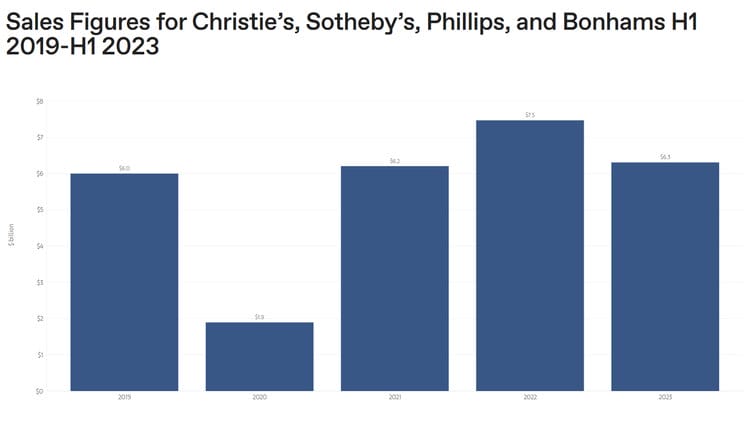
The global art market surpassed pre-pandemic levels in 2022, with worldwide art sales growing by 3% to an estimated US$67.8 billion . The US experienced the strongest post-pandemic recovery, and the UK art market reclaimed second place, followed by the Chinese market.
Overall, surveys across all industries indicated an optimistic outlook for 2023.
The seventh edition of the Art Basel and UBS Global Art Market Report offers a comprehensive macroeconomic analysis of the state of the global art market in 2022, including the first quarter of 2023. The report was authored by cultural economist Dr. Clare McAndrew , founder of Arts Economics , and published by Art Basel and UBS.
Where does the data come from?
The report is based on a survey of high-net-worth individuals (HNWIs) , defined as those with disposable household wealth exceeding $1 million in 2023. The sample survey was conducted in 11 regions over a three-month period.
To ensure that respondents actively participated in the art market, they had to have acquired artworks worth more than $10,000 between 2021 and 2023. These criteria selected participants from the United Kingdom, Hong Kong, Japan , mainland China, Singapore, Italy, Germany, Taiwan, Brazil, the USA, and France – all with an average age of approximately forty.
Key data and insights
Global art market
Global art market sales figures showed a 3% increase compared to the previous year, reaching an estimated US$67.8 billion. This put the art market in 2019 above pre-pandemic levels.
However, there were differences in performance depending on the sector, region, and price range. The main driver of market value growth across all sectors in 2022 continued to be the high end of the market.
Key markets
The art market in the USA maintained its leading position worldwide, increasing its revenue share from 43% to 45% compared to the previous year.
The British market returned to second place with an 18% share of total sales, followed by the Chinese market, whose share fell from 20% to 17%. Among all major art markets, the US experienced one of the strongest post-pandemic recoveries, with sales rising an impressive 8% year-over-year to a record $30.2 billion.
The United Kingdom maintained stable growth, recording a moderate increase to $11.9 billion. This represents a 5% increase compared to the previous year, but is still below the pre-pandemic level in 2019 ($12.2 billion).
Following a strong recovery in 2021, mainland China and Hong Kong a challenging year with a significant 14% decline in sales. However, with total sales of $11.2 billion, this was still 13% higher than in 2020 – the second-lowest level since 2009.
Sales channels
Art dealers: In 2022, dealers' revenue is expected to reach approximately US$37.2 billion, representing a 7% increase compared to the previous year. This indicates that the market has recovered following the outbreak of the pandemic in 2019.
Industry surveys also show that the highest-grossing retailers saw a significant increase of 19%, with their average sales exceeding the $10 million mark.
Auctions: In 2022, the auction market impressive sales with a number of record prices.
Aside from these spectacular headlines, however, the overall sales momentum was more subdued. Overall, sales by auction houses , both public and private, declined by approximately 2% to a total of US$30.6 billion (compared to US$31.2 billion in 2021).
Nevertheless, they were still a considerable 11% above the level before the start of the pandemic in 2019.
Art fairs : In 2022, there was a significant increase in visitor numbers at art fairs . Collectors were once again willing to participate in live events in person, and galleries presented their works at the same number of fairs as in the 2019 average.
The share of sales at art fairs rose from 27% in 2021 to a remarkable 35% in 2022, but is still below the pre-pandemic level (42% in 2019).
Online sales : In 2022, the event market returned to normal, resulting in a decline in the e-commerce share of sales for both retailers and auction houses. After two years of exceptional growth, online sales experienced another decline.
Revenue in 2022 amounted to only 11 billion US dollars, a decrease of 17% compared to the previous year and a significant drop from the record 13.3 billion US dollars of 2021. Nevertheless, the figure was still an impressive 85% higher than in 2019.
Disintermediation
The report also examines the consequences of disintermediation in the art market, a much-discussed topic over the past three years. Online platforms have increased direct communication and interaction between artists and collectors.
However, the impact of disintermediation on the art market has so far been relatively limited. Most expenditures continued to be made through dealers and galleries (30% directly and a further 15% via art fairs), and 17% via auctions.
A study also revealed that 20% of spending was done through external online platforms (6% via Instagram and 6% through NFT platforms outside the art market).
A difficult year for NFTs and crypto art
The past three years have seen the rise of platforms art-related NFTs outside the art market. This has been a significant development, and interest in NFTs was among the biggest trends in 2021.
However, in 2022 this market cooled down, and the focus shifted away from rising prices and speculation. It is important to note that transactions via NFT platforms are not included in the estimated overall value of the art market, as they take place outside of galleries, dealers, and auction houses.
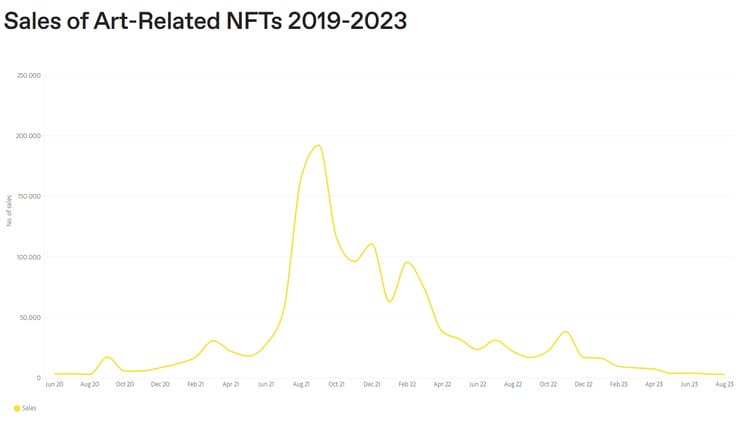
Nevertheless, an analysis of sales on these platforms shows a rapid increase in activity in 2021 followed by a sharp decline in 2022.
Although the value of art-related NFTs declined sharply from the end of 2021, still almost $1.5 billionin 2022. This represents a 49% decrease compared to the previous year, but a seventy-fold increase compared to the market in 2020 ($20 million).
Sotheby’s and Christie’s have set up digital teams because the relationship between artist and dealer has changed through NFTs.
Digital artists can often offer their works directly through auctions and deliver higher quality work despite higher fees.
Although sales volume is declining, interest in NFTs high and continues to attract new collectors. In 2021, the average time between purchase and resale of art-related NFTs was only about one month (33 days), while the average resale period in the art market in general is 25 to even 30 years.
Outlook for 2024
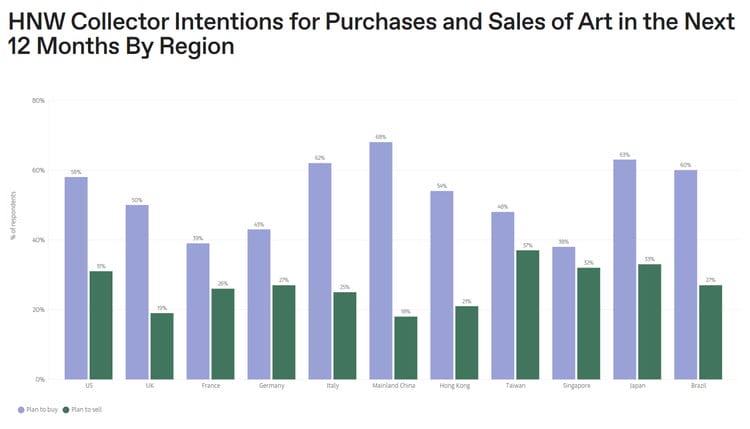
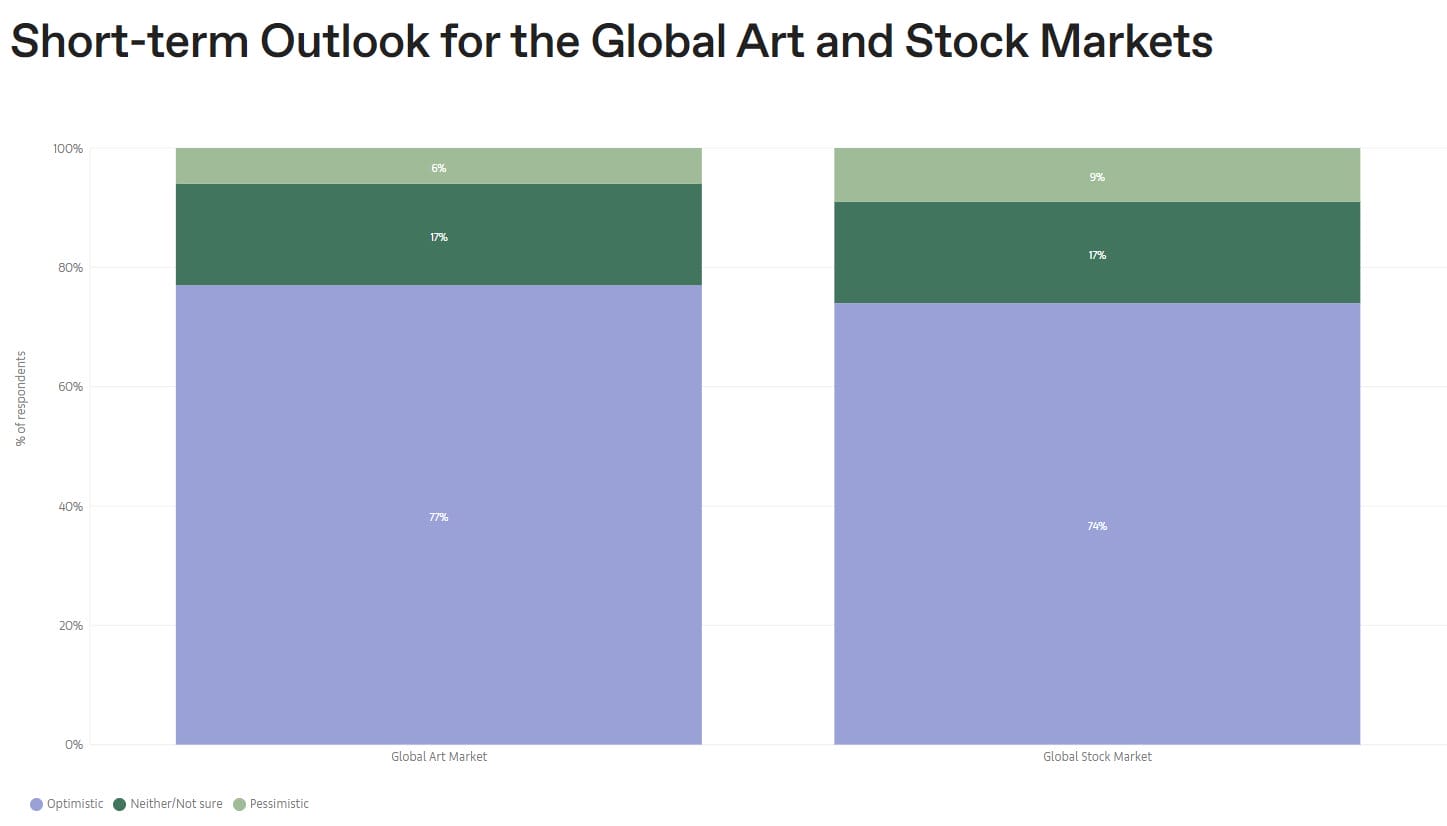
According to a survey by Art Economics and UBS, 77% of wealthy art collectors are optimistic about the global art market in 2023 and for the first months of 2024.
A majority of 55% even plan to acquire artworks by spring 2024. Particularly noteworthy is that this figure rises to 65% in key markets such as the USA. Collectors from mainland China were especially active in their purchasing plans, with 68% indicating their intention to acquire works. Large majority from Japan, Brazil, and Italy also expressed interest in buying art.
Furthermore, 45% of retailers expect an increase in their sales during this period, while 10% predict a significant improvement.
Surveys of medium-sized companies in the auction sector also show positive results: 48% expect an increase in sales and a full 60% expect an increase in online sales.
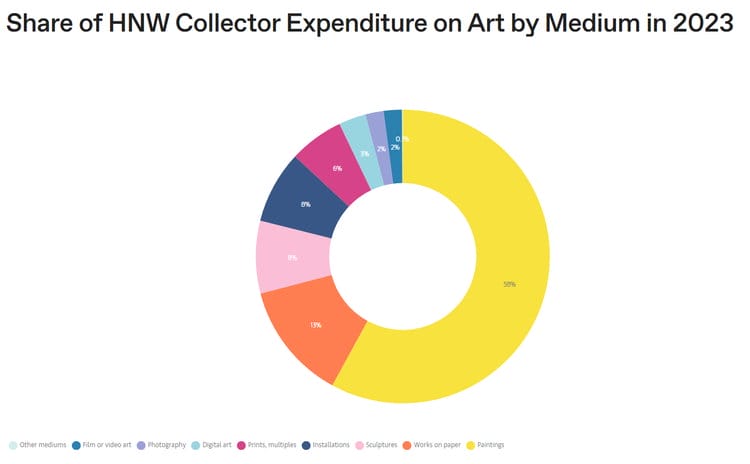
Paintings remained the preferred choice with an approval rating of 84%. Sculptures and works on paper followed in second and third place.
In contrast to purchases, only 26% of collectors planned to sell works from their collection within the next twelve months (by April 2024) – compared to 39% the previous year. Most stated that they would hesitate to sell because they are convinced that the prices for their artists' artworks will improve in the future.
HNWIs are more optimistic about art than the stock market
Despite the ongoing turmoil in the financial sector, high inflation, the continuing effects of three years of COVID-19 and the ongoing war in Ukraine, 77% of wealthy art collectors were confident about the future recovery of the art market in the coming months.
This proportion was slightly higher than those who were optimistic about the stock market (74%).
The market for art fairs is gaining momentum
The art fair market has slowly recovered following the impact of the pandemic. Reports indicate that collectors, galleries, and artists are becoming more involved in exhibitions, fairs, and similar events.
Looking ahead to 2024, almost all collectors (92%) plan to continue attending art-related exhibitions and events, either as much as before or even more. Only a small minority of 4% indicate that they intend to reduce their participation.
Especially in Great Britain, the majority of collectors (63%) hope to be able to attend even more events.
Regarding international travel to exhibitions, fairs or other art-related events, 66% of respondents would like to travel more frequently next year than this year.
Only a stable 12% plan to take fewer trips. The main reasons for this are rising costs for international travel and reduced interest in events and exhibitions abroad.
Furthermore, the desire to reduce one's ecological footprint through less travel also plays a role. The survey also reveals an awareness among the surveyed collectors regarding the sustainability of the art market and their thoughts on the matter. A large majority (72%) believe that the transport of artworks could be made more sustainable and that alternative delivery methods to air freight should be used – where available – such as sea or land transport.
Owner and Managing Director of Kunstplaza. Journalist, editor, and passionate blogger in the field of art, design, and creativity since 2011. Successful completion of a degree in web design as part of a university study (2008). Further development of creativity techniques through courses in free drawing, expressive painting, and theatre/acting. Profound knowledge of the art market through years of journalistic research and numerous collaborations with actors/institutions from art and culture.
A fundamental need for every artistically creative person is likely to be the ability to live off their art.
In order to secure your own existence, it is essential to make money with art . In fact, contrary to the majority perception, many artists can live well from their creative work these days. Nevertheless, a vast majority of all freelance artists are dependent on further sources of income (e.g. giving courses, order work, part -time jobs, etc.).
Recognition as an artist often does not bring immediate financial security. Therefore, artists are often also life artists.
The opportunities to make a living from one's own art have, however, grown significantly due to the internet and social media. As an artist, however, you must be versatile and flexible to succeed. A certain degree of perseverance is also essential.
Customer care and self -marketing are also important pillars for success as an artist .
In this section, we compile numerous articles, information, tips, and advice to help you make a living from your art.
We use technologies like cookies to store and/or access device information. We do this to improve the browsing experience and to show (non-)personalized ads. If you agree to these technologies, we can process data such as browsing behavior or unique IDs on this website. The refusal or withdrawal of consent may adversely affect certain features and functions.
The technical storage or access is necessary for the legitimate purpose of storing preferences that are not requested by the subscriber or user.
Always active
Die technische Speicherung oder der Zugang ist unbedingt erforderlich für den rechtmäßigen Zweck, die Nutzung eines bestimmten Dienstes zu ermöglichen, der vom Teilnehmer oder Nutzer ausdrücklich gewünscht wird, oder für den alleinigen Zweck, die Übertragung einer Nachricht über ein elektronisches Kommunikationsnetz durchzuführen.
Vorlieben
Technical storage or access is required for the lawful purpose of storing preferences that have not been requested by the subscriber or user.
Statistiken
The technical storage or access that is used exclusively for statistical purposes. The technical storage or access that is used exclusively for anonymous statistical purposes. Without a subpoena, voluntary compliance by your internet service provider, or additional records from third parties, information stored or retrieved for this purpose alone cannot usually be used to identify you.
Marketing
Die technische Speicherung oder der Zugriff ist erforderlich, um Nutzerprofile zu erstellen, um Werbung zu versenden oder um den Nutzer auf einer Website oder über mehrere Websites hinweg zu ähnlichen Marketingzwecken zu verfolgen.









 Autumn Leaves - metal wall decoration