What are the current state of art sales and the art market in 2022? And what does that mean for you as an artist? In this article, we present the latest figures and answer the most important questions.
Analyzing the art market is never easy, as, unlike in other sectors, much of the data and sales figures are not publicly available. Even today, the art market remains one of the least regulated investment markets for this reason.
Furthermore, hardly any comparable market adapts so quickly to changing trends and focuses: what is all the rage today can be completely irrelevant in just a few months. Finally, the impact of the pandemic on the art world in 2021 varied considerably – in certain regions, borders were closed for much of the year, while in other countries the “new normal” arrived in the summer.
To nevertheless provide an overview of the art market situation in 2022, UBS, in partnership with Art Basel, publishes a comprehensive Art Market Report , auctions , the art trade, and collectors. This year's report comprises a full 279 pages.
To save you time, we'll try to condense the information to the essentials. If you still want to read the full report, you can download it here .
A look back at 2021
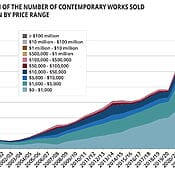
After the art market experienced its biggest price slump in 10 years in 2020, it was able to recover strongly in 2021. UBS estimates the total value of art and antiques sales by dealers and auction houses at approximately $65.1 billion , an increase of about 29% compared to the previous year. This figure even surpasses the pre-pandemic level of 2019.
All market segments grew – auctions (+47%), private sales (+33%), and the art trade (+18%). As always, the American art market remained the leader with $28 billion (43%), followed by China and Great Britain.
The online art market also continued to grow, increasing by 7% to a total of $13.3 billion. This growth was accompanied by an unprecedented boom in the emerging NFT market, which saw an increase of approximately $11.1 billion in 2021. This is particularly impressive considering that only about 6% of all art dealers currently carry NFTs in their inventory (although another 19% have expressed interest in doing so within the next two years). A large portion of their sales still comes from art fairs (29%), while online sales accounted for a decline for the first time (from 30% to 20% in 2021).
This is what we can expect for 2022
To put our expectations for the art market in 2022 into perspective, the Art Market Report also surveyed dealers, auction houses, and collectors about their outlook for 2022: Despite the ongoing uncertainty in 2021 regarding the pandemic and its long-term effects, most wealthy collectors (74%) were optimistic about the development of the global art market over the next six months when surveyed in December 2021 .
This majority was consistent across all regions, although optimism was lower in places like Taiwan and Germany, mainly due to the generally greater uncertainty among collectors there. Online sales are also expected to increase, and the growing NFT market expected to gain further momentum. This is good news for us artists and for the art market in general.
What does that mean for you as an artist?
For you as an artist, this essentially means only positive things, as the optimistic mood of major collectors, art dealers, and auction houses often spreads to smaller collectors and local art businesses. Subject to further pandemic restrictions, 2021 has primarily demonstrated the importance of creating crisis-proof systems and cultivating or building customer relationships.
The number one tool for artists remains their own online presence , whether via website or social media. You can find more tips and tricks on this topic in our section " Tips for Artists" .
Max Rübensal is a contemporary artist and art writer from Berlin who reflects in his works and texts on symbolism, identity, pop culture and the ever-increasing digitalization of our everyday lives.
A fundamental need for every artistically creative person is likely to be the ability to live off their art.
To secure one's own existence, it is essential to earn money with art. In fact, nowadays—contrary to the majority perception—many artists can live well from their creative work. Nevertheless, a significant majority of all freelance artists still rely on additional sources of income (e.g., teaching courses, commissioned work, side jobs, etc.).
Recognition as an artist often does not bring immediate financial security. Therefore, artists are often also life artists.
The opportunities to make a living from one's own art have, however, grown significantly due to the internet and social media. As an artist, however, you must be versatile and flexible to succeed. A certain degree of perseverance is also essential.
Customer relations and self-marketing are also important pillars for success as an artist .
In this section, we compile numerous articles, information, tips, and advice to help you make a living from your art.
We use technologies such as cookies to store and/or access device information. We do this to improve your browsing experience and to display (non-)personalized advertising. If you consent to these technologies, we can process data such as browsing behavior or unique IDs on this website. Refusal or withdrawal of consent may adversely affect certain features and functions.
Functional
Always Active
Technical storage or access is strictly necessary for the legitimate purpose of enabling the use of a specific service expressly requested by the subscriber or user, or for the sole purpose of carrying out the transmission of a message over an electronic communications network.
Preferences
The technical storage or access is necessary for the legitimate purpose of storing preferences that were not requested by the subscriber or user.
statistics
Technical storage or access that is solely for statistical purposes.Technical storage or access that is used solely for anonymous statistical purposes. Without a subpoena, the voluntary consent of your internet service provider, or additional recording by third parties, the information stored or retrieved for this purpose cannot generally be used to identify you.
marketing
Technical storage or access is required to create user profiles, to send advertising, or to track the user on one or more websites for similar marketing purposes.







 J-Line Statuette "Olivier" – Ethnic elegance in black stone
56,50 €
J-Line Statuette "Olivier" – Ethnic elegance in black stone
56,50 €