An overview of Christoph Waltz's work is to a large extent a story of clarification and correction: the correction of the misconception that Waltz only became a great actor through Hollywood, and the clarification of how many great roles he has already filled in almost four decades.
By the time the media frenzy from the center of American film made the actor a household name, he had already made good use of the almost limitless possibilities of his talent for a very long time; after all, acting was in Mr. Waltz's blood like few others: Christoph Waltz was born into a family firmly rooted in the theater, which at the time of his birth had already been supplying the Vienna Burgtheater with actors, set designers and costume designers for over 70 years.
Naturally, this son of a family that appears on all lists of famous acting families also wanted to become an actor and trained at top institutions in Vienna and New York. He was already on stage in Vienna at the age of 20, in 1977. In the following years, he had engagements in Frankfurt am Main, Hamburg, Cologne, Salzburg, and Zurich. From the very beginning of his acting career, Waltz also took on roles in television productions and feature films.
He was frequently cast in crime dramas , sometimes appearing in several consecutive episodes, including "Parole Chicago," "Der Alte," "Derrick," "Ein Fall für zwei," "Die Staatsanwältin," "Schimanski," "Kommissar Rex," "Polizeiruf 110," "Rosa Roth," "Unter Verdacht," "Der letzte Zeuge," "SOKO Rhein-Main," "Der Staatsanwalt," and "Stolberg." He was slated to become the new inspector for the Vienna "Tatort" in 1987, but Inspector Pasetti only lasted one episode. In 2006 and 2008, Waltz returned to a more substantial role among those involved in the crime.
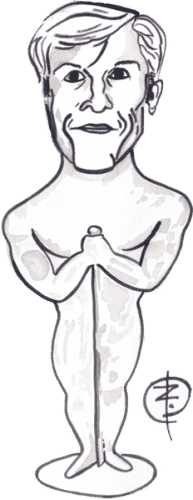
Cartoon of Christoph Waltz at the Oscars; by Strassengalerie [CC-BY-SA-3.0], via Wikimedia CommonsHowever, Christoph Waltz was never limited to crime films, neither in talent nor in his love of acting, as the colorful sequence of his other roles can only hint at here in excerpts: As early as 1981 he appeared in the love drama “Tristan and Iseult” directed by Veith von Fürstenberg, in 1982 in the historical youth film “The Mysterious Stranger” based on a story by Mark Twain, in 1983 he played the narcissistically inclined Nathanael in “The Sandman” based on ETA Hoffmann and in 1986 Friedrich Nietzsche in Peter Patzak’s “Wahnfried”, a film adaptation of the life of Richard Wagner.
In 1989, a political satire followed, with Waltz playing the young and idealistic EU official Dorfmann in “Der große Reibach” or “The Gravy Train”, in which the English director David Tucker already illuminated the Brussels bureaucracy in the light of the new Eastern European sales markets with a distanced view from the island.
The first collaboration with the Polish director and film producer Krzysztof Zanussi followed in 1991 in the film “Life for Life” about Maximilian Kolbe, where Waltz impresses as an escaped concentration camp prisoner plagued by guilt.
Waltz also appears in historical films and comedies, for example in Tom Toelle's historical two-parter "King of the Last Days" as the Anabaptist Jan van Leiden (1993) or in "Man Seeks Woman" directed by Vivian Naefe in 1994. Also in 1994, he garnered attention as a bomb-planting bus driver in the docudrama "Day of Reckoning – The Rampage Killer of Euskirchen," and in 1995 he starred alongside Catherine Zeta-Jones in the internationally cast television production "Catherine the Great.".
In 1996, he received further accolades, including a special prize at the Baden-Baden Television Festival for his performance in “You Are Not Alone – The Roy Black Story,” and the Bavarian Television Award in 1997. His career continued with “The Color of Life” (directed by Krzysztof Zanussi), the thriller “Vicky's Nightmare” directed by Peter Keglevic (both in 1997), and his first screenplay and directorial effort, “If You Dare,” in 1998.
In the same year, he also filmed two thrillers, “Shock – A Woman in Fear” and “The Finale”, two melodramas, “Murderous Inheritance – Exchange with a Dead Woman” and “Revenge for My Dead Child”, and a comedy, “The Strange Behavior of Sexually Mature Urbanites During Mating Season”, in which Waltz is a lot of fun as a frustrated novelist.
The series continues in its same colorful vein: in 1999 with the Australian-German thriller “Falling Rocks”, and in 2000 with “Dance with the Devil”, the film about the kidnapping of Richard Oetker, for which Waltz, along with his colleagues Sebastian Koch and Tobias Moretti and director Peter Keglevic, was awarded the Adolf Grimme Prize
In the same year, he also filmed “Queen's Messenger” and “She,” two co-productions from Canada, Great Britain, and Bulgaria, and “The Devil Woman” with Iris Berben. The range of films he has made so far is already hard to surpass in terms of variety and passion for acting, and this continues, with action films (“Terror on the Orient Express”), dramas (“Rieke's Love”), comedies (“Angel Seeks Wings”), and thrillers (“Dorian – Pact with the Devil”), all filmed in 2001, but in the USA, Germany, Great Britain, and Canada. The picture is similar in 2002, 2003, and 2004, with well over a dozen films, the roles demanding and interesting (e.g., as the false friend Pföderl in “Jennerwein,” as the power-hungry business villain in “The Matriarch,” as the wonderfully disoriented soon-to-be ex-husband in “Divorce Victim Man,” or as the cynical analyst in “The Old Monkey Fear”).
In 2004, Waltz received another Grimme Prize for his role as a bored sales representative (“Business Trip – What a Night”), and the offers kept increasing. In the following years, he took on all sorts of ambitious roles in productions spanning national borders. The mere mention of the characters he portrayed illustrates the diversity: He played Casanova (Karl Löwen in “Franziska’s Feeling for Men”) and scientist (Czerny in “Lapis Lazuli – In the Eye of the Bear”), doctor (“The Prosecutor – Lucky Children”) and investigator (“The Last Judgment”), lover (Büffel and Frank Arbogast in “The Zurich Engagement”) and ex-convict (Thomas Sell in “Hare and Hedgehog”), a success-spoiled midlife crisis sufferer (Helmut Bahr in “The Enchantment”) and a world-weary murderer (Sebastian Flies in “Deadly Sin”), all roles from the years 2006 to 2008. But the real breakthrough, the recognition as a star, somehow took its time.
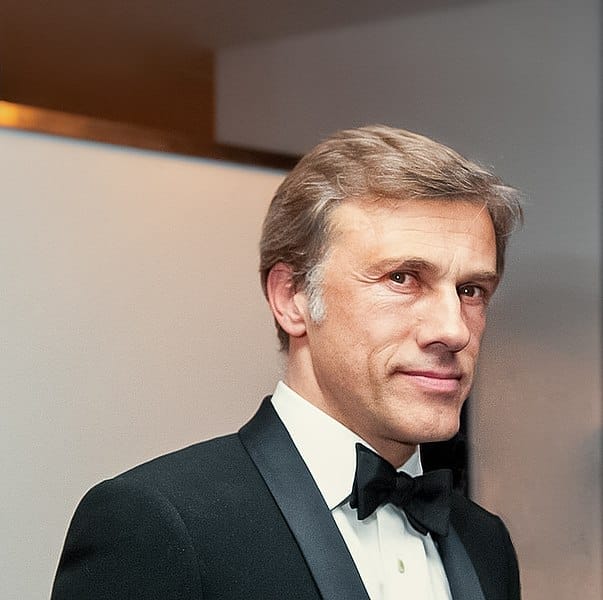
Christoph Waltz photo by Philipp von Ostau, CC BY-SA 3.0, via Wikimedia Commons
Until Quentin Tarantino in the role of an SS-Standartenführer in his anti-war film "Inglourious Basterds," and certainly not just because of his perfectly fitting Austrian accent. The film became a huge box office success in 2009 and is often considered Tarantino's best film; Waltz received over a dozen awards for his performance, including the Oscar for Best Supporting Actor.
From this time on, Hollywood began to claim Waltz's talent, and he embraced it with enthusiasm and a touch of satisfaction: Quentin Tarantino had ignited decades of his efforts – something that meant an incredible amount to him at his age. He wasn't "in his so-called autumn"; on the contrary, for him, spring had just begun.
Since then, Waltz has played the comic book villain (Chudnofsky in “The Green Hornet”, 2010), a circus director (in “Water for Elephants”, 2011), a father (Alan Cowan in “Carnage”, 2011) and a bounty hunter (Dr. King Schultz in “Django Unchained”) in Hollywood productions, has directed and contributed to screenplays and soundtracks, and the recognition and offers are constantly increasing, some awards are coming up and many projects are in the planning stages.
Let's hope Christoph Waltz doesn't become too serious – after playing Cardinal Richelieu in the 2011 film "The Three Musketeers," he is set to portray Mikhail Sergeyevich Gorbachev in Mike Newell's political disaster film "Reykjavik," which will be filmed in 2013…
When you see how relaxed Waltz's face and demeanor became as a result of his finally deserved success, some admirers of his talent and sensitivity wish for completely different roles for him – perhaps a mad magician or a cynical but amusing enlightener – no question, Christoph Waltz is still capable of much more.
The following video shows the press conference with Quentin Tarantino, Jamie Foxx, Christoph Waltz, Kerry Washington and Samuel L. Jackson for the German premiere of Christoph Waltz's latest film "Django Unchained":
We use technologies such as cookies to store and/or access device information. We do this to improve your browsing experience and to display (non-)personalized advertising. If you consent to these technologies, we can process data such as browsing behavior or unique IDs on this website. Refusal or withdrawal of consent may adversely affect certain features and functions.
Functional
Always Active
Technical storage or access is strictly necessary for the legitimate purpose of enabling the use of a specific service expressly requested by the subscriber or user, or for the sole purpose of carrying out the transmission of a message over an electronic communications network.
Preferences
The technical storage or access is necessary for the legitimate purpose of storing preferences that were not requested by the subscriber or user.
statistics
Technical storage or access that is solely for statistical purposes.Technical storage or access that is used solely for anonymous statistical purposes. Without a subpoena, the voluntary consent of your internet service provider, or additional recording by third parties, the information stored or retrieved for this purpose cannot generally be used to identify you.
marketing
Technical storage or access is required to create user profiles, to send advertising, or to track the user on one or more websites for similar marketing purposes.






 J-Line decorative cushion "Smiley", tufted cotton
32,50 €
J-Line decorative cushion "Smiley", tufted cotton
32,50 €