A woman might desire a clean, slim silhouette – and equally the pleasure of taking up space with a full skirt. How a wedding dress translates such desires into form is revealed in its bodice, the lace, and the transitions between skin and fabric.
Those who look at the dresses on display will see a variety of ideas about presence. An open shoulder, a high collar, or pleats that sweep out to the sides alter the relationship between body and fabric. For the wearer, it's a personal decision: How much does she want to reveal, where does she want a clear outline, and where can the dress be more flowing? These questions lead right to the heart of the design process.
A corsetdemonstrates how individual lines create a form. Visible boning structures the bodice. The contours of the cups add their own curve above. Where the narrow panels meet the waist, the design becomes more defined. This makes the transition to the skirt particularly striking: the eye is first drawn to the close-fitting construction and then to the fullness beneath.
In Melusine,this framework remains visible through transparent inserts; the strapless bodice has defined cups and clearly visible corset boning. Three-dimensional floral appliqués lie over the structure and continue onto the multi-layered skirt. Detachable tulle sleeves sit below the shoulders, adding volume to the upper silhouette. The contrast between the clean lines of the bodice and the soft sleeves emphasizes the bare shoulders.
Melusine with strapless bodice, visible boning, three-dimensional floral appliqués and low-set tulle sleeves. Photo: DAMA Couture
The interesting aspect here lies in the layering. You can follow the line of a rod and simultaneously see how a floral motif extends beyond it. The straighter line and the irregular edge of the appliqué both remain legible. Such transitions demonstrate how carefully the construction and embellishment are coordinated. The edges of the flowers also serve a purpose: they soften the regular structure of the upper part.
02 Transparency is characterized by
A transparent panel also makes the skin part of the visible surface. Open spaces are created between the lace motifs, highlighting their outlines. How revealing a top appears therefore depends as much on the distribution of the motifs as on the depth of the neckline. A dense floral border and a single motif in the middle of a transparent area create different transitions.
Ondineshowcases this particularly clearly on the back: A deep illusion neckline meets floral lace appliqués and a row of covered buttons. The motifs extend into the sheer area, creating an irregular boundary between skin and fabric. The fit-and-flare cut follows the waist and hips before the skirt gently flares out. Floral lace continues all the way to the train, thus connecting the open back with the long silhouette.
Ondine from behind with a deep illusion neckline, floral lace and a row of covered buttons. Photo: DAMA Couture
The back of the dress takes on a distinct composition through this arrangement. The row of buttons forms a narrow center; floral shapes branch out to the sides. A close-up view reveals the individual edges, while from a distance the overall line becomes apparent. Both elements are integral to the design. For the woman wearing the dress, the deep neckline signifies a different kind of openness than a bare shoulder: visibility is concentrated in one specific area.
03 Peak between blossom and geometry
The designs shown here are from DAMA Couture. The brand is based in Warsaw and designs its wedding dresses there. The examples demonstrate how lace can be used: as a three-dimensional flower, as a translucent surface, or as a recurring geometric pattern.
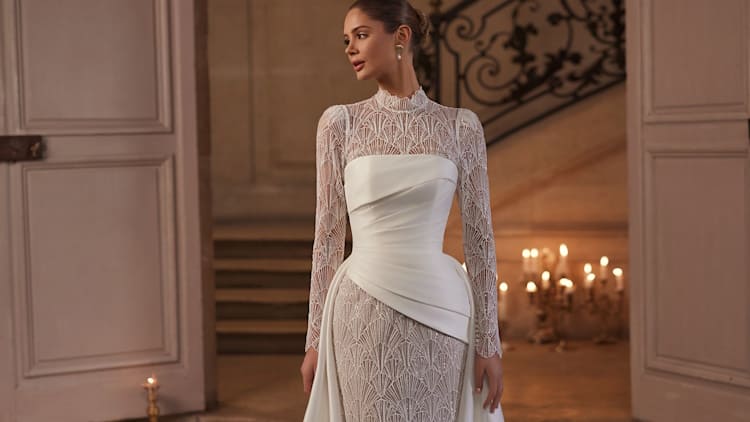
Juniona's dress features a geometric, fan-shaped motif in the Art Deco style , adorning a figure-hugging silhouette. A high stand-up collar and long, narrow sleeves extend the pattern to the neck and wrists. This can be paired with a textured satin overskirt, its draped waist opening into a wide train. The smooth, light-reflecting satin surface contrasts sharply with the intricate lace detailing.
Juniona with geometric fan lace, stand-up collar, long sleeves and a satin overskirt draped at the waist. Photo: DAMA Couture
The lace wedding dresses from DAMA Couture reveal a design distinction that the word "lace" alone hardly conveys. A raised flower casts small shadows; a fan pattern orders the surface through repetition. When combined with satin, a more stately, serene surface is added. The eye shifts between detail and outline. Those who appreciate geometric patterns can find a personal connection in this combination of dense design and smooth fabric.
04 How folds create space
Thetis giveit volume at the hips. The fitted bodice has delicate lace straps and sheer elements. The lace extends over the skirt into a generous train. The fullness is created right at the transition from the bodice to the skirt, so that the narrow waist and the side pleats together define the silhouette.
Thetis with transparent corset elements, lace straps and a wide lace skirt with pleats at the hips. Photo: DAMA Couture
The comparison with the satin overskirt shows how differently volume can be created. There, another layer is added to the slim basic shape. Here, the fullness is an integral part of the A-line itself. On the folded lace surface, light areas and shadows alternate; the pattern flows over the curves. The comparison to a sculpture has a specific purpose here: the effect is also created by how the surface recedes from the body.
For the wearer, such choices become a form of expression. Perhaps she is drawn to the visible construction of a bodice, perhaps the closed nature of a high collar, or the broad outline of a pleated skirt. This can be traced back to a single line. A dress gains personal meaning when the woman finds something in these details that she would like to show: bare shoulders, an open back, or her delight in a generous silhouette
Owner and Managing Director of Kunstplaza . Publicist, editor, and passionate blogger in the fields of art, design, and creativity since 2011. Graduated with a degree in web design from university (2008). Further developed creative techniques through courses in freehand drawing, expressive painting, and theatre/acting. Profound knowledge of the art market gained through years of journalistic research and numerous collaborations with key players and institutions in the arts and culture sector.
We use technologies such as cookies to store and/or access device information. We do this to improve your browsing experience and to display (non-)personalized advertising. If you consent to these technologies, we can process data such as browsing behavior or unique IDs on this website. Refusal or withdrawal of consent may adversely affect certain features and functions.
Functional
Always Active
Technical storage or access is strictly necessary for the legitimate purpose of enabling the use of a specific service expressly requested by the subscriber or user, or for the sole purpose of carrying out the transmission of a message over an electronic communications network.
Preferences
The technical storage or access is necessary for the legitimate purpose of storing preferences that were not requested by the subscriber or user.
statistics
Technical storage or access that is solely for statistical purposes.Technical storage or access that is used solely for anonymous statistical purposes. Without a subpoena, the voluntary consent of your internet service provider, or additional recording by third parties, the information stored or retrieved for this purpose cannot generally be used to identify you.
marketing
Technical storage or access is required to create user profiles, to send advertising, or to track the user on one or more websites for similar marketing purposes.









 Timeless elliptical dining table with ceramic-marble surface
1.950,00 €