It's that one, almost intimate moment in the morning. You're standing in front of the bathroom mirror, the brush glides through your hair, and suddenly a small, loose clump remains caught in the bristles. You pull it out. In that brief instant, everything changes: as long as those fibers were on your head, they were part of your identity, a symbol of vitality, attractiveness, and self-expression.
Now, isolated in the palm of your hand, something strangely uncanny suddenly seems to cling to them. A touch of transience. Perhaps you even feel a faint impulse of unease before you dispose of them in the trash.
It is precisely within this emotional balancing act – between deep personal identification and the sudden shudder of the abject – that one of the most fascinating movements in contemporary art moves. What we wash, cut, blow-dry, and style daily is no longer solely the domain of the cosmetics industry.
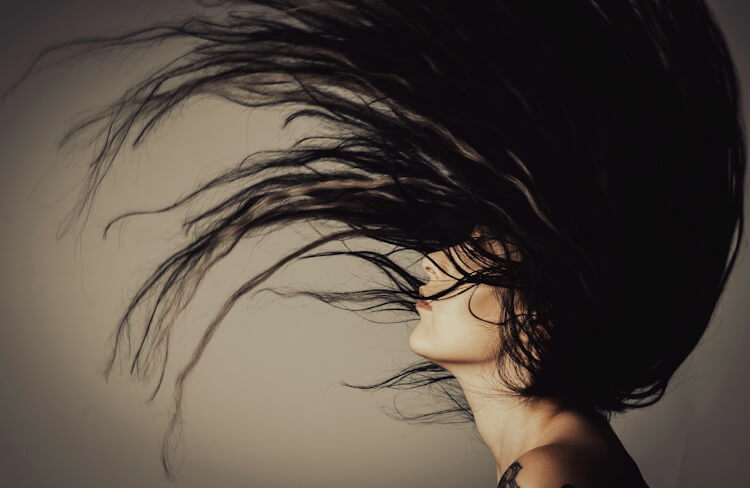
Hair has conquered the world's museums and galleries, not as a painted subject, but as a textile, organic, highly political medium. Photo by Resat Kuleli @resat, via Unsplash
It is perhaps the most radical canvas of our time. A fiber that, like no other material, conveys identity, power structures, and the fundamental fear of decay. In a world driven by visual perfectionism, hair becomes the ultimate battlefield—and the last refuge of ritual.
The legacy of shock: From the fur-covered teacup to contemporary provocation
To understand why hair in art touches us so deeply, we must look back to the moment when hair first truly destabilized the pristine world of bourgeois aesthetics. In 1936, the Surrealist Meret Oppenheim a banal teacup, saucer, and spoon with gazelle fur. Le Déjeuner en fourrure was born.
The effect was electrifying and deeply disturbing: the furry object immediately evoked tactile associations in the viewer's mouth – a collective shudder. Oppenheim proved that the mere presence of hair in places where it doesn't belong can instantly expose societal taboos and repressed desires.
The Paradox of Hair in Art
On the body
Separated / Isolated
Symbol of youth & vitality
Object of discomfort
Tool of self-presentation
Relic & Memento Mori
Cultural code of belonging
Political protest medium
Over the past four years, this surrealist impulse has experienced a remarkable renaissance. Major international retrospectives and cultural-historical exhibitions – such as the groundbreaking show Des cheveux et des poils at the Musée des Arts Décoratifs in Paris – have rehabilitated hair as a seismograph of social upheaval.
Contemporary artists today use the material far less for a quick, surreal shock effect and more for a profound dissection of our present. Hair has moved beyond the niche of the purely decorative; it has become a malleable material that tells stories often beyond the grasp of words.
Strands of resistance: Hair as a feminist and political monument
There is no such thing as apolitical hair. Whether we let it grow, straighten it, cover it, or shave it off: every decision is a response to societal norms. Particularly in contemporary feminist art, hair is therefore used as a powerful weapon. Hair is the visible extension of our inner microcosm, and whoever controls it controls the body.
A look at recent world events shows how pressing this issue is. The revolutionary protests in Iran since the end of 2022, under the banner "Woman, Life, Freedom" (Jin, Jiyan, Azadî), were sparked by the repressive enforced hijab. The protests made the public cutting of one's hair a global symbol of resistance against tyranny.
This seismic cultural upheaval continues to resonate in contemporary art. Performance artists worldwide take up knives or scissors to sacrifice strand after strand of hair in gallery spaces. It is an act of dispossession of the patriarchal gaze: hair, traditionally regulated as a patriarchal attribute of female beauty and chastity, becomes, in the moment of its destruction, a monument to autonomy.
In expansive installations, artists also use tons of real hair or synthetic fibers to address colonial wounds and racist beauty ideals. For Black artists, for example, the theme of Black hair has always been a central medium for discussing liberation from Eurocentric patterns. When enormous, sculptural braids occupy the space, hair becomes a collective architecture of resilience. It reveals that our hair is linked to the finest nerve pathways of power.
The Immortal Archive: Matter of Transience
Beyond its political dimension, hair possesses a metaphysical quality that fascinates curators and artists alike: its sheer indestructibility. While flesh and skin decompose over time, hair resists decay for centuries. It is a biological permanent resident on this earth. This makes it the ideal vehicle for the classic artistic motif of memento mori – the reminder of one's own mortality.
In contemporary art, hair is often treated like an archaeological find or forensic evidence. Hair stores everything. It is an archive of our lives: it documents the stress we experienced, the food we ate, and the environmental toxins we were exposed to. When artists work with human hair, they are always also working with the ghosts of the past.
Hair is the only thing that remains of us when we die. It is not dead material, but the preserved energy of an existence.”
Consider delicate, minimalist installations where fine hairlines are drawn like fragile cracks through white porcelain bowls, or where woven hairnets refract the light. Here, the fragility of life becomes palpable. Hair functions as a relic of everyday life. It reminds us that we are transient, while the fiber on our heads will effortlessly outlive us. It is this melancholic poetry that lends the material an almost sacred aura.
Daily curation: Hair care as a meditative act in visual capitalism
But the art history of hair isn't only written in the grand halls of Documenta or the Venice Biennale. It's rewritten every day – in the seclusion of your own bathroom. In an era dominated by the dictates of visual perfectionism, Instagram filters, and the flawless, AI-generated avatars of our digital feeds, everyday hair care has taken on a completely new quality. It has become a ritualistic, almost meditative act.
Let's consider combing, washing, oiling, and braiding beyond their purely hygienic benefits: it's the daily, conscious curating of one's own body. In a hyper-accelerated world where we are constantly mentally focused on the external world, engaging with our hair forces us into the presence of our own reflection. It is one of the few remaining analog constants. The slow brushing out of knots in the evening becomes a ritual cleansing of the day's impurities; the massaging in of oils a form of tactile self-care.
This brings us full circle to contemporary art. If hair is the medium through which we express our identity, then the bathroom is the studio where we reshape that identity daily. It's an act of silent resistance against standardization. By taking time for this seemingly mundane grooming, we momentarily escape the pressure to be productive in a world that constantly seeks to optimize us. We're not just styling a hairdo—we're asserting our very existence.
How we pour the foundation of our daily sculpture
Anyone who sees hair as a canvas quickly realizes: no work of art can truly shine without the right foundation. But while we often give the most attention to the perfect hairstyle, the precise cut, or the daring color, the real foundation of healthy, supple hair is usually laid in silence. It's the often-underestimated bottle on the edge of the bathtub: conditioner. It's far more than just a detangling agent after a shower – it's the true architect of hair's natural beauty.
The secret to smooth hair: Why the right conditioner is the basis of every hair care routine
Why washing is only half the story
Every hair wash is essentially a profound intervention in the delicate structure of the hair fiber. While shampoo fulfills the fundamental task of cleansing, it acts like a strict curator: it not only removes the build-up of daily life but also breaks down the cuticle layer and strips the hair of its natural, protective oils. At this critical point, conditioner comes into play.
Conditioner acts as a balancing corrective in the bathroom ritual. Its tasks are as precise as they are essential:
Closing the structure: It seals the opened cuticle layer and protects the hair from microstructural damage.
Reducing resistance: By minimizing friction between individual strands, hair breakage is actively prevented.
The interplay of light: Only a smooth surface optimally reflects the light and gives the hair that deep, vibrant shine.
Preparing the shape: He transforms the hair into a supple, receptive medium that is ready for subsequent styling.
Reading hair: individual diagnosis
Just as a conservator analyzes every painting before working on it, hair also requires a precise assessment. Choosing the right care is not a matter of chance, but the result of a deep understanding of one's own biology. Every hair fiber reacts sensitively to the active ingredients it is offered.
Ingredients – A look inside the lab
Behind the suppleness we can feel with our fingertips lies pure natural science. High-quality formulas in contemporary skincare products rely on a finely tuned synergy of protection and regeneration. Three pillars support this textile structure:
Natural oils: They mimic the skin's own lipids, coat the fiber like a wafer-thin protective film and provide elasticity.
Proteins: They act like liquid building blocks that repair micro-fine cracks in the keratin structure and strengthen the hair from the inside out.
Panthenol: As an intense moisture magnet, it penetrates deep into the hair shaft and protects it from the threat of drying out due to hairdryer heat or environmental factors.
The skincare triumvirate: conditioner, mask and leave-in
In modern hair care, each product has its established role. To avoid overloading your routine, it helps to clearly define the functions of each product. While the hair mask is responsible for intensive deep treatment for regeneration and the leave-in product acts as a long-lasting protective shield during styling, the conditioner the undisputed star of everyday life. It guarantees the daily dose of basic moisture and ensures that easy combability that makes the morning routine with your hair a truly meditative experience.
The right application transforms a chemical product into a sensory experience. Time is the invisible active ingredient here
Scientific studies repeatedly underscore this necessity: Regular conditioner use demonstrably increases hair fiber elasticity and drastically reduces the risk of breakage. But this magic only works if the ritual is correct. After shampooing, conditioner should be applied exclusively to the damp lengths and ends of the hair – where it has the longest history and is most vulnerable to damage. After a short time of two to five minutes, during which the active ingredients can penetrate the hair, the hair is gently rinsed with clean water.
The curated bathroom: Long-term aesthetics instead of quick effects
Well-groomed hair is not a product of chance, but the result of a consistent, appreciative routine. Choosing lightweight formulas that nourish the hair without weighing it down means investing in the longevity of your own personal canvas.
In a world flooded with endless options, the search for the perfect companion for this ritual often feels like a journey of discovery. Modern culture and beauty platforms like MAKEUP are increasingly acting as digital curators: they offer a space to delve deep into the world of professional, customized hair care products, far removed from standardized drugstore shelves. Thus, clicking on the right conditioner becomes the first step in a conscious self-presentation – and the bathroom is transformed into a true artist's studio.
The infinite fiber of being
Hair in art history has undergone a fundamental transformation: from Oppenheim's surreal taboo-breaking to the loud, feminist, and political statements on the streets and in contemporary museums, to the intimate ritual in front of the home mirror. It is far more than inanimate keratin. It is a living cultural medium, a seismograph of our fears, desires, and social struggles.
The next time you pull a loose strand from your brush, perhaps don't toss it away quite so carelessly. Consider it for a second for what it truly is: a tiny, highly complex work of art. A fragment of your own story, poised to endure through time. Hair remains the most fascinating link between our most intimate selves and the grand stage of world history—linked fiber by fiber, strand by strand.
Owner and Managing Director of Kunstplaza . Publicist, editor, and passionate blogger in the fields of art, design, and creativity since 2011. Graduated with a degree in web design from university (2008). Further developed creative techniques through courses in freehand drawing, expressive painting, and theatre/acting. Profound knowledge of the art market gained through years of journalistic research and numerous collaborations with key players and institutions in the arts and culture sector.
We use technologies such as cookies to store and/or access device information. We do this to improve your browsing experience and to display (non-)personalized advertising. If you consent to these technologies, we can process data such as browsing behavior or unique IDs on this website. Refusal or withdrawal of consent may adversely affect certain features and functions.
Functional
Always Active
Technical storage or access is strictly necessary for the legitimate purpose of enabling the use of a specific service expressly requested by the subscriber or user, or for the sole purpose of carrying out the transmission of a message over an electronic communications network.
Preferences
The technical storage or access is necessary for the legitimate purpose of storing preferences that were not requested by the subscriber or user.
statistics
Technical storage or access that is solely for statistical purposes.Technical storage or access that is used solely for anonymous statistical purposes. Without a subpoena, the voluntary consent of your internet service provider, or additional recording by third parties, the information stored or retrieved for this purpose cannot generally be used to identify you.
marketing
Technical storage or access is required to create user profiles, to send advertising, or to track the user on one or more websites for similar marketing purposes.





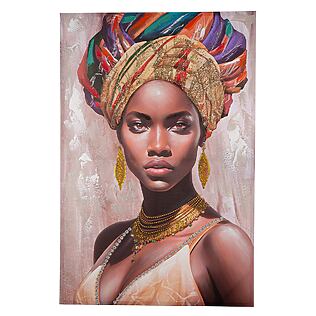
 African Art canvas print "Adissa", portrait of a woman with gold accents
115,00 €
African Art canvas print "Adissa", portrait of a woman with gold accents
115,00 €