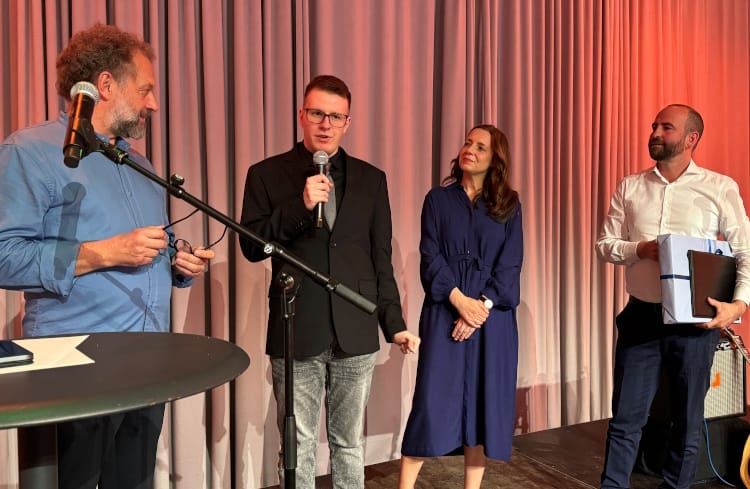
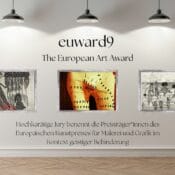
Last Sunday, July 14, 2024, the winner of the euward9 audience award was announced Haus der Kunst in Munich as part of the closing ceremony of the exhibition “Samaneh Atef, Belén Sánchez, Desmond Tjonakoy. euward9”
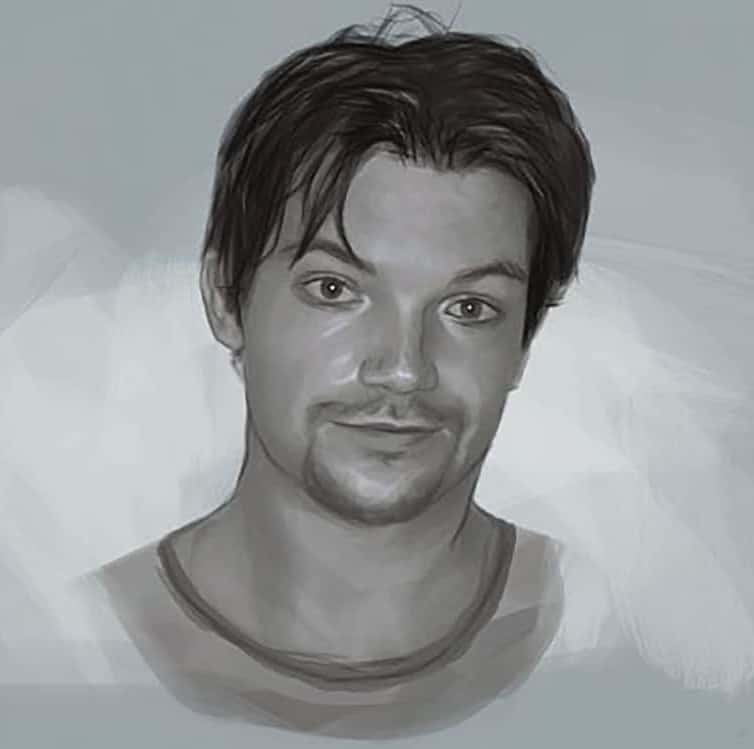
Jakob Ujvari was born in Miskolc, Hungary, in 2000. He grew up in Munich with his twin brother Jonas and two other siblings. After graduating from a special needs school in Munich in 2019, he began working full-time as a young artist at the Atelier Augustinum.
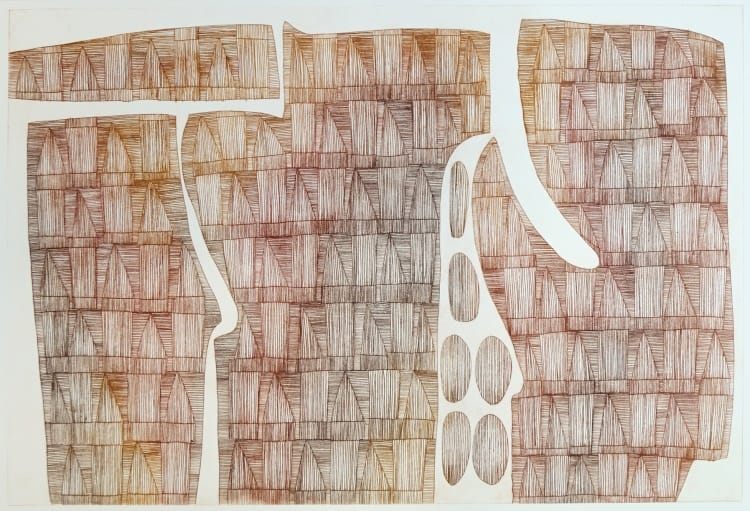
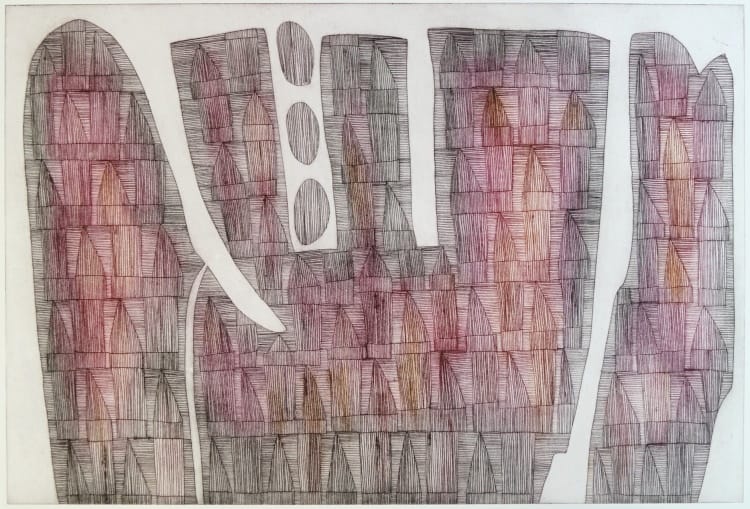
Ujvari's artistic work is characterized by a distinctive graphic-linear style. With a few strong and precise lines, he creates clear forms on Indian handmade paper or etching plates.
He favors abstract forms that extend across the entire page and merge together. A continuous, rhythmic internal drawing unites the individual forms into a harmonious whole. The resulting compositions appear both archaic and contemporary, even modern.
The European Art Award – The art prize and its international significance
The euward is a prestigious international art prize of significant global relevance, dedicated to talented artists with intellectual disabilities. It recognizes the work of outstanding contemporary artists with cognitive impairments. What makes it unique is that there is no comparable art prize with such continuity in Europe or on any other continent.
The concept for the euward award was developed between 1998 and 1999, documented in writing, and implemented by Klaus Mecherlein for the Augustinum in 2000. Initially, the euward was awarded every two years (2000/2002/2004), and since then approximately every three years (2007/2010/2014/2018/2021/2024).
From 2004 to 2010, the euward exhibition was presented three times at the renowned Haus der Kunst in Munich, and since 2021 it has been a regular part of the program again.
Positioning of the euward
The art world is gradually opening up to the works of people with intellectual disabilities. The euward Art Prize advocates for the recognition of this critical and high-quality art, which is often still rejected by the traditional art scene.
Through a scientific approach, euward explores this new artistic phenomenon and emphasizes its significance within the overall context of art.
inclusion means that their unique perspectives and life experiences must be respected in their art without leveling or diminishing their diversity. Ignoring disabilities does not lead to greater inclusion, but rather restricts diversity in art.
Award-winning and cross-sectional exhibition
From the outset, the euward concept has incorporated a dual focus in the presentation and publication of the award-winning art. The euward exhibition , primarily dedicated to honoring and showcasing the prize winners in the form of a comprehensive solo exhibition , simultaneously offers a representative overview of the contemporary art scene within the context of intellectual disability in Europe.
Presenting all approximately 20 artists nominated for the euward offers a unique opportunity to showcase a cross-section of European art. This provides an additional incentive for the audience and allows for a comprehensive exploration of the phenomenon of art in the context of intellectual disability.
Art in the context of intellectual disability
Since 2000, euward has provided a platform for artworks created in connection with intellectual disabilities. These works are celebrated as expressions of a unique approach to the world and perception. Cognitive impairment is not seen as an obstacle, but as a potential.
The euward exhibition distinguishes itself from purely aesthetic art exhibitions by people with disabilities and avoids a purely aesthetic approach. However, it is both possible and worthwhile to view this unique art within the context of contemporary art as well as in other contexts.
The conditions under which such artworks were created deserve special attention, while their reception can take various perspectives. It is important to clearly distinguish between art production and reception, especially with terms like “Outsider Art” or “Art Brut ,” in order to avoid misunderstandings.
Artistic practice and intellectual disability
The art of people with intellectual disabilities is increasingly recognized as part of the neurodiverse artistic landscape . The individual character shaped by their disability allows for a unique approach to the world and to artistic creation.
The personal objects hold deep meaning for the artists themselves and raise interesting questions. Contextualizing this art broadens our understanding of the wide spectrum of human artistic creation. This particular form of creative expression remains relevant today and has inspired artists such as Paul Klee , Alfred Kubin, and Salvador Dalí .
Reception of the works of creators with intellectual disabilities
The phenomenon of artistic outsiders (i.e., untrained, spontaneous creators and inventors of forms out of inner necessity) was first discovered, investigated and published by physicians in psychiatric institutions in the mid-19th century (Cesare Lambroso, 1887).
They were first referred to as “artists” (Walter Morgenthaler, 1921) and later incorporated into the concept of Art Brut (a raw, anti- or extra-cultural art) by Jean Dubuffet (1945). However, until around 1960, there were no concepts of art by people with intellectual disabilities, because there was no concept of these people.
It was only with the establishment of therapeutic homes and art initiatives such as Annedore Spellenberg's studio (1965) in Stetten that the art of people with cognitive disabilities became visible. Since this art was mostly created in institutions, supervised art spaces, and under guidance (sometimes even with educational aims), it found no place in the Art Brut canon and was sometimes met with rejection and exclusion by representatives of Art Brut.
Michel Thévoz (Collection de l'Art Brut, Lausanne) attributed to her in a publication the existential energy and subversive power of Art Brut.
Numerous misunderstandings surrounding Outsider Art
Outsider art is an art phenomenon that is often misunderstood and therefore requires closer examination. Artists working in this style do not see themselves as traditional artists, but rather bring a unique perspective and creative energy to their work.
This type of art differs significantly from established “cultural art” and offers insights into the diversity of human creativity beyond established norms. Outsider art represents an alternative approach to Western art tradition and emphasizes the individual forms of expression of the artists, who are often neurodiverse.
This is not a social category or a form of discrimination, but an unconventional, authentic form of art that questions and challenges the established art system.
By Outsider Art as an independent artistic movement , we open up space for critical reflection within the art world and enable an appreciative engagement with diverse forms of expression.
Owner and Managing Director of Kunstplaza. Journalist, editor, and passionate blogger in the field of art, design, and creativity since 2011. Successful completion of a degree in web design as part of a university study (2008). Further development of creativity techniques through courses in free drawing, expressive painting, and theatre/acting. Profound knowledge of the art market through years of journalistic research and numerous collaborations with actors/institutions from art and culture.
We use technologies like cookies to store and/or access device information. We do this to improve the browsing experience and to show (non-)personalized ads. If you agree to these technologies, we can process data such as browsing behavior or unique IDs on this website. The refusal or withdrawal of consent may adversely affect certain features and functions.
The technical storage or access is necessary for the legitimate purpose of storing preferences that are not requested by the subscriber or user.
Always active
Die technische Speicherung oder der Zugang ist unbedingt erforderlich für den rechtmäßigen Zweck, die Nutzung eines bestimmten Dienstes zu ermöglichen, der vom Teilnehmer oder Nutzer ausdrücklich gewünscht wird, oder für den alleinigen Zweck, die Übertragung einer Nachricht über ein elektronisches Kommunikationsnetz durchzuführen.
Vorlieben
Technical storage or access is required for the lawful purpose of storing preferences that have not been requested by the subscriber or user.
Statistiken
The technical storage or access that is used exclusively for statistical purposes. The technical storage or access that is used exclusively for anonymous statistical purposes. Without a subpoena, voluntary compliance by your internet service provider, or additional records from third parties, information stored or retrieved for this purpose alone cannot usually be used to identify you.
Marketing
Die technische Speicherung oder der Zugriff ist erforderlich, um Nutzerprofile zu erstellen, um Werbung zu versenden oder um den Nutzer auf einer Website oder über mehrere Websites hinweg zu ähnlichen Marketingzwecken zu verfolgen.







 J-Line Luxuriöses 1-Sitzer Sofa mit Knopfheftung, schwarzer Veloursamtbezug und goldfarbenes Metallgestell
1.250,00 €
J-Line Luxuriöses 1-Sitzer Sofa mit Knopfheftung, schwarzer Veloursamtbezug und goldfarbenes Metallgestell
1.250,00 €