One exhibition, two exhibition venues – how is that possible? This idea is currently being brought to life “Between Pixel and Pigment. Hybrid Painting in Post-Digital Times” at the Marta Herford and the Kunsthalle Bielefeld
Until November 10, 2024, visitors still have the opportunity to experience an impressive collection of artistic works that impressively demonstrates that painting has by no means lost its importance in the digital age.
Rather, it shows that it receives new impetus through the dynamics of digitalization and continues to evolve.
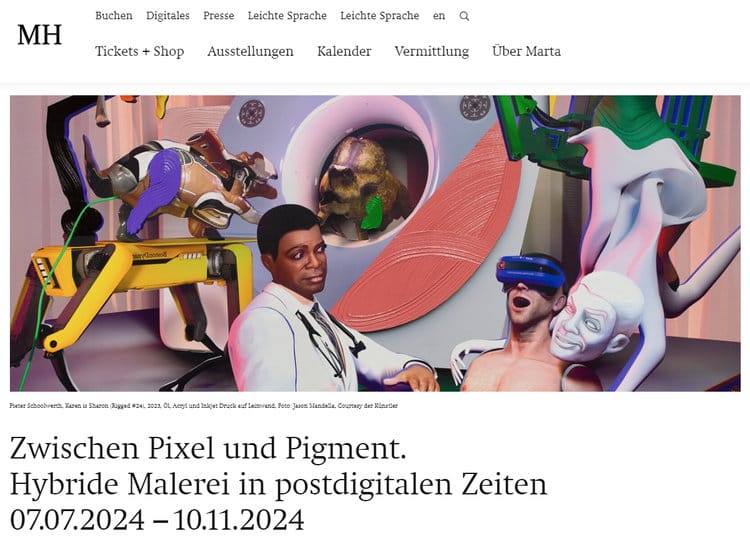
Between pixel and pigment: Hybrid painting in post-digital times. Screenshot by Marta Herford
The exhibition offers a fascinating trajectory, ranging from the iconic works of Andy Warhol to the innovative creations of Peter Kogler and the contemporary masterpieces of Tim Berresheim and Avery Singer . In total, approximately 150 exhibits by 25 artists are displayed across the two buildings, transporting visitors into a world that exists at the intersection of digital pixels and traditional color pigments.
This hybrid approach to painting leads to a fruitful exploration of the possibilities offered by modern technology – and impressively demonstrates that creativity knows no bounds.
Michael Stoeber , author of KUNSTFORUM , describes in his review after visiting this exhibition:
The collective effort has produced great things. And even though each exhibition can be enjoyed on its own, it is definitely worth making the short journey of a few kilometers between the two cities to see everything.”
Thisassessment not only highlights the appeal of the connection between the two institutions, but also encourages direct engagement with the exhibits – an invitation you will surely not want to refuse.
Experience for yourself this extraordinary fusion of digital technology and painting. Be inspired by the diversity of creative approaches and the dialogue between tradition and innovation that comes alive in these two exhibition spaces.
Further information can be found directly on the exhibition pages of the two museums:
Owner and Managing Director of Kunstplaza . Publicist, editor, and passionate blogger in the fields of art, design, and creativity since 2011. Graduated with a degree in web design from university (2008). Further developed creative techniques through courses in freehand drawing, expressive painting, and theatre/acting. Profound knowledge of the art market gained through years of journalistic research and numerous collaborations with key players and institutions in the arts and culture sector.
In this magazine section, you will find numerous reports and articles about the use of artificial intelligence (AI) in art,design and architecture.
It's not just about the question of how AI can be used in these areas, but also about the impact this has on creative creation.
For while some experts believe that the use of AI will lead to a revolution in art and design, there are also voices from within the industry itself that are skeptical of AI art and AI-powered image generators.
An early example from 2016 of the use of AI in art is the project “The Next Rembrandt” . Here, software was developed that created a new painting in the style of the Dutch painter based on data analysis – without human intervention.
The result was surprisingly realistic and clearly demonstrated the potential of this technology even back then.
What does this development mean for traditional crafts? Will they become obsolete or can new opportunities be created?
These questions occupy many people both within and outside the industry alike.
In any case, the connection between art and artificial intelligence offers us exciting insights into possible future scenarios.
We warmly invite you to embark on an adventure of discovery with us!
We use technologies such as cookies to store and/or access device information. We do this to improve your browsing experience and to display (non-)personalized advertising. If you consent to these technologies, we can process data such as browsing behavior or unique IDs on this website. Refusal or withdrawal of consent may adversely affect certain features and functions.
Functional
Always Active
Technical storage or access is strictly necessary for the legitimate purpose of enabling the use of a specific service expressly requested by the subscriber or user, or for the sole purpose of carrying out the transmission of a message over an electronic communications network.
Preferences
The technical storage or access is necessary for the legitimate purpose of storing preferences that were not requested by the subscriber or user.
statistics
Technical storage or access that is solely for statistical purposes.Technical storage or access that is used solely for anonymous statistical purposes. Without a subpoena, the voluntary consent of your internet service provider, or additional recording by third parties, the information stored or retrieved for this purpose cannot generally be used to identify you.
marketing
Technical storage or access is required to create user profiles, to send advertising, or to track the user on one or more websites for similar marketing purposes.






 Terracotta belly vase with rattan details, black (size: M)
Original price was: €54.9527,95 €The current price is €27.95.
Terracotta belly vase with rattan details, black (size: M)
Original price was: €54.9527,95 €The current price is €27.95.


