A research group at the University of Chicago has developed an effective technique. This technique allows artists to protect their artwork from AI image generators that use artificial intelligence to create images in an existing style.
As reported by the New York Times , the software "Glaze is called ," which places a kind of "veil" over the images that is not visible but prevents AI systems like Stable Diffusion from reproducing the style.
This approach is reminiscent of methods used to prevent facial recognition.
How AI image generators are shaking up the art world
It is no exaggeration to say that the introduction of text-to-image generator models shook the art industry and triggered a veritable earthquake among artists. By sending simple text requests like "A picture of a dog on the moon" to processing models like Stable Diffusion or MidJourney , suddenly any user can create incredibly detailed, high-resolution graphics and artwork.
Previously, this required many hours of work from professional artists. AI art has even won prizes at established art conferences, served as magazine covers, and is used to illustrate children's books and video games
More powerful models continue to enter the market, catalyzed by venture capital funding and technological research breakthroughs. Just a few months after their release, these models quickly reach a broad user base and are growing rapidly in terms of users and platforms. In September 2022, MidJourney reported over 2.7 million users and 275,000 AI-generated artworks being created every day.
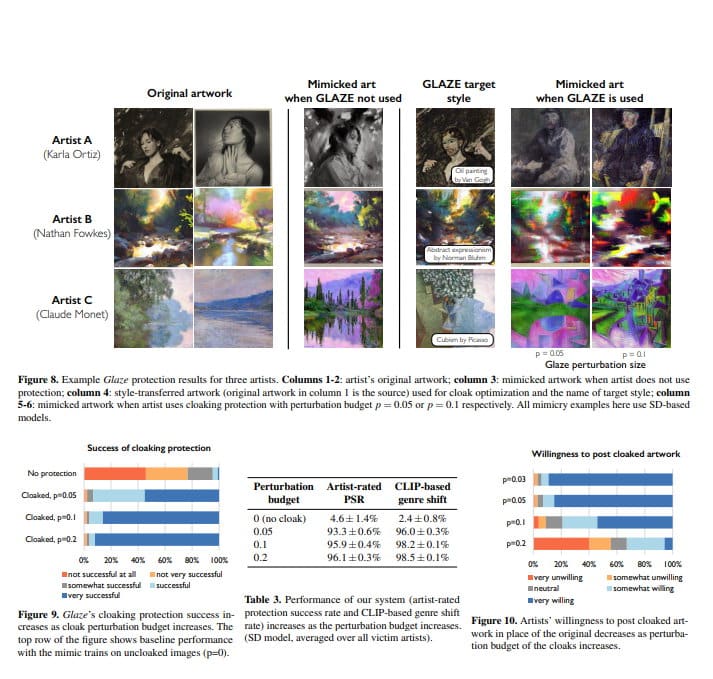
Examples of reproduced styles of two very well-known artists without (images left) and with the use of glaze (right) (Image: Shawn Shan et al.)
Beyond unresolved legal issues concerning copyright, intellectual property, and artistic consent for use, it is clear that these AI models have significant negative impacts on independent artists. For the estimated hundreds of thousands of independent artists
worldwide, most work on commission and attract clients by promoting samples of their artwork online.
Professional artists undergo years of training, developing their individual artistic style. The AI model also relies on imitating existing styles and benefits from training with them, without compensating the artists responsible. This effectively ends their ability to earn a living.
The imitation of synthetic art by popular artists continues to increase. This pushes original artwork out of search results, further impairing the artist's ability to promote themselves and showcase their work to potential clients.
Ultimately, these copycat attacks demoralize art students training to become future artists. Art students see their future careers being replaced by AI models.
Fear of marketing one's own art
Artists are afraid to publish new work on online platforms, Ben Zhao, a computer scientist involved in the project, told the US newspaper. They fear that by doing so, they are "feeding the monster, which is getting bigger and bigger.
This would destroy their business model. Therefore, they developed a tool that allows them to make artworks available for download, slightly modified to make it impossible for AI technology to recognize a style. A test with 1,000 artists showed that Glaze is extremely effective.
It quickly became apparent that AI image generators like Stable Diffusion or Midjourney could be used to mimic the style of individuals after their success last year. The case of Polish digital artist Greg Rutkowski, whose style was frequently copied, made this clear.
He told the New York Times that he "significantly fewer requests" for illustrations of his work. This criticism had also reached those who developed Stable Diffusion, and as a result, the AI no longer generates art in Rutkowski's style.
The conflict is escalating
The Chicago team explained that artists can upload their work to Glaze and choose a different style, which minimally alters the artwork and prevents it from being used as training material for AI systems. This allows the work to be posted online without the risk of AI learning the style.
However, they admit that this isn't future-proof and that countermeasures will eventually be found. In the meantime, new works can be protected. Versions for Windows and Mac are planned, and they hope for widespread distribution. Rutkowski intends to use Glaze.
Raymond Ku, a copyright expert, told the New York Times that he expects some kind of compensation system to be developed soon, from which artists will receive minor financial compensation if needed.
The conflict is likely to escalate further until that point.
Owner and Managing Director of Kunstplaza . Publicist, editor, and passionate blogger in the fields of art, design, and creativity since 2011. Graduated with a degree in web design from university (2008). Further developed creative techniques through courses in freehand drawing, expressive painting, and theatre/acting. Profound knowledge of the art market gained through years of journalistic research and numerous collaborations with key players and institutions in the arts and culture sector.
A fundamental need for every artistically creative person is likely to be the ability to live off their art.
To secure one's livelihood, earning money through art is essential . In fact, contrary to popular belief, many artists today can make a good living from their creative work. Nevertheless, the vast majority of freelance artists still rely on additional sources of income (e.g., teaching courses, commissions, side jobs, etc.).
Recognition as an artist often does not bring immediate financial security. Therefore, artists are often also life artists.
The opportunities to make a living from one's own art have, however, grown significantly due to the internet and social media. As an artist, however, you must be versatile and flexible to succeed. A certain degree of perseverance is also essential.
Customer relations and self-marketing are also important pillars for success as an artist.
In this section, we compile numerous articles, information, tips, and advice to help you make a living from your art.
We use technologies such as cookies to store and/or access device information. We do this to improve your browsing experience and to display (non-)personalized advertising. If you consent to these technologies, we can process data such as browsing behavior or unique IDs on this website. Refusal or withdrawal of consent may adversely affect certain features and functions.
Functional
Always Active
Technical storage or access is strictly necessary for the legitimate purpose of enabling the use of a specific service expressly requested by the subscriber or user, or for the sole purpose of carrying out the transmission of a message over an electronic communications network.
Preferences
The technical storage or access is necessary for the legitimate purpose of storing preferences that were not requested by the subscriber or user.
statistics
Technical storage or access that is solely for statistical purposes.Technical storage or access that is used solely for anonymous statistical purposes. Without a subpoena, the voluntary consent of your internet service provider, or additional recording by third parties, the information stored or retrieved for this purpose cannot generally be used to identify you.
marketing
Technical storage or access is required to create user profiles, to send advertising, or to track the user on one or more websites for similar marketing purposes.




 J-Line table lamp with natural rattan shade, black metal base
119,00 €
J-Line table lamp with natural rattan shade, black metal base
119,00 €