In today's often highly rationalized art world, the value of intuition in the creative process is easily lost. From the perspective of decades of experience as an engineer and artist, Johann Kralewski examines the phenomenon of implicit knowledge at the intersection of science, philosophy, and studio work.
Intuitive thinking as a driving force for artistic innovation
The essay explores why purely factual knowledge blocks creative progress and how intuitive thinking acts as a driving force for artistic innovation. Echoing Picasso's credo "I do not seek, I find," the text advocates for a more inclusive approach to factual knowledge.
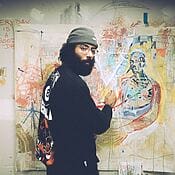
The Second Brain – Thoughts on Implicit Knowledge in Art. An essay by the artist Johann Kralewski. Photo by Alex Shuper @alexshuperart, via Unsplash
As someone who came to art from another field, my world about thirty years ago was built more from sheet metal and screws. I came from a world where things had to work, where solutions had a specific purpose, and where mistakes were to be avoided as much as possible. And yet, there was something in the back of my mind. A certain nonconformity, perhaps, that made thinking outside the box seem appealing. At the time, I didn't know that this very perspective would one day become more important than much of what technology had to offer.
In my first creativity workshop, which I held for my employees, the focus was still specifically on sheet metal and screws. I concluded with a quote from Picasso: "I do not seek, I find." A contradiction? Apparently so.
Because, consciously or unconsciously, we are constantly searching. In the chaotic office, for the car keys. On the internet, for a potato soup recipe. For a solution to a technical problem. Or for an explanation for something that eludes our previous experience. I understand art as nothing other than a permanent process of searching. A process in which failure is not necessarily the opposite of success, but sometimes its complement.
Besides all the methods and techniques for solving a wide variety of problems, and besides the rapidly developing and occasionally fetishistic AI, there is something that cannot be so easily transformed into a method: intuition.
A problem-solving technique for lazy people?
Or perhaps a skill we have forgotten how to take seriously.
Even in business, important decisions have never been made solely on the basis of numbers, facts, and calculations. Experience, feeling, and intuition play a role—sometimes a decisive one. During one of my creativity training courses, I came across the concept of implicit knowledge, also "tazitic knowledge ." At the time, I took note of it rather casually, without giving much thought to its true implications.
Today he seems much more interesting to me. He has also been studied in depth by several scientists. Tazite's knowledge is knowledge that we possess and apply without being able to fully explain it. We know something without being able to say exactly where we got it from. We recognize something without being able to explain the path to this recognition step by step.
A knowledge that we ourselves sometimes know nothing about
The philosopher and theorist of science Michael Polanyi has described this phenomenon in detail. He points out that, especially in scientific work, a significant part of the knowledge acquisition process is not entirely reducible to rules and formulas: A problem is identified, one approaches it, and is guided by an inner sense of orientation.
I would replace the word "scientist" in this description with the word "artist" without much hesitation.
And then, as this article was almost finished, I came across a thought in Aristotle. That was a bit of a surprise for me. Aristotle does distinguish between epistēmē, knowledge in the narrower sense, and téchnē, art or skill. He certainly doesn't equate the two. But he treats them as different forms of rational knowledge. His description of téchnē is particularly interesting: it is directed toward the production of something—something that could also be otherwise.
This comes remarkably close to the artistic process. The artist decides – and sometimes only knows why afterward. And sometimes not at all. Perhaps this is precisely where the path leads us to the title of this text: The Second Brain.
It's good to know we have a friend who can help us in many situations. A friend we can trust if we give them some space and time. Above all, we mustn't overwhelm them with our knowledge. Because knowledge has a peculiar quality: it focuses our attention on what is already known. It shows us what has worked, what has been proven, and what we have learned from the past.
Those who rely solely on existing knowledge risk remaining trapped in the confines of the past. They might make fewer mistakes, but they also don't move forward. The second brain, however, seems to do something different. It connects experiences, impressions, feelings, and knowledge without constantly asking our permission. It works in the background, searching for connections while our conscious mind still believes it isn't even looking.
In this sense, Picasso's famous quote could also take on a different meaning: "I do not seek, I find."
Perhaps Picasso simply left the searching to his second brain. And finally, a sentence, this time from a scientist:
Imagination is more important than knowledge, because knowledge is limited
Johann Kralewski, born in 1949, lives and works as a sculptor, painter, and graphic artist in Islisberg and Locarno. His professional identity lies at the intersection of science and art. After training as a chemical technician and photographer, he completed a degree in metallurgy in 1977 and worked successfully for decades as a graduate engineer in industry, where he registered numerous patents.
Around the turn of the millennium, Kralewski shifted his focus to artistic creation. From 2001 to 2003, he initially studied at the Institute of Fine Arts at Philipps University of Marburg under Prof. Eckhard Kremers, specializing in screen printing, lithography, drawing, and project development. During this period, he engaged intensively with the informal, anti-intellectual art of Art Brut by Jean Dubuffet, as well as the expressive painting of Francis Bacon.
His artistic process today is characterized by an intuitive and often parallel working method. Alongside painting and drawing, he creates expansive, interdisciplinary installations that combine sculpture, sound art, and performance. His works—especially the traveling sculpture series "The Pilgrims" —are exhibited in public and institutional spaces and reviewed in the media. In his own texts, he reflects on the creative processes behind his cycles, exploring the intersections between art, society, and the unconscious.
We use technologies such as cookies to store and/or access device information. We do this to improve your browsing experience and to display (non-)personalized advertising. If you consent to these technologies, we can process data such as browsing behavior or unique IDs on this website. Refusal or withdrawal of consent may adversely affect certain features and functions.
Functional
Always Active
Technical storage or access is strictly necessary for the legitimate purpose of enabling the use of a specific service expressly requested by the subscriber or user, or for the sole purpose of carrying out the transmission of a message over an electronic communications network.
Preferences
The technical storage or access is necessary for the legitimate purpose of storing preferences that were not requested by the subscriber or user.
statistics
Technical storage or access that is solely for statistical purposes.Technical storage or access that is used solely for anonymous statistical purposes. Without a subpoena, the voluntary consent of your internet service provider, or additional recording by third parties, the information stored or retrieved for this purpose cannot generally be used to identify you.
marketing
Technical storage or access is required to create user profiles, to send advertising, or to track the user on one or more websites for similar marketing purposes.







 Vintage chest of drawers in factory design, wood + aluminum
1.485,00 €