The cultural and creative industries (CCI) are considered one of the most future-oriented sectors. Their importance to both society and the economy is particularly evident in their role as a driving force for innovative product and service developments.
This sector plays a key pioneering role in the transition to a knowledge-based economy. The economic importance of the cultural and creative industries should not be underestimated.
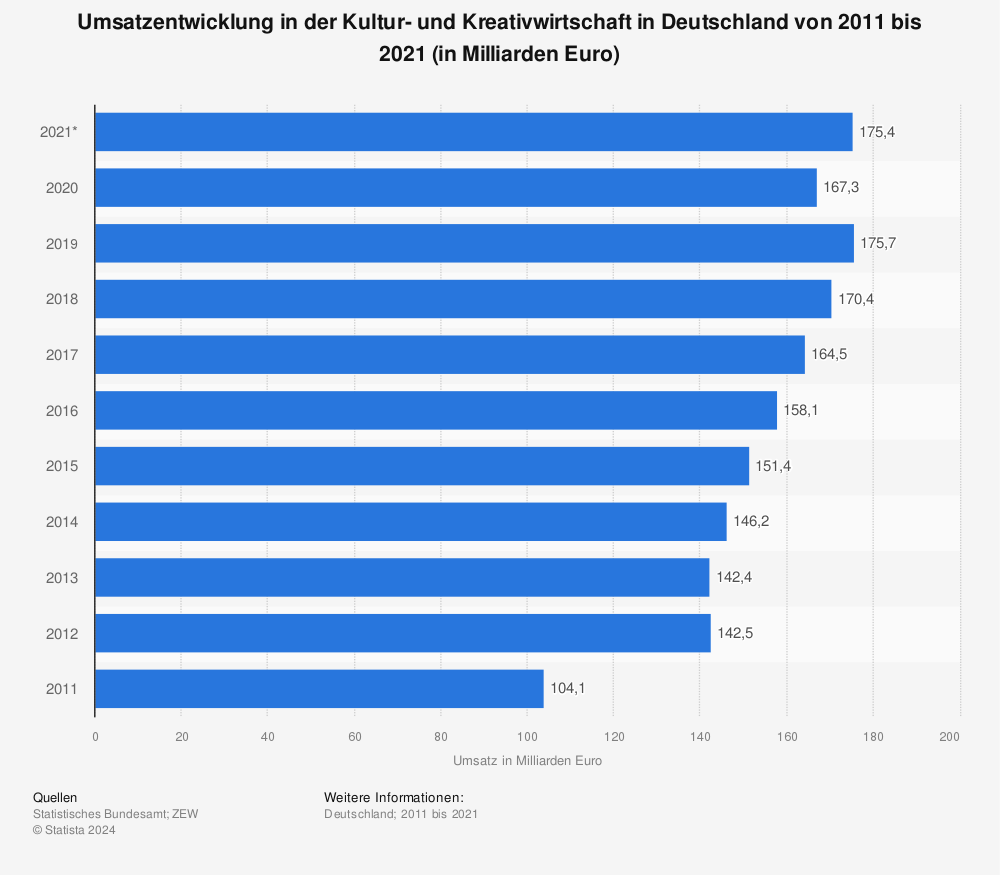
In 2021, approximately 226,000 companies with around 1.81 million employees generated total revenue of €175.4 billion. This sector contributes approximately €103.7 billion to the value added of the Federal Republic of Germany and can now compete with traditional industrial sectors. It is slightly above the level of mechanical engineering and ahead of other sectors such as the automotive industry, financial services, energy supply, and the chemical industry ( see sources #1 and #2 ).
Source: Statista
The nuclear power plant thus acts as an important economic factor, which is of great importance to this country and its people, both economically and innovatively.
The entire economic sector recorded impressive figures in 2021, particularly in the software and games industry . With annual revenues exceeding €56 billion, this sector dominates the market, generating a remarkable 29 percent of total revenues. Furthermore, the software/games industry achieved the highest value creation within the sector (a remarkable 36.4 percent).
advertising and press markets also presented themselves as significant sub-sectors of the cultural and creative industries, each with a turnover of almost 30 billion euros.
The design industry leads the list in terms of the number of companies in this sector, with over 52,000 active businesses, including sole proprietorships. The software/games industry and the architecture industry follow, with approximately 41,000 and 35,000 companies respectively.
According tothe 2022 Monitoring Report on the Cultural and Creative Industriesby the Federal Ministry for Economic Affairs and Energy, the art market is surprisingly one of the smallest sub-markets of the cultural and creative industries in terms of added value and revenue. This includes, in particular, the many visual artists and galleries, the art trade, auction houses, and museum shops.
This fact was particularly surprising to us because, in our view, the art market occupies a special place within the multifaceted world of cultural institutions. It continuously provides new impetus and significantly shapes the art world.
Nevertheless, total sales in the German art market in 2021 amounted to "only" around € billion . The largest revenue shares were generated by the retail sale of artworks (37.8%) and independent visual artists (34.8%). Both artists and museums recorded declining sales in 2021. A total of 44,405 people were employed in the art market ( see source #1 ).
So far, a significant sector of the German economy, namely the skilled trades , has not been explicitly mentioned as part of the KKW (Cultural and Creative Industries Concept). This is particularly noteworthy, as many craft businesses are known to carry out diverse cultural and creative economic activities.
For example, stained-glass artists produce church windows, experienced metalworkers manufacture organic metal facade elements for modern architecture, painters and varnishers revive historical rooms with colors of past eras, and organ and harmonium builders sell high-quality instruments worldwide.
Should artistic contributions of craftsmanship (like these stained-glass windows) be considered part of the creative industries in the future? Photo by K. Mitch Hodge @kmitchhodge, via Unsplash
Is the concept of the creative industries not precise enough or even deficient in that it has so far excluded the contribution of skilled trades?”
The basis for the definition and delimitation of nuclear power plants that has been valid to date is the recommendations of the Conference of Economics Ministers at their meetings in June and December 2009.
It may be necessary to expand its classification in the future to include craft-specific activities.
Previously there was no separation between art and craft
In earlier times, painters and sculptors were skilled craftsmen who mostly used their artistic abilities in the service of the rich and powerful. Emperors, kings, princes, and clergy commissioned them to create portraits, historical scenes, and religious depictions.
The themes and commissions were dictated by the clients, leaving artists little room for their own creative ideas. Art was primarily seen as a technical skill and less as an expression of individual visions.
The concept of the “artist” as an independent and creative individual developed later. In France, the first differentiation occurred in 1647 with the founding of the Royal Academy of Painters and Sculptors ( Académie royale de peinture et de sculpture ). This step marked an important milestone in the recognition of artists as independent creative personalities who were not only technically skilled but also artistically inspired.
Today, art and craft merge into a harmonious unity under the term “craftsmanship” , in which both aesthetic design and craftsmanship are equally valued.
Have the cultural and creative economic activities of the skilled trades received too little attention?
This question was already investigated in 2011 on behalf of the then Federal Ministry for Economic Affairs and Technology . A comprehensive analysis of cultural and creative industry activities in the skilled trades was commissioned and a study was conducted.
This study was conducted in cooperation with the Institute for Small and Medium-Sized Enterprises and Crafts at the University of Göttingen and the Office for Cultural Economics Research in Cologne . The results promise to provide deeper insights into the significant potential of crafts within this sector ( see source #3 ).
The analysis of craft activities two main objectives . Firstly, reliable data on crafts within the core area of the cultural economy were to be collected. Secondly, data on creative economy activities in crafts that extend beyond this core area were to be gathered. This means identifying craft activities and related economic sectors that, while adhering to the principles of the cultural economy, have not yet been considered in the concepts of the Conference of Economic Ministers.
We will refer to excerpts from it below.
The study revealed that this sector is subject to constant change, which is why the classification model must remain flexible. In Germany, discussions are already underway regarding the inclusion of other sectors such as musical instrument production, handicrafts, and photography.
This suggests that, in addition to the eleven sub-markets known so far, there are other areas in which many companies are active in the cultural and creative industries, including in the skilled trades .
This economic sector is distinguished by its innovative activities. Its unique problem-solving skills allow it to maintain close contact with its clients and offer a wide range of training and qualification opportunities in the field of design. In doing so, it impressively combines innovation, creativity, form, and design.
In this context, one can certainly speak – analogously to the fine arts – of a creative act and a “work” as a result. It can therefore be argued that craft products and services create significant added value in the cultural and economic sector.
In addition, the study 7 fields of activity of the crafts within the cultural and creative industries spectrum:
Restoration / Preservation of cultural heritage
Preservation of traditional cultural techniques
Design / Layout
Architectural culture
Arts and crafts / Applied arts
Musical instrument making
Creative services
Furthermore, several important trades were examined in detail in the form of fact sheets. These included:
The summary can be interpreted as suggesting a revision of the classification of the cultural and creative industries, taking into account the contributions of the crafts sector.
Empirical study shows: Craft products and services provide significant added value for the cultural and creative industries. Photo by Quino Al @quinoal, via Unsplash
For the year 2010, the study recorded approximately 15,700 companies in 22 sectors. These employed almost 48,000 people and generated a turnover of about 3.4 billion euros. Most craft businesses operated in the fields of photography and the manufacture of jewelry, goldsmithing, and silversmithing.
According to the results of the empirical survey, a total of 55,232 craft businesses were predominantly active in the cultural and creative industries. Within this sector, the craft industry thus represents approximately 5.4% of all businesses, employing 4.4% of the workforce and accounting for 2.6% of total revenue.
Exemplary examples of craftsmanship from practice
Up to this point, we have primarily focused on a scientific and theoretical classification of the skilled and creative contributions of crafts to our economy and have been able to determine how diverse and substantial these services are for our value creation.
Now we would like to take a closer look at some impressive examples from practice that reinforce the results of the empirical analysis cited above.
Plumbers can do art
Aside from the fact that both words begin with a "K", one wouldn't necessarily make an association at first glance. But that's far from the truth. Numerous practical examples demonstrate a remarkable connection between plumbing craftsmanship and artistry.
Take, for example, an old fort at the entrance to the port of Marseille, which was transformed into a museum in 2013 and is now part of the "Museum of European and Mediterranean Civilisations ." Fort St. Jean, built in 1660 by Louis XIV, once served as a defense against rebellious inhabitants in southern France. After various uses, including as a prison and barracks, the fortress was converted as part of Marseille's year as European Capital of Culture in 2013.
The Museum of European and Mediterranean Civilisations is located in the Old Port of Marseille. Image source: Kent Wang from Barcelona, Spain, CC BY-SA 2.0, via Wikimedia Commons
A modern exhibition hall, constructed from classic reddish building materials and clad in copper elements, captivates visitors. The use of perforated copper in varying lengths and arrangements lends the building a unique aesthetic. The fusion of historic fortress and contemporary museum creates a fascinating experience for visitors of all interests – especially for enthusiasts of modern German plumbing technology.
Another copper attraction . After leaving the shrouded staircase and entering the upper platform, you will be greeted by an impressive artwork made of copper pipes , which provides pleasant shade. The pipes have been intricately bent into an intricate structure reminiscent of the delicate tendrils of a grapevine.
This impressive structure invites visitors to approach and admire the many details revealed in its intricate copper weave. It is a masterpiece of metalwork and a real eye-catcher that never fails to amaze (see source #4).
That plumbers can possess a creative streak is also proven by Ulrich Berthold from Gersdorf. The trained plumber has dedicated himself to his artistic passion for an impressive 32 years. His skills are not limited to repairing faucets and gas stoves; for decades, he has been bringing impressive works of art to life in his modest garage.
He recently gave the public a fascinating insight into his work through an impressive exhibition of his works, as reported by the Freie Presse ( see source #5 ).
That plumbing is a true craft is also shown by a report ( see source #6 ) about the young Christoph Beiercompleted his training at the roofing and plumbing company Leib in Moorenweis ( .
It's quite common for plumbers and HVAC technicians to be confused. This misconception has historical roots. In the past, it was common for plumbers to also perform plumbing work. Even today, there are still plumbers who offer additional plumbing services from a single source, such as the pipe cleaning service in Munich offered by the plumbing company N & J GbR.
The core tasks of a metalworker involve bending, folding, cutting, and welding sheet metal in workshops or on construction sites to shape it as needed. These workpieces are then used to create components for metal roofs and facades, which the tradespeople also install or repair. They also take care of elements such as gutters, ventilation ducts, and window sills.
In addition to these tasks, plumbers also create handcrafted objects, such as ornaments, lanterns, vases, or the classic weathervane. These activities require a high degree of craftsmanship, good hand-eye coordination, and meticulous attention to detail.
Overall, the profession of plumber is extremely versatile and demanding, as it requires both manual dexterity and artistic talent.
The profession of plumber or coppersmith is undoubtedly one of the most traditional crafts, with origins that can be traced back to ancient Egypt. We learn this during a visit to the European Plumber and Coppersmith Museumin Karlstadt, Lower Franconia.
European Plumbers' and Coppersmiths' Museum in Karlstadt (Bavaria) Image source: Salino01, CC BY-SA 3.0, via Wikimedia Commons
The museum, housed in a futuristic building, contains an impressive collection of antique machines, tools, documents, and journeyman and master pieces from the tinsmithing, plumbing, sheet metal work, and coppersmithing trades. The Munich Plumbers Guild also has a workshop on display there. A visit is therefore highly recommended for anyone who works with metals professionally.
This museum not only commemorates the millennia-old tradition of these trades, but also passionately presents modern and pioneering techniques in these professional fields.
The stonemason – craftsman and artist in one person
The way artistic and manual skills merge into a single profession can be clearly observed at the stonemasonry business Franke Naturstein ( see source #7 ). Here, they refer to poetic job descriptions such as...
The stonemason is a preserver of timeless beauty.”
However, the company's employees can only partially confirm this when they consider their practical experience. Restoration work undoubtedly occupies a significant place in our field of activity. This requires particular sensitivity in order to counteract and preserve damage caused by environmental pollution to church steps, facades, sculptural reliefs, or monuments.
When implementing new natural stone projects, stonemasons are challenged to contribute their own creativity and develop innovative solutions.
The various tasks of a stonemason include not only gravestones, memorials, monument preservation and restoration, but also artistic activities such as creating new sculptures or statues. They are also involved in construction and landscape design projects.
Tobias Kabel also gives us a fascinating insight into the profession of stonemason. In the following video, he shows us how one of his best pieces is made: a pointed arch tracery window with a quatrefoil made of sandstone.
Closing remarks
Both theoretical considerations, scientific analysis, and practical observations paint a clear picture: craftsmanship undoubtedly makes a remarkable contribution to the cultural and creative industries. It makes a fundamental contribution to our economic performance and is a powerful engine for ingenuity and innovation.
As far as we have information, there has been no reclassification by the Conference of Economic Ministers that takes into account the value-added share of the skilled trades in the nuclear power plant sector.
The need for it remains, however! We'll see what the future brings.
Sources:
Federal Ministry for Economic Affairs and Climate Action:Monitoring Report on the Cultural and Creative Industries 2022, https://www.kultur-kreativ-wirtschaft.de/KUK/Redaktion/DE/Publikationen/2022/monitoringbericht-kultur-und-kreativwirtschaft-2022.html
Institute for Small and Medium-Sized Enterprises and Crafts at the University of Göttingen (ifh Göttingen) & Office for Cultural Economics Research (KWF) Cologne:“Crafts in the Cultural and Creative Industries” Final Report (Oct 2011) , https://www.kultur-kreativ-wirtschaft.de/KUK/Redaktion/DE/Publikationen/2011/handwerk-in-der-kultur-und-kreativwirtschaft.pdf
Plumber's Magazine:Art made of copper , https://www.klempnerhandwerk.de/kunst-aus-kupfer-21082013
Freie Presse : When the plumber becomes an artist , https://www.freiepresse.de/zwickau/hohenstein-ernstthal/wenn-der-klempner-zum-kuenstler-wird-artikel12152818
ZEITonline : True Craftsmen: How do I become a plumber? , https://www.zeit.de/news/2020-08/10/wie-werde-ich-klempnerin
Franke Natural Stone : The Stonemason – Craftsman and Artist , https://www.frankenaturstein.de/der-steinmetz-handwerker-und-kuenstler/
Owner and Managing Director of Kunstplaza . Publicist, editor, and passionate blogger in the fields of art, design, and creativity since 2011. Graduated with a degree in web design from university (2008). Further developed creative techniques through courses in freehand drawing, expressive painting, and theatre/acting. Profound knowledge of the art market gained through years of journalistic research and numerous collaborations with key players and institutions in the arts and culture sector.
We use technologies such as cookies to store and/or access device information. We do this to improve your browsing experience and to display (non-)personalized advertising. If you consent to these technologies, we can process data such as browsing behavior or unique IDs on this website. Refusal or withdrawal of consent may adversely affect certain features and functions.
Functional
Always Active
Technical storage or access is strictly necessary for the legitimate purpose of enabling the use of a specific service expressly requested by the subscriber or user, or for the sole purpose of carrying out the transmission of a message over an electronic communications network.
Preferences
The technical storage or access is necessary for the legitimate purpose of storing preferences that were not requested by the subscriber or user.
statistics
Technical storage or access that is solely for statistical purposes.Technical storage or access that is used solely for anonymous statistical purposes. Without a subpoena, the voluntary consent of your internet service provider, or additional recording by third parties, the information stored or retrieved for this purpose cannot generally be used to identify you.
marketing
Technical storage or access is required to create user profiles, to send advertising, or to track the user on one or more websites for similar marketing purposes.







 Metal sculpture "Big Lips", abstract aluminum art
95,00 €
Metal sculpture "Big Lips", abstract aluminum art
95,00 €


