
WTAWT or the opposite: Three Studies of Lucian Freud (Triptych)

If you click on "WTAWT" ("What the Artist Wants to Tell"), you can expect fun. Pure fun, crazy fun, silly fun – and yet, once again, not fun that can do without some background knowledge. You can have fun without background knowledge with your dog in the park, but even during joyful interaction with another person, it would be good if you had some idea of what you're doing...
And when WTAWT aims to present the world's most famous paintings in a fun way, a little background knowledge about these paintings is essential. But don't worry, we're keeping things lighthearted; most of the text is really just there to spark your imagination and, ideally, make you laugh now and then.
This time we would like to present the work of an artist that became the most expensive artwork ever auctioned in the world on November 12, 2013. And since the highest prices for artworks are now only achieved at auctions, this work is currently the most expensive painting in the world.
With the following limitations: It's possible that another painting has already been auctioned for an even higher price. You'll find out soon enough when another article in the WTAWT category discusses that artwork. It's also possible that a mafia boss or a dictator who fled into exile with his people's money paid even more for a work of art, but that, unfortunately (thankfully), is outside our sphere of knowledge and therefore cannot be covered in the WTAWT category.
The most expensive painting in the world is therefore that of Francis Bacon. By whom, with what subject, for what reason was it painted (and why is it so expensive)?
The painting, by Francis Bacon, depicts Lucian Freud three times, as it is a triptych. It is also titled "Three Studies of Lucian Freud (Triptych)," and was painted by Bacon in 1969. Forty-four years later, at Christie's auction in New York in November 2013, this triptych sold for $142.4 million.
Francis Bacon (28.10.1909 – 28.04.1992) is an Irish painter who, in the period after World War II, became one of the most important painters of the 20th century, with growing international significance.
Francis Bacon painted this picture because he mainly deals with the depiction of the human body in his (representational) paintings, and it probably shows Lucian Freud because he had been friends with him for over two decades.

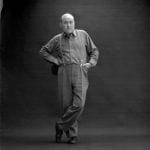
by Reginald Gray [CC-BY-SA-3.0], via Wikimedia Commons
Each panel of the triptych has the typical Bacon canvas size of 198 x 147.5 cm, which he most often used. The reason given was that his studio didn't allow for larger dimensions. For any curious person, the question immediately arises as to why his studio didn't allow for dimensions larger than 2 x 1.5 meters; after all, Bacon surely had sufficient financial resources for most of his career to afford a spacious studio.
A valid point, a surprising answer: Bacon did indeed have a studio that, for a period of about 30 years (with interruptions), was unsuitable for larger canvases. It was the upper floor of an old coach house in the Reece Mews in the London borough of South Kensington, with a narrow wooden staircase for access and tiny windows.
Bacon had made himself quite comfortable in this coach house studio, with a simply and modestly furnished living space and a tiny but totally focused studio room, featuring a window on each side and a skylight. Almost chaotically cluttered with work materials and paintings, this small room in the center offered just enough space for the easel with the painting Bacon was currently working on; this working atmosphere is said to have greatly appealed to him and inspired him.
If the 147.5 cm measurement confuses you: The canvas measures 78 × 58 inches, a common canvas size for this unit of length. The odd measurements result from the conversion; one inch equals 2.54 cm. To be precise, the canvas measures 198.12 x 147.32 cm.
Like all of Bacon's paintings, this oil triptych lacks a protective varnish and is instead framed and glazed. As is often the case with Bacon's work, Lucian Freud, seated on a wooden chair in the center of the painting, is surrounded by a cage-like structure of lines. These create a kind of room within a room, excluding the viewer. Although it is a triptych, this depiction, like all of Francis Bacon's, is not intended to tell a story. It simply shows three Lucian Freuds, without any connection to one another, without any meaningful references or suggestion of a dramatically structured narrative.

from procsilas (Flickr) [CC-BY-2.0], via Wikimedia Commons
Bacon himself once said that the Cinemascope format of widescreen cinema inspired the idea of triptychs. For some art historians, such an explanation is far too simplistic; they see a deeper meaning behind the three-part canvas and are reminded of altarpieces with hinged wings.
A viewer of the painting who is not trained in art history will likely often wonder why this work consists of three paintings, but will certainly have some other thoughts about "Lucian Freud" to consider beforehand, depending on their personal situation:
Alexander Steinfeld sees the artwork as a three-part poster in front of him every time he trains on the complicated machine. This machine is designed to simultaneously engage the quadratus lumborum, iliopsoas, rhomboid major, and latissimus dorsi muscles. That's probably why he hangs twisted in the machine, like a screw. Training deep abdominal muscles, the latissimus dorsi, and the rhomboid major at the same time must be almost impossible.
He would have considered it possible that he would have to hang upside down and at a slight angle downwards to train all these muscles at the same time; and he would have done exactly that if necessary, because if you want to look good, you have to do something for it.
" Ultimate Workout" is the hottest fitness club in Düsseldorf, and Alexander Steinfeld is happy that he gained access through a business acquaintance. Alexander Steinfeld has always seen the poster as a useful motivator, especially because of the truly well-trained and strong physiques depicted in the three images.
Having just heard that the original sold at auction for over $140 million, his motivation is even stronger. If it's possible to generate such revenue with a few such mundane images, that's truly impressive. Moreover, for a good-looking person with a perfectly toned physique, it's also possible to reach the pinnacle of the business world.
Alexander Steinfeld works as a motivational trainer for other prominent figures in the business world, charging €85 per individual session and €2,375 per seminar, earning a net income of around €15,000 per month. But those who aspire to great heights naturally have to maintain a corresponding lifestyle… well, "maintain" is perhaps too strong a word. His apartment is tiny and located far out in the country, and no one ever sees it. But the office costs a pretty penny, as do the parties, business dinners, designer clothes, and the leased BMW… he practically never has more than €5,000 left over for investments.
Grumbling, he calculates during a particularly grueling training session how long he would have to work to raise the purchase price of the painting, in euros 106 million… With an investment at 10% interest, which is unfortunately no longer readily available everywhere, it would take around 300 years; with the current highest realistic interest rate, even for optimists, of around 4%, it would probably take 300 lifetimes, or even much longer, since the sums would increase much more slowly – the machine crackles loudly, and Alexander has lost the desire to calculate.
Although, thinks Alexander Steinfeld, and quickly calculates how much the 150 places advertised in the studio would actually generate. €350 per month x 150 training stations equals €52,500 per month, €630,000 per year – already a very promising start, but that would only amount to just under €11 million in 30 years, at 10%. But wait a minute, those 150 places have to be vacated every two hours, between 9 a.m. and 11 p.m., so that's 700 places at €350 each = €245,000, €2,940,000 per year.
Oh, nonsense, they're not all fully booked. But when he's training, the studio is almost always packed, and even if it's less crowded during the day, you can probably assume a 75% occupancy rate, so a good 500 customers, €2,100,000. Of those, probably 300 drink a bottle of Cristal in the lounge after their workout, usually two, for €345, making at least €180 profit. That's 300 x €360 (not even counting food, etc., the lounge is really buzzing), €108,000 a month, €1,296,000, + the €2,100,000 = €3.4 million, which is €60 million in 30 years – almost half is still missing.
Such high selling prices for paintings should simply be banned, and the painter certainly couldn't have imagined this calculation in his head; life is simply unfair, thinks Alexander, and in the course of the evening he treats himself to four bottles of champagne, with a very sweet, but unfortunately also very thirsty mouse.
Nathalie Bruchmüller is supposed to give a presentation on Lucian Freud for her art studies and is currently looking at an enlarged version of the triptych for the first time. She lets the image sink in and allows her thoughts to wander freely.
Not exactly a flattering portrayal; Lucian Freud looks a bit like Rocky might have looked if he hadn't defeated Ivan Drago. His face is an inarticulate blur of color in all three pictures, yet wasn't Lucian Freud (apart from the inherited, slightly bewildered, psychotherapeutic look he sports in many photos) actually quite handsome, unlike Francis Bacon?
Perhaps that was precisely it: a fellow student had just explained to her with absolute conviction that men were just as vain as women, especially artists and homosexuals, and perhaps Bacon couldn't cope with the fact that he was already developing sagging cheeks, while Freud, 13 years his senior, didn't even have the slightest wrinkles on his face... Ugh, how unfair – Nathalie has to admit to an artistic sublimation; after all, Bacon could paint the body positions with a flick of the wrist that she has been working on in vain for over a year.
But still, Bacon and Freud were good friends, so why would Bacon paint a friend like that? With friends who paint you like that, who needs enemies? Perhaps Lucian Freud was just as enthusiastic a gambler as Bacon, and Bacon owed him money he wanted to "work off" with a portrait? But no, Bacon had already painted his first pictures with distorted faces around 1948.
And Lucian Freud was not only the grandson of Sigmund Freud (which probably spoils the fun anyway), he was also a very serious and very busy painter, who in 1969 was already showing signs of becoming one of the most respected portrait painters of the 20th century in England; he certainly didn't gamble.
Freud was therefore also a competitor of Bacon, and the two regularly portrayed each other in their friendship of over 30 years (which, contrary to what is often written, began as early as 1945) – until the necessarily more down-to-earth Bacon had had enough of the snobbish, high-society-loving Freud in the mid-1970s.
However, it is well known that Bacon didn't care at all who the person sitting before him actually was. He was only concerned with depicting the body in a pose, not with his model; he didn't want to portray them in a recognizable or realistic way. "What's important for a painter is painting and nothing else," Bacon clarified shortly before his death in 1991.
So perhaps it wasn't an affront to a friend after all, and actually these mangled faces are faces that scream—the scream being a subject Bacon had firmly embraced since the early 1950s? Did Bacon, with this late scream in his painting, at least ironically suggest, during a period of agreement with Freud, that he was indeed the superior painter of the two? Or did he simply use his friend Lucian Freud to elicit a scream from him, a crowning achievement for all his source studies on the subject?
Bacon studied texts and image fragments related to screams; he was fascinated by Nicolas Poussin's "Massacre of the Innocents" as well as by a still from Sergei Eisenstein's film Battleship Potemkin, showing the nanny who had just been fatally wounded by a shot to the eye.
He even compiled a collection of medical photographs from books and magazines, close-ups of distorted mouths, teeth, and all manner of oral diseases. He was also said to have been impressed by Georges Bataille's article "La Bouche" (from 1930, in the journal Documents), which reveals the mouth as the vehicle for humanity's most significant experiences, whether food or drink, love or anger, pain or pleasure. Viewed in this light, perhaps it's not really about Lucian Freud at all, but about the scream itself, about anger or pain, fear or lust?
Nathalie shudders with anger. She simply can't make sense of this picture; surely one has a critical view of life when one constantly doesn't know how to pay off gambling debts, and it's no secret that too much alcohol doesn't exactly make you happy.
Francis Bacon is also said to have experienced a great deal of violence, from his father, from the insurgents of the Irish republican Sinn Féin movement (at that time the organization, also called the "political arm of the IRA", was not yet a party) and probably also from his long-time friend, George Dyer, who was known to be both depressed and prone to violence.
But isn't there another way to process this? In Nathalie's opinion, the triptych is far from Bacon's best work, not least because it evokes a depressing mood in the viewer. While processing painful experiences is certainly important, can't artists also offer their audience a bit of a break and highlight the more cheerful aspects of life?
Perhaps the blog commentator who recently dismissed the triptych as hastily sketched from three different perspectives and difficult to recognize against the ugly background color was right after all?
He also considers Jean-Michel Basquiat's works to be mediocre sketches by a talented seven-year-old, and Mark Rothko's paintings to be boring, flattened Twinkies (small, oblong cream cakes). Gerhard Richter paints with frogs freshly chopped in a blender, and Jackson Pollock's paintings as the result of warm-up exercises.
Harsh assessments, certainly not objectionable from the point of view of freedom of expression – if only this commentator didn't simultaneously make it abundantly clear that he has not the slightest idea of art as a source of ideas for a creative society (he interprets Warhol's "mediocre" work as an unoriginal reproduction of advertisements, Lichtenstein's paintings as comic art, and he has only ever seen one of Jeff Koons' balloon dogs).
Even if one doesn't necessarily have to join in the jubilation of Christie'sauctioneer Jussi Pylkkänen about the many bidders who can spend over 20 million on a painting – that's roughly like someone who can't read calling a poem by Sappho a failure because they don't like the look of the cola (rhythmic elementary units) used, or criticizing a poem by Baudelaire to the ground because it has too many stanzas.

You might also be interested in:




Design and Decor Highlights
-
 Maritime canvas painting "Malta", hand-painted
82,00 €
Maritime canvas painting "Malta", hand-painted
82,00 €
VAT included.
Delivery time: 3-6 working days
-
J-Line Semi-abstract nude painting "Nocturnal Nude", black and white fine art print, framed
225,00 €
VAT included.
Delivery time: 2-3 working days
-
Tribal decoration "shell necklace" in ethnic style, made from natural materials
49,90 €
VAT included.
Delivery time: 1-3 working days
-
J-Line wall decoration "3 African women", acrylic paint + rope mix on canvas
325,00 €
VAT included.
Delivery time: 5-8 working days
-
Little Party - Metal wall decoration
44,95 €
VAT included.
Delivery time: 3-5 working days
-
Rustic bar stool "Kedut" made from sustainable teak wood
169,00 €
VAT included.
Delivery time: 2-4 working days
-
Kitchen trolley made of lacquered reclaimed wood with rustic charm
595,00 €
VAT included.
Delivery time: 6-11 working days


