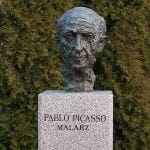
The artist “in himself” – many people immediately think of Picasso when such a phrase is uttered. Those interested in art don't simply accept this mental image and this status, but rather ask themselves why Picasso was assigned this role.
One could spend an entire art degree trying to find the answer, but even a few theories can give curious people a clue as to why Picasso's art is so famous and what secret lies behind it:
These 5: Simply rearrange the painting, and learn even more
The last section of this article discussed how the secret to Picasso's success certainly also lies in the fact that he never rested on his laurels, but was constantly searching for his own style even as a young artist. And that Picasso wasn't afraid to repeatedly experiment with radical changes in his style during this search, regardless of whether his potential customers liked it, and that he was usually proven right.
The fact that he remained right for almost his entire life also has its reason, because only those who constantly develop themselves and their knowledge can remain right in the long run, and that is exactly what Picasso did throughout his life:
Learning, always more, always…
The next famous painting on the list of examples presented at the beginning of this article is that of the women of Avignon: “Les Demoiselles d'Avignon” from 1907 has long been recognized by art historians as a “key painting of classical modernism” .
Picasso created a visual language unprecedented in the history of Western painting. "Les Demoiselles" represents a turning point, incorporating all the ideas that were converging on a Cubist style at the time – with this painting, Picasso officially launched Cubism .
In preparation for this composition, he thought through and dissected the European art tradition from its roots, starting with archaic art, then he studied the great masters across the centuries: from Uccello (1397 – 1472), Piero della Francesca (1420 – 1492), El Greco (1541 – 1614), Poussin (1594 – 1665) to IngresCézanne whom Picasso revered and whose late work exhibited an “essentially cubist” rhythmic structure.
From the elements he discovered, Picasso developed a new artistic language, not simply wanting to break with tradition to create something new. Rather, his aim was to destroy convention, the uncritical agreement about what art is and how it should be.
The Demoiselles are thus a unique reflection on painting and on art and its beauty, in the opinion of many art experts a deeper and more thorough reflection than has ever taken place in any other work of European painting.
What his contemporaries didn't immediately recognize was that the visual expression of the Demoiselles was initially described as a language of deformation, or they were categorized as Assyrian or Egyptian. Overall, people were rather perplexed by the works Picasso produced in the period of 1907 and 1908, which he himself called the période nègre (in the sense of “African-influenced”).
As is usually the case when someone comes up with something fundamentally new and is also a bit faster than their contemporaries… the role of the painting as a key work in modern art history is now just as undisputed as its far-reaching significance for the subsequent development of painting.
In this painting, Picasso used many elements of artistic representation in a completely new way, including, for example, the division of body shapes into delimited representational areas, and he dared to make an almost unprecedented change: In the painting "Les Demoiselles d'Avignon" he abandoned central perspective, which had been considered one of the most important achievements of artistic representation since the Renaissance.
Picasso depicts the five women in the painting from several perspectives simultaneously. This occurred after months of struggling with the form, and he thus followed one of the most modern intellectual currents of his time – his exploration of simultaneity in painting coincided with Einstein's exploration of this question in physics.
The “Demoiselles”, viewed with suspicion or rejection by contemporaries, languished for quite some time in Picasso’s studio. They were first presented to the (presumably also irritated) public in July 1916 at the “Art Moderne en France” exhibition and were finally bought directly from Picasso’s studio by the fashion designer and art collector Jacques Doucet in 1924.
And once again, Picasso was absolutely right
Just over a decade later, it became clear that Doucet had demonstrated good instincts with the purchase of “Les Demoiselles”: in 1939, the painting from Doucet’s estate was acquired by the Museum of Modern Art in New York for $28,000 at the behest of the far-sighted patron (and co-founder of MoMA) Lillie P. Bliss; in 2005, Heinz Berggruen $13.7 million for one of Picasso’s first studies for “Les Demoiselles”, a gouache.
Picasso was so disappointed by the reactions of his friends and critics after completing the painting that he kept it in his studio with the picture plane facing the wall. Unlike other unrecognized geniuses, however, he was at least able to experience recognition of the achievement expressed in this painting later in life, and the painting even brought him an immediate and significant benefit:
In connection with the commotion surrounding the painting, Picasso was introduced to Daniel-Henry Kahnweiler . The young German-French gallery ownerPicasso's works for the first time in 1907. Around the same time, Picasso also met the painter Georges Braque , and with whom he would establish Cubism over the next few years.
The painting "Les Demoiselles d'Avignon" exemplifies another of Picasso's outstanding qualities: he was a lifelong learner, and he was determined to continue learning throughout his life. "This openness to every new insight, to every new experience both external and internal, is the essence of modern man," Picasso recognized, somewhat ahead of the leading educational theorists of the 21st century.
And at the age of 26, he already had the courage to follow the insights he had gained through his own work – central perspective had been untouchable for subsequent painters since its “invention” by Brunelleschi and its manifestation by great painters like Giotto and Dürer; to abandon it was a real risk.
…and learning from the right teachers
Picasso consistently avoided consulting institutions and people who might discourage a student from learning. And when he did, he quickly and successfully completed the necessary steps and then turned to what truly advanced him: self-study, engaging with experts in the field, and travel.
This constant learning is the real reason why he was able to express many talents – for example, he first learned to see very clearly, and then began to explore this seeing spatially.
Thus, as an untrained sculptor, he was able sculptures that would have a major influence on 20th-century sculpture . Picasso had no great ambitions with this sculpture; he simply saw the three-dimensional works as a field for experimentation with his painting – and he experimented so well that the works inspired a whole range of contemporary sculptors to reconsider their work.
Picasso lived to be 91 years old and continued to paint or create something artistic – not because he was always so diligent, but because he always remained curious, Picasso left us a body of work that quickly makes our eyes water with awe when we look at it.
The previous sections of this article have already revealed part of the secret to Picasso's success: Picasso simply achieved extraordinary things as an artist, constantly evolving, reorienting himself, and learning throughout his life. However, this is still not enough to fully explain Picasso's success, as there are other components that will be explored in the following sections of this article.
If you are currently learning (or creatively developing) something that will take quite a long time, and you feel that after each chapter learned (or part of the project completed) you have at least an equally large task ahead of you, let yourself be comforted by the following quote from Picasso, he knew the feeling:
The worst part is, nothing is ever truly finished; there's never a moment when you can say, "I've done a good job, and tomorrow is Sunday." As soon as you stop, it's time to start all over again. You can leave a picture as it is and decide never to touch it again. But you can never write "The End" underneath it
The artist “in himself” – many people immediately think of Picasso when such a phrase is uttered. Art enthusiasts don't simply accept this mental image and this status, but rather ask themselves why Picasso was assigned this role. One could spend an entire art degree trying to find the answer, but even a few theories can offer curious minds a glimpse into why Picasso's art is so famous and what secret lies behind it:
These 6: Picasso's art helps us understand
The five sections of this article so far have already shed light on some of the secrets behind Picasso's success: exceptional talent from the very beginning, a knack for making the right connections, fearless artistic creation in constant evolution, no fear of reorientation, and lifelong learning.
But there is something else that is an important reason why Picasso became so famous: There are paintings by Picasso that have helped many people to understand their world at least a little better:
“Guernica” – the most famous anti-war painting in the world
“Guernica” from 1937 is famous because Picasso addresses war as a defining event of his time. He succeeds so powerfully in capturing the horrors of war and the shock it caused that Guernica is still considered the most important anti-war painting in the history of art.
In this colossal composition (349 x 777 cm, more than 27 square meters of picture surface), Picasso follows a path first taken by Goya with his “Desastres de la Guerra” in the 19th century: Here, the artist no longer acts as an employee of the nobility or the clergy, portraying a war as a kind of giant game with unfortunate but fairly treated losers on both sides, but rather he takes sides, placing the true victims at the center of attention.
Picasso achieves this through a masterful visual language“Guernica,” he consciously used very universal and simple forms that are understood (almost like a pictogram) by people around the world. In this way, he ensured that the message of this painting is understood beyond the European cultural sphere.
“Guernica” is a political indictment that opens up possibilities for action for people
With this painting, Picasso created a kind of "political propaganda art ," making a profoundly political statement without serving any specific political, military, or religious interests. He simply and fundamentally condemns war and destruction. No heroes, no perpetrators, no triumph of good.
Picasso depicts the total apocalypse with all its horrors , without documenting the events. According to experts, it is precisely through this generalized, uncommented depiction that he makes the horror accessible to emotional processing. Thus, the painting offers a path to healing psychological wounds, because it opens the possibility of overcoming the speechless powerlessness in the face of the horrific.
But if overcoming this paralyzing powerlessness allows people to develop a conscious anti-war stance, then “Guernica” achieve even more: Picasso will have presented a crucial work with “Guernica” that encourages human commitment against war.
This is also how “Guernica” is viewed – because of its ingenious visual language almost all over the world: The powerful anti-war image is one of the most published (“quoted”) images, whether as newspaper print, mural, poster, graffiti or billboard; “Guernica” also served as a model for many sculptures.
Many of the components responsible for Picasso's exceptional position among artists have now been addressed in this article, but two aspects are still missing, which will be shown in the last section.
Finally, here's a quote from Picasso to encourage you to look at lots of art and think about what a work of art is meant to say:
We all know that art is not truth. Art is a lie that teaches us to understand the truth, at least the truth that we as human beings can understand. The artist must know how to convince others of the veracity of his lies
In this sense, “learning to see art” not only helps to recognize the call to action against war in a picture like “Guernica”, but will also, conversely, protect you from being manipulated by “artistic representation”, e.g. in advertising, with financially damaging consequences.
The artist “in himself” – many people immediately think of Picasso when such a phrase is uttered. Art enthusiasts don't simply accept this mental image and this status, but rather ask themselves why Picasso was assigned this role. One could spend an entire art degree trying to find the answer, but even a few theories can offer curious minds a glimpse into why Picasso's art is so famous and what secret lies behind it:
These 7: Many works of art and many arts
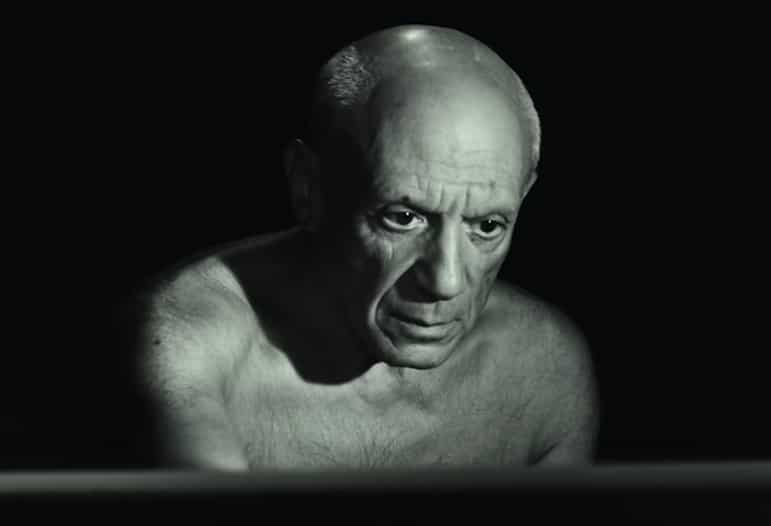
Century genius Pablo Picasso works with focused attention on one work
This article has already taught you a great deal about the reasons that Picasso and his artwork so exceptionally famous. To conclude, we will address two aspects that both contributed significantly to Picasso becoming a "myth" :
An incredible number of works of art
The first section of this article listed a few of Picasso's "particularly famous" works , noting that the list of his most famous works could go on for quite some time. This is indeed the case, and the sheer number of Picasso's artworks certainly contributes significantly to his status as an exceptional artist.
Watch Picasso paint a masterpiece
The last section just introduced the legendary anti-war painting “Guernica”. This means that this article has discussed works of art by Picasso created “El pequeño picador” ) and 1937 ( “Guernica”
These are works of art from 47 years of his activity, 36 years of “making art” lie behind the year 1937 and before Picasso… Picasso lived to be 91 years old, of these 91 years he devoted 85 to the art of painting and created pictures that are considered works of art for 83 years.
Picasso 600 works of art per year , that's 50 works of art per month, almost two works per day – or significantly more, considering that 809 preliminary studies are documented for the painting “Les Demoiselles d'Avignon” alone.
When a heart attack on April 8, 1973, brought his prolific output to an end, he is said to have left behind a total of around 50,000 works of art , and these works are consistently high quality rather than mass production, handcrafted by him and not reproduced by assistants like Andy Warhol – truly impressive!
Picasso “could do many arts”
Throughout this time, Picasso was only talked about as a painter , but another reason for the secret of his success lies in the fact that he was by no means limited to pictorial representation:
Picasso modeled 20 nude seated women and 28 women's heads (not to suggest that he had discovered the female brain at that time), 31 montages and 86 modern metal sculptures .
He produced prints , from 1919 to 1930 and again from 1945 onwards, lithographs , a series of one hundred prints between 1930 and 1937, from 1935 onwards a series of etchings of bullfights, in 1949 the Peace Dove (a typical peace dove by Picasso can be seen here , but he painted many), in 1968 two large series of etchings on bullfighting, circus anderoticism , and again and again commercial graphics , posters and book illustrations , calendar pictures , cards and music books .
Picasso designed sets and costumes productions, including Sergei Diaghilev's Ballets Russes in 1917, Manuel de Falla's opera "The Three-Cornered Hat" in 1919, Igor Stravinsky's "Pulcinella" in 1920, and Satie's ballet "Les Aventures de Mercure" in 1924. Some of his design sketches can be viewed at picassocinefilo.wordpress.com .
In the spring of 1947, Picasso moved into a ceramics studio and created nymphs and fauns from clay , decorated plates and platters with bullfighters and women, owls and goats, and also quickly invented a new, white clay mixture.
In 1949, together with the photographer Gjon Mili, various light paintingson photographic paper , so-called luminographies , in which he used a flashlight like a drawing pen.
Painting with light – Picasso and his luminograms
Picasso was also active in literature, leaving behind dozens of poems and two plays , 1941 “Le Désir attrapé par la queue” (translated into German by Paul Celan under the title “Wie man Wünsche beim Schwanz packt”) and 1948 “Les quatre petites filles” (Four Little Girls).
Even though you will probably need a little Picasso break after reading the seven sections of this article – there is much more interesting information about Picasso to share (see links to related articles above).
If you now have the impression that you have a vague idea of why Picasso is so extraordinarily successful, but still don't have the slightest idea how to understand a particular painting – just leave it be, look at art and be happy or annoyed by it, freely paraphrasing Picasso's saying:
Everyone wants to understand art. Why not try to understand a bird's song? Why do we love the night, the flowers, everything around us, without necessarily wanting to understand it? But when it comes to a painting, people think they have to 'understand' it
Owner and Managing Director of Kunstplaza . Publicist, editor, and passionate blogger in the fields of art, design, and creativity since 2011. Graduated with a degree in web design from university (2008). Further developed creative techniques through courses in freehand drawing, expressive painting, and theatre/acting. Profound knowledge of the art market gained through years of journalistic research and numerous collaborations with key players and institutions in the arts and culture sector.
We use technologies such as cookies to store and/or access device information. We do this to improve your browsing experience and to display (non-)personalized advertising. If you consent to these technologies, we can process data such as browsing behavior or unique IDs on this website. Refusal or withdrawal of consent may adversely affect certain features and functions.
Functional
Always Active
Technical storage or access is strictly necessary for the legitimate purpose of enabling the use of a specific service expressly requested by the subscriber or user, or for the sole purpose of carrying out the transmission of a message over an electronic communications network.
Preferences
The technical storage or access is necessary for the legitimate purpose of storing preferences that were not requested by the subscriber or user.
statistics
Technical storage or access that is solely for statistical purposes.Technical storage or access that is used solely for anonymous statistical purposes. Without a subpoena, the voluntary consent of your internet service provider, or additional recording by third parties, the information stored or retrieved for this purpose cannot generally be used to identify you.
marketing
Technical storage or access is required to create user profiles, to send advertising, or to track the user on one or more websites for similar marketing purposes.








 Organic wall mirror "Bosa", curved wooden frame (white, 46 x 61 cm)
39,00 €
Organic wall mirror "Bosa", curved wooden frame (white, 46 x 61 cm)
39,00 €