• Art Magazine
    • Art Magazine > Homepage
    • Architecture
    • Sculpture
    • Design
    • Digital art
    • Fashion Design
    • Photography
    • Freelancing
    • Garden design
    • Graphic design
    • Handmade
    • Interior design
    • AI Art
    • Creativity
    • Art Marketing
    • Art Periods And Movements
    • Art history
    • Art trade
    • Artists
    • Art Market Knowledge
    • Art scene
    • Works of art
    • Painting
    • Music
    • News
    • Product design
    • Street Art / Urban Art
    • Tips for artists
    • Trends
    • Living from art
  • Online Gallery
    • Online Gallery > Homepage
    • Categories
      • Abstract art images
      • Acrylic painting
      • Oil painting
      • Sculptures & Statues
        • Garden sculptures
      • Street art, Graffiti & Urban art
      • Nude Art / Erotic Art
    • Post new artwork
    • Browse art
    • Search for artwork
  • Design & Decor Shop
    • Shop > Homepage
    • Wall decoration
    • Canvas art
    • Metal art
    • Sculptures
    • Furniture
    • Lighting
    • Textile wall hangings
    • Mirrors
    • Home textiles
    • Home accessories
    • Watches
    • Jewelry
    • Outlet / Sale
  • My account
    • Customer area
    • For artists
      • Login
      • Register
The product has been added to your shopping cart.

Joseph Beuys – The controversial figure with the expanded concept of art

Lina Sahne
Lina Sahne
Lina Sahne
Sat. January 27, 2024, 6:22 p.m. CET

Want to read new articles immediately? Follow Kunstplaza Magazine on Google News.

Joseph Beuys is still not understood by many of today's critics, but he is undoubtedly one of the most important artists of the 20th century.

The performance artist, sculptor, draftsman, and art theorist redefined the concept of art by engaging with humanism and social philosophy, anthroposophy, and politics in his work. Beuys thus developed an "expanded concept of art"that demands creative participation from the artist in society and politics.

Even though opinions on the value of his artworks vary considerably, with this postulate he fulfills in an ideal-typical way a popular idea of ​​the artist who acts with interest and commitment and does not ask for material wealth.

His concept of art through school lessons and through his personal acquaintance with the Flemish painter introduced to art

Moortgat also awakened in the young Joseph an enthusiasm for Norse mythology, the youthful misinterpretation of which first led him to the Hitler Youth and then, in 1941, to volunteer for the Luftwaffe. There, he even earned the Iron Cross for his military service.

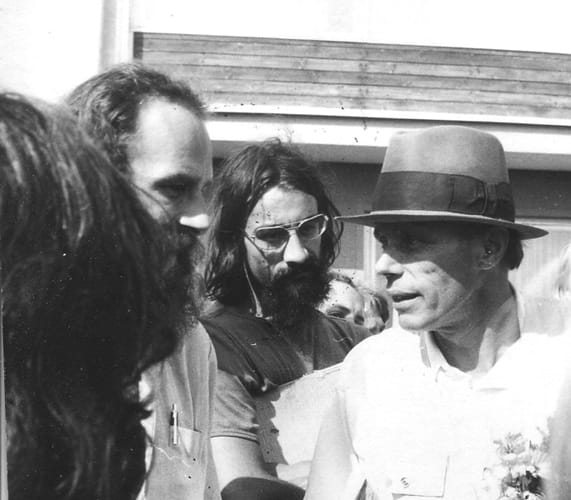
Joseph Beuys in Achberg (1973), photograph by Rainer Rappmann
<span=”style:font-size:0.7em;”>von Rainer Rappmann [GFDL], via Wikimedia Commons

During one of his five plane crashes in the war, Beuys suffered serious injuries and survived only because Crimean Tatars kept him from freezing to death with fat rubs and felt blankets until he received medical attention.

This explains the role that felt and fat later played in his art. Such experiences also quickly turned Beuys's never-absolute commitment to the military and party politics into a thing of the past, given his strict Catholic upbringing.

After his release from captivity, he finally decided to become an artist. He enrolled at the Düsseldorf Art Academy to study sculpture, joined the "Kleve Artists' Association," and in 1951 became a master student of the renowned Ewald Mataré.

During his time in the military, the nature-loving Beuys learned even more about zoology and botany from his instructor Heinz Sielmann; during his studies, he explored the ideas of Rudolf Steiner and anthroposophy.

Steiner's teachings, which place man at the center and aim to open access to supersensible potentials, were to decisively influence Beuys' path; they showed him the way to a mystical worldview.

Thus, after graduating in 1953, Beuys increasingly distanced himself from classical sculpture, struggling with his art and at times falling into deep depressions. When the Düsseldorf Art Academy appointed Beuys to the chair of monumental sculpture in 1961, he had already developed his expanded concept of art, invented "Social Sculpture," and caused a sensation with the statement that "every human being is an artist."

In the early 1970s, Beuys began to completely break away from the rules of academic life. He accepted students without regard to the admission criteria and was therefore dismissed from the art academy in 1972.

Beuys' work, which by this time consisted of installations and objects made from the most unusual materials, as well as paintings and drawings, achieved international recognition during this period, and he became one of the most expensive artists in the world. His concept of art largely met with incomprehension, sometimes even strong rejection, from the public; every public acquisition of his works sparked major debates.

Numerous scandals and minor scandals marked his further work: in 1973, two local politicians unknowingly destroyed his work “untitled (bathtub)” when they cleaned the supposedly dirty sanitary object and then used it to wash glasses.

's purchase of an object made of mortuary stretchers and fat, paid for 270,000 DM, was Lenbachhaus described as a "waste of taxpayers' money," and the object as the "most expensive piece of junk of all time."

which had just become famous through this event, "Fat Corner", as art and simply cleaned the artwork away.

Since then, art lovers have grappled with the concept of art as an idea, and even decades after his death, Beuys remains controversial in the art world. And yet, Beuys's understanding of art has influenced many subsequent artists.

The repeated scandals surrounding his artworks have also contributed, almost unnoticed but crucially, to anchoring the idea of ​​art as a society-shaping force in people's minds.

Lina Sahne
Lina Sahne

Passionate author with a keen interest in art

www.kunstplaza.de

You might also be interested in:

Salvador Dali with Babou the Ocelot (1965)Salvador Dalí – The eccentric Catalan and fame-seeking Surrealist Rosemarie Trockel: Portrait of a singular artistRosemarie Trockel: Portrait of a singular artist Georg Baselitz photographed by Lothar Wolleh, Mülheim, 1971Georg Baselitz – An artist turns pictures upside down Bust of Pablo Picasso in Celebrity Alley in Kielce, PolandPablo Picasso: Master of Cubism – Biography, work & life The spider sculpture Maman by Louise Bourgeois in BilbaoLouise Bourgeois – Pioneer of installation art

Seek

Similar posts:

  1. Salvador Dalí – The eccentric Catalan and fame-seeking Surrealist
  2. Rosemarie Trockel: Portrait of a singular artist
  3. Georg Baselitz – An artist turns paintings upside down
  4. Pablo Picasso: Master of Cubism – Biography, Work & Life
  5. Louise Bourgeois – Pioneer of Installation Art

Featured Art

  • Acrylic painting &quot;PERFECT MISTAKE&quot; (2024) by Edyta Grzyb, limited edition pigment print behind acrylic glass
    Acrylic painting "PERFECT MISTAKE" (2024) by Edyta Grzyb, limited edition pigment print behind acrylic glass
  • Pablo Picasso&#39;s poster design &quot;Dove of Peace&quot; (1961) for the International Peace Congress, Exclusive Edition
    Pablo Picasso's poster design "Dove of Peace" (1961) for the International Peace Congress, Exclusive Edition
  • &quot;Reclining Female Nude on a White Cushion&quot; (1917) by Amedeo Modigliani, limited reproduction
    "Reclining Female Nude on a White Cushion" (1917) by Amedeo Modigliani, limited reproduction
  • &quot;Two Ladies in a Café&quot; by Ernst Ludwig Kirchner (limited reproduction)
    "Two Ladies in a Café" by Ernst Ludwig Kirchner (limited reproduction)
  • Pop Art masterpiece &quot;Untitled, April&quot; (1985) by Keith Haring, reproduction on paper
    Pop Art masterpiece "Untitled, April" (1985) by Keith Haring, reproduction on paper

Design and Decor Highlights

  • Handwoven tapestry wall hanging &quot;Tibetan Child&quot; by Alison Wright, stretched on a frame and sound-absorbing Handwoven tapestry wall hanging "Tibetan Child" by Alison Wright, stretched on a frame and sound-absorbing 644,00 € – 944,00 €

    VAT included.

    Delivery time: 10-17 working days

  • Rattan pendant lamp &quot;Chapeau&quot;, inspired by classic hat shapes (natural) Rattan pendant lamp "Chapeau", inspired by classic hat shapes (natural) 154,95 €

    VAT included.

    Delivery time: 1-3 working days

  • Round coffee table &quot;Hi Matata&quot; made of suar wood (black) Round coffee table "Hi Matata" made of suar wood (black) 615,00 € The original price was: €615.00395,00 €The current price is: €395.00.

    VAT included.

    Delivery time: 3-5 working days

  • Luxurious designer chair &quot;Wave&quot; black (set of 2) Luxurious designer chair "Wave" black (set of 2) 355,00 €

    VAT included.

    Delivery time: 1-3 working days

  • Hypoallergenic lambskin rug in classic black (50 x 85 cm) Hypoallergenic lambskin rug in classic black (50 x 85 cm) 67,00 €

    VAT included.

    Delivery time: 3-5 working days

  • Delicate swallow flight gold bangle - Globetrotter jewelry with a gold-plated swallow pendant Delicate swallow flight gold bangle - Globetrotter jewelry with a gold-plated swallow pendant 20,90 €

    VAT included.

    Delivery time: 1-3 working days

  • Three-legged Wabi-Sabi coffee table &quot;Seseh&quot; made from recycled teak wood (size: S) Three-legged Wabi-Sabi coffee table "Seseh" made from recycled teak wood (size: S) 285,00 €

    VAT included.

    Delivery time: 1-3 working days

Kunstplaza

  • About us
  • Legal notice
  • Accessibility
  • Press Area / Mediakit
  • Advertising on Kunstplaza
  • FAQ – Frequently Asked Questions
  • Get in touch

Languages

Art Magazine

  • About our magazine
  • Editorial Policy / Editorial Standards
  • Guest contributions / Guest author
  • RSS feeds / Subscribe to news

Online Gallery

  • About our gallery
  • Guidelines & principles
  • Buy Art in 3 Steps

Online Shop

  • About our shop
  • Newsletter & deals
  • Quality Promise
  • Shipping & Payment
  • Return Policy
  • This is how style integration succeeds
  • Affiliate Program
Carossastr. 8d, 94036 Passau, Germany
+49(0)851-96684600
info@kunstplaza.de
LinkedIn
X
Instagram
Pinterest
RSS

Proven Expert Label - Joachim Rodriguez

© 2026 Kunstplaza

ImprintTerms & ConditionsPrivacy

Prices incl. VAT plus shipping costs

Manage privacy

We use technologies such as cookies to store and/or access device information. We do this to improve your browsing experience and to display (non-)personalized advertising. If you consent to these technologies, we can process data such as browsing behavior or unique IDs on this website. Refusal or withdrawal of consent may adversely affect certain features and functions.

Functional Always Active
Technical storage or access is strictly necessary for the legitimate purpose of enabling the use of a specific service expressly requested by the subscriber or user, or for the sole purpose of carrying out the transmission of a message over an electronic communications network.
Preferences
The technical storage or access is necessary for the legitimate purpose of storing preferences that were not requested by the subscriber or user.
statistics
Technical storage or access that is solely for statistical purposes. Technical storage or access that is used solely for anonymous statistical purposes. Without a subpoena, the voluntary consent of your internet service provider, or additional recording by third parties, the information stored or retrieved for this purpose cannot generally be used to identify you.
marketing
Technical storage or access is required to create user profiles, to send advertising, or to track the user on one or more websites for similar marketing purposes.

  • Manage options
  • Manage services
  • Managing {vendor_count} suppliers
  • Read more about these purposes
Manage options
  • {title}
  • {title}
  • {title}