Jean Dubuffet – the most famous representative of Art Brut
Jean Philippe Arthur Dubuffet was born on July 31, 1901, in Le Havre, France, the son of a wealthy wine merchant. He is one of the most prominent figures in French post-war art , working as a painter, draftsman, printmaker, and sculptor.
He gained international renown particularly for his way of responding to the destruction of the Second World War with layered material images.
Jean Dubuffet (1901–1985) was a French painter and sculptor and is considered a master of European modernism . Dubuffet's work is characterized by a reaction against prevailing notions of high culture, beauty, and good taste.
For over four decades, he was both prolific and experimental, expressing his creativity in many forms, including writing and music. He employed a wide range of artistic techniques, including painting, drawing, printmaking, large-scale outdoor sculptures, and works combining painting, sculpture , dance , and theatre with live performers.
Show
table of contents
Educational and professional background
After primary school, he completed his secondary education (1918) and then went to Paris, where he studied language, music, and literature. He broke off these studies at the Académie Julian after six months. He wanted to become a painter and teach himself how to paint.

Paolo Monti, CC BY-SA 4.0, via Wikimedia Commons
After his military service (1923), his doubts about cultural values led him to abandon painting (1924). He traveled to Buenos Aires for a year and returned to Le Havre in 1925 to join his father's wine business.
Return to painting
It wasn't until 1942, after a long creative hiatus and three years as a soldier in World War II, that he finally returned to painting. Dubuffet sold his wine business to devote himself entirely to art. As early as 1944 and 1945, he presented his works at the Galerie René Drouin in Paris.
In his first phase of work, Dubuffet followed the simplified, proportion-ignoring style of naive and childlike art . His works depict, for example, idyllic rural scenes with cyclists passing grazing cows in the landscape .

Paolo Monti, CC BY-SA 4.0, via Wikimedia Commons
In the early post-war period, he gained international renown, especially in the USA, where he "primitive" Pierre Matisse Gallery in New York in To view and collect works by unknown artists, Dubuffet traveled to Switzerland with his friends Jean Paulhan and Paul Budry .
Rediscovering Art Brut. “Dubuffet’s List” in the Prinzhorn Collection reveals Dubuffet’s perspective on the art of the mentally ill. The Fondation Beyeler is showing over 100 of his major works.
This video is embedded using YouTube's enhanced Privacy mode, which blocks YouTube cookies until you actively click to play the video. By clicking the play button, you consent to YouTube placing cookies on your device, which may also be used to analyze user behavior for market research and marketing purposes. For more information about YouTube's use of cookies, please see Google's Cookie Policy at https://policies.google.com/technologies/types?hl=de.
Origin of the art movement Art Brut
In 1945, the artist coined the term "Art Brut ." He systematically collected works by naive artists, children, and people with intellectual disabilities. During his travels to Switzerland, where he visited psychiatric institutions, he became aware of the works of Adolf Wölfli , Aloyse Corbaz , and Heinrich Anton Müller . He championed an art form that lacked any connection to the art world and was free from academic roots.
By acquiring the works of these artists, he laid the foundation for the later world-famous exhibition "Collection de l'art brut". Through collecting art by the mentally ill and other social outcasts, Dubuffet rose to become a leading figure of "Outsider Art" .
Artworks by Jean Dubuffet
Barbican curator Eleanor Nairne takes us on a tour through her highlights from Jean Dubuffet: Brutal Beauty.
This video is embedded using YouTube's enhanced Privacy mode, which blocks YouTube cookies until you actively click to play the video. By clicking the play button, you consent to YouTube placing cookies on your device, which may also be used to analyze user behavior for market research and marketing purposes. For more information about YouTube's use of cookies, please see Google's Cookie Policy at https://policies.google.com/technologies/types?hl=de.
The exhibition celebrated the French artist Jean Dubuffet (1901-1985), one of the most unique and provocative voices in postwar modern art. He railed against conventional notions of beauty and sought to capture the poetry of everyday life in a darker, more authentic way.
This is the first major overview of his work in Britain in over 50 years, showcasing four decades of his career, from early portraits and fantastic statues to butterfly assemblages and huge colorful canvases.
Barbican Art Gallery until August 22, 2021 .
Artwork by Jean Dubuffet on Pinterest:
Jean Dubuffet: An Urban Imagination
Curator Dr. Sophie Berrebi presents “Jean Dubuffet and the City” at Hauser & Wirth Zurich, the first presentation to focus on exploring the role of the city in Dubuffet’s four decades of artistic achievements, highlighting the artist’s changing portrayal of urban characters and the visual, as well as the experimental dynamics of Paris that influenced his work.
With over 50 important paintings, works on paper, architectural and sculptural models from the 1940s to the 1980s, the exhibition reveals Dubuffet's shifts in vision, from representation to imagination and from evocation to the construction of an urban imagination, and enables a new understanding of artistic creation and the meaning of the city.
This video is embedded using YouTube's enhanced Privacy mode, which blocks YouTube cookies until you actively click to play the video. By clicking the play button, you consent to YouTube placing cookies on your device, which may also be used to analyze user behavior for market research and marketing purposes. For more information about YouTube's use of cookies, please see Google's Cookie Policy at https://policies.google.com/technologies/types?hl=de.
Dr. Sophie Berrebi, Associate Professor (UD1) at the University of Amsterdam, is an art historian specializing in the work of Dubuffet and contemporary art. Most recently, she curated the 2017 exhibition “Jean Dubuffet: The Deep End” at the Stedelijk Museum, Amsterdam, Netherlands.
An extensive scientific publication entitled “Dubuffet and the City. People, Place and Urban Space” , researched and written by Dr. Berrebi and published by Hauser & Wirth Verlag, accompanies the exhibition.
All images: © ADAGP, Paris and DACS, London 2018
Documentary footage from "The Artist's Studio: Jean Dubuffet". Courtesy of Michael Blackwood Productions.
Exhibitions – A History:
- 1944: Galerie René Drouin, Paris
- 1945: Galerie René Drouin, Paris
- 1947: Pierre Matisse Gallery, New York
- 1954: Retrospective, Cercle Volney, Paris
- 1959: documenta 2 in Kassel
- 1957: Retrospective, Morsbroich Castle, Leverkusen
- 1962: Robert Fraser Gallery, London
- 1964: L'Hourloupe, Palazzo Grassi, Venice
- 1964 documenta 3 in Kassel
- 1968 documenta 4 in Kassel
- 1973: Retrospective, Guggenheim Museum, New York
- 1980: Retrospectives, Academy of Arts, Berlin
- 1980: Museum of Modern Art, Vienna
- 1980: Kunsthalle, Cologne
- 1981: Exhibition for his 80th birthday, Solomon R. Guggenheim Museum, New York
- 1985: Retrospective, Fondation Beyeler, Basel
- 1998: Karsten Greve Gallery, Cologne
- 2009: Kunsthalle der Hypo-Kulturstiftung, Munich[6]
- 2009: Galerie Beyeler, Basel
- 2016: Jean Dubuffet – Metamorphoses of the Landscape, Fondation Beyeler, Riehen
- 2017: Jean Dubuffet's Art Brut! The beginnings of his collection. An exhibition of the Collection de l'Art Brut, Lausanne, Museum Gugging, Maria Gugging
- 2021: Jean Dubuffet. Brutal Beauty – Barbican Gallery, London
Development and growth of the species brood
- 1947: Founding of the first Art Brut art gallery, the Foyer de l'Art Brut – in collaboration with Michel Taipié.
- 1947: Founding of the association Companie de l'Art Brut, whose aim is to collect, research and promote outsider art.
- 1949Exhibition of the collection of Art Brut works (200 works by 63 artists) at the René Drouin Gallery
- 1951: Emigration of the Art Brut collection to East Hampton, where it was cared for by the artist Alfonso Ossorio.
- 1959Dubuffet was once again gripped by his passion for collecting and significantly expanded the Art Brut collection.
- 1962The Collection del' Art Brut returned to Paris. Unfortunately, only selected visitors were permitted, as this location was reserved for research purposes and therefore not open to the public.
- 1967The collection was exhibited at the Musée des Arts décoratifs. In the following years, the Art Brut collection grew considerably again.
- 1971: Publication of the Catalogue de l'Art Brut. It listed 4104 works by 133 artists.
- 1975Dubuffet donated his collection to the city of Lausanne (15,000 objects).
- 1976: Exhibition of the Collection del' Art Brut in Lausanne in a public museum.
- 1979: Traveling exhibition for the Arts Council of Great Britain
Autobiography and death of the artist Jean Dubuffet
In the year before his death, Jean Dubuffet wrote his autobiography . He died on May 12, 1985, in Paris. His estate is managed by the Dubuffet Foundation in Paris, where his former studio can still be visited. Jean Dubuffet was a wine merchant, painter, sculptor, writer, collage artist, and performance artist.

Jean Dubuffet, CC BY-SA 3.0, via Wikimedia Commons
In the artistic field, he did not adhere to Western notions of morality and aesthetics and believed that art could exist without academic training . The paintings of this leading figure of Art Brut were sometimes criticized as barbaric. Dubuffet's Art Brut collection is now housed in Lausanne at the Collection de l'Art Brut .
Jean Dubuffet's Top 10 Tips for Artists
Jean Dubuffet believed that art was for everyone. He drew inspiration from cave paintings, graffiti, and the creations of children, tattoo artists, incarcerated artists, and psychiatric patients, experimenting with unconventional materials and turning his studio into a kind of laboratory. But his most important advice was clear: Paint boldly !
Feeling inspired? Check out Jean Dubuffet's top 10 tips for artists.
This video is embedded using YouTube's enhanced Privacy mode, which blocks YouTube cookies until you actively click to play the video. By clicking the play button, you consent to YouTube placing cookies on your device, which may also be used to analyze user behavior for market research and marketing purposes. For more information about YouTube's use of cookies, please see Google's Cookie Policy at https://policies.google.com/technologies/types?hl=de.
Directed by Daniel D. Moses
Important links and sources:
- Jean Dubuffet at Artfacts.Net
- Fondation Dubuffet, Paris
- Works and exhibitions at MoMA
- Jean Dubuffet at artnet – Available artworks

Owner and Managing Director of Kunstplaza . Publicist, editor, and passionate blogger in the fields of art, design, and creativity since 2011. Graduated with a degree in web design from university (2008). Further developed creative techniques through courses in freehand drawing, expressive painting, and theatre/acting. Profound knowledge of the art market gained through years of journalistic research and numerous collaborations with key players and institutions in the arts and culture sector.
You might also be interested in:


Featured Art


Design and Decor Highlights
-
 Rose gold-plated necklace made of 925 sterling silver with preserved Christ's thorns flower / hydrangea leaf in a glass medallion
42,90 €
Rose gold-plated necklace made of 925 sterling silver with preserved Christ's thorns flower / hydrangea leaf in a glass medallion
42,90 €
VAT included.
Delivery time: 1-3 working days
-
Handwoven tapestry wall hanging "Ethiopian Hamar Woman" by Mario Gerth, stretched on a frame and sound-absorbing
644,00 €
VAT included.
Delivery time: 10-17 working days
-
Coastal Bohemian Interior wall mirror "La Duchessa", abaca fibers, natural
219,95 €
VAT included.
Delivery time: 1-4 working days
-
Coastal-Boho bench "Raffia" made of raffia and sustainable teak wood
The original price was: €175.00122,50 €The current price is: €122.50.
VAT included.
Delivery time: 3-5 working days
-
Maritime metal wall relief "Boat Tour", gold-colored accents
75,00 €
VAT included.
Delivery time: 3-5 working days
-
Faux fur cushion "Galena" (45x45cm), grey
26,50 €
VAT included.
Delivery time: 3-5 working days
-
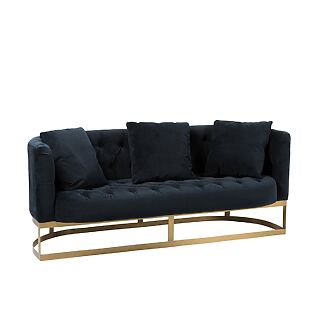
J-Line Luxury 2-seater sofa with button tufting, black velour velvet cover and gold-colored metal frame (incl. cushions)
2.395,00 €
VAT included.
Delivery time: 2-4 working days