There is probably no artist of classical modernism whose life's work has been so consistently integrated into our everyday consumption as that of the Austrian "golden boy" Gustav Klimt.
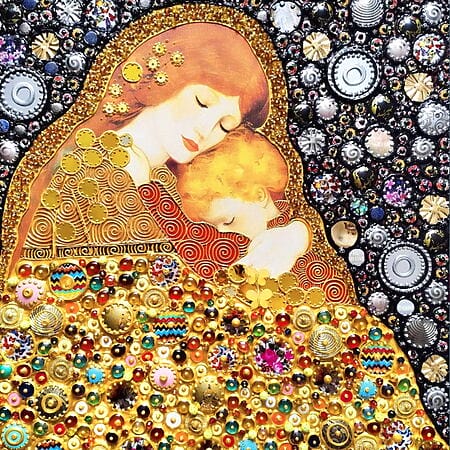
A quick glance into souvenir shops or the decoration departments of large furniture stores reveals a pervasive marketing machine. His paintings – and above all, the famous couple in love – now adorn umbrellas, notebooks, and all sorts of merchandise. They can even be purchased as prints on ostrich eggs or as templates for coloring pages.
On his 150th birthday, July 14, 2012, even Google dedicated a Doodle—a specially designed Google logo—to the Viennese artist. Naturally, Klimt's painting "The Kiss" integrated into this Doodle, the image that already has a successful history as a favorite print template for furniture store art and is currently also available as a print on an ostrich egg or as a template for coloring pages.
Beyond the Gold Rush: Gustav Klimt, the rebellious chronicler of modernism. Photo by Mathilde Langevin @mathildelangevin, via Unsplash
This unrestrained reproduction of gold-accented works has, for design purists, almost reduced the painter to a tragic symbol of living-room kitsch – a role that doesn't even begin to do justice to him, his artistic intentions, or his historical significance.
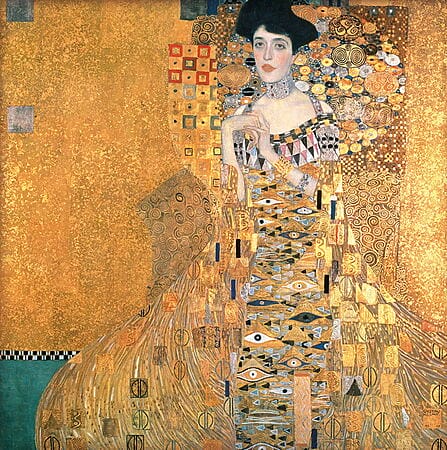
The vast majority of Klimt's work does not contain gold. According to the consensus among art historians and current analyses of his catalogues raisonnés, his Golden Period began around 1898 and ended in 1909.
The extensive use of gold leaf and the almost Byzantine-style, flat ornamentation were therefore not a fleeting whim of a single year. Key experiences for this development were presumably trips to Venice and especially to Ravenna in 1903.
In Ravenna, he studied the medieval gold mosaics in the early Christian churches of San Vitale and Sant'Apollinare in Classe. Klimt subsequently translated their sacred, otherworldly, and transcendent effect into a completely new, secular, and often sexually charged visual language. The absolute pinnacle of this phase, the world-famous painting "The Kiss," on which he worked from 1907 to 1908, undoubtedly belongs to this context.
Gustav Klimt's famous painting "The Kiss" is on permanent display in the Upper Belvedere of the Belvedere Museum in Vienna, Austria. Photo by Mary @rozoviesloniki, via Unsplash
While it is undisputed from an art historical perspective that the majority of his work, spanning over four decades, was created entirely without the use of precious metals, it cannot be denied that his Golden Age was more formative and protracted than earlier, narrower analyses of the years 1906 and 1907 might have initially suggested.
From celebrated academic to outsider
To fully grasp the radical nature of Klimt's later work, one must delve into his early artistic beginnings within the deeply conservative milieu of the Austro-Hungarian Monarchy. At the tender age of 14, in 1876, the talented draftsman entered the Vienna School of Applied Arts. This institution differed from the traditional Academy of Fine Arts, as it focused less on elitist, free artistic practice and instead on the sound, practical training of drawing teachers.
Gustav Klimt – The Gorgons (1902)
In 1883, he moved into his first studio. Together with his brother Ernst Klimt and fellow student Franz Matsch, he founded the successful "Artists' Company." This studio collective undertook lucrative public commissions that reflected the representative tastes of late Historicism during the Ringstrasse era. They produced elaborate sgraffito (a special stucco technique) for museum buildings, contributed to the decoration of theaters and pageants, and painted opulent murals and ceiling paintings.
One of the most prestigious commissions of this early period was, towards the end of the 1880s, the painting of the magnificent staircases and the auditorium of the new Vienna Burgtheater. For the virtuoso execution of this work, the trio received the Golden Cross of Merit. At the same time, Gustav Klimt himself was awarded the coveted Imperial Prize, endowed with 400 ducats. At this point, his path as a highly decorated, state-sponsored painter of prestigious works seemed irrevocably set.
But beneath the polished surface of Viennese society, a great deal of unrest was brewing. The late 19th century was an era of massive intellectual upheaval. Sigmund Freud began mapping the human psyche and the unconscious. In this environment, Klimt also sensed that the rigid academic style of painting no longer did justice to the complexity of modern reality.
The first official step in his search for a new, authentic form of expression was his joining the "Association of Visual Artists of Vienna"However, he quickly found the prevailing, innovation-averse attitude of the established artists there to be stifling.
From this time onward, Klimt was caught in the conflict between resistance to innovation and the pursuit of progress in modern art. In 1897, Klimt co-founded the Vienna Secession. This newly founded artists' association demanded uncompromising freedom for art, far removed from any state interference or market-driven censorship.
A university scandal: Anatomy, decay and the naked truth
The break with the establishment manifested itself most dramatically in the scandal surrounding the so-called Faculty Paintings. The Ministry of Education had commissioned Klimt to design monumental ceiling paintings for the ceremonial hall of the University of Vienna, which were intended to allegorically represent the disciplines of philosophy, medicine, and law. However, instead of glorifying the sciences as triumphant achievements of the rational human mind, Klimt chose an increasingly expressionistic, somber, and almost mosaic-like style in his work on these pieces.
He depicted humanity as a blind, instinct-ridden, disease-ridden, and death-plagued web of intertwined bodies. In his hometown, these radical works provoked sharp rejection and open hostility among conservative academic circles. An unprecedented public debate erupted over the boundaries of art.
Ironically, in 1900, his ceiling painting on philosophy was awarded a gold medal at the Paris World's Fair, demonstrating how far ahead the international avant-garde was of the provincial Viennese understanding of art. The conflict escalated to such an extent that Klimt ultimately refused to hand over the works to the Ministry of Education and repaid the fee already paid out of his own pocket.
Recent research in the history of medicine sheds entirely different light on this scandal. In the spring of 2026, the Josephinum – the medical history museum of the University of Vienna – dedicated the groundbreaking special exhibition "Gustav Klimt and Medicine". This exhibition revealed the profound depth of Klimt's engagement with the natural sciences of his time.
He therefore gazed with interest through microscopes, studied cellular tissue structures and embryos, and integrated these biological microworlds directly into his paintings as ornamental elements. The golden bubbles surrounding his portraits are interpreted as stylized representations of sperm or egg cells. For him, anatomy was not merely dry science, but a source of aesthetics.
He recognized the biological fragility of existence, which greatly disturbed contemporary audiences at the time
Provocation as an artistic weapon
Gustav Klimt: Beethoven Frieze
Klimt did not react to the hostility of his time with retreat, but with outright irony. A striking example of this is the oil painting "Goldfish" from 1902. It was Klimt's direct painterly response to the massive criticism leveled at his faculty paintings by traditionalists. The painting even originally bore the working title "To My Critics." In the foreground, the work depicts a red-haired nymph who smiles mischievously at the viewer, blatantly presenting her bare buttocks. It was an aesthetically brilliant, yet unmistakable gesture of contempt for the prudish bourgeoisie.
His approach to eroticism was characterized by an uncensored openness that was taboo in the society of his time. While academic history painting always concealed the naked body under the guise of mythological scenes, Klimt liberated sexuality from this moral constraint. He addressed female desire and intimate lives not from a punitive perspective, but with empathetic fascination.
In the years following his official departure from the Secession in 1905, triggered by internal disagreements, the artist was by no means stagnant. Through ongoing dialogue with other leading figures of the time, such as Auguste Rodin, he steadily developed his style towards a more expressive modernism. His role as a mentor is particularly noteworthy. In 1907, Klimt met the exceptional young Expressionist Egon Schiele , whose immense talent he immediately recognized and nurtured. Together with his colleagues, Klimt organized the "Kunstschau" in 1908 and 1909 , a significant forum that provided an international platform for modern Viennese art.
Even beyond national borders, he enjoyed enormous success in his later years. At the International Art Exhibition in Rome in 1911, he was awarded first prize for the controversial painting "Death and Life" —an imaginative composition with distinctly surreal elements
Shortly before his death in 1916, during his presidency of the "League of Austrian Artists," once again demonstrated his affinity for the avant-garde at an exhibition in the Berlin Secession. He did so by exhibiting alongside Egon Schiele, Oskar Kokoschka, and Anton Faistauer. Klimt was thus the decisive driving force behind Vienna's integration into the international artistic modernism movement.
Anyone who reduces Gustav Klimt today to kitsch with gold flecks misunderstands the explosive power of his art. He didn't paint pleasing pictures for mere decoration, but rather hurled radical innovations and provocations at his time.
Anyone who delves deeper into his work beyond the printed versions of "The Kiss" will discover a profoundly philosophical and contradictory innovator whose influence on art history extends beyond decorative gold leaf.
Expert opinions on scientific classification
Dr. Tobias G. Natter
Qualifications: Internationally renowned art historian, curator of numerous exhibitions on Viennese Modernism and author of the comprehensive catalogue raisonné “Gustav Klimt – Complete Paintings” (2022).
Assessment: Dr. Natter curated, among other things, the special exhibition at the Josephinum in Vienna (2026), which re-evaluated Klimt's work in a medical context. He emphasizes the psychological depth of the artist and refutes the image of him as a mere decorator.
Klimt was more than a painter of beautiful surfaces. He depicted all of life – in its harshness and its truth. The exhibition places Klimt in his time: Vienna as a ‘laboratory of modernity’, where doctors, artists and thinkers were in constant exchange
Qualifications: Director of the Josephinum (Museum of the History of Medicine at the Medical University of Vienna) and holder of the UNESCO Chair in Bioethics.
Assessment: She situates Klimt's work at the direct interface between art and natural science. The research collaboration she oversees makes it clear that Klimt's detailed exploration of cellular tissue structures and human decay was not purely aesthetic. Rather, it reflected a profound biological understanding of human existence (from birth to death), which overwhelmed the conservative public of the time.
444,00 € – 744,00 € Select version
This product has several variations. The options can be selected on the product page
Recommendations for further study (External online sources)
Google Arts & Culture – Klimt's Golden Phase: an interactive, extremely high-resolution digital exploration of the works created between 1901 and 1909. This platform uses digital X-ray and infrared images to illustrate the painter's complex working methods and the immense influence of the Ravenna mosaics. Visit the exhibition on Google Arts & Culture.
Association of Visual Artists Vienna Secession:The official website of the historical and contemporary Secession offers excellent historical background information on the founding of the movement, the architectural concept of the exhibition hall, and the creation of the monumental Beethoven Frieze. Visit the Secession website
Leopold Museum Vienna – Focus on Viennese Modernism: The Leopold Museum houses one of the world's most important collections of Austrian art from around 1900. The museum's online resources offer scholarly essays and in-depth analyses of the relationship between Gustav Klimt and his protégé Egon Schiele. Visit the Leopold Museum website
List of sources
Source text: “Gustav Klimt – The Golden Boy from Vienna” (Word document submitted as part of the assignment).
SpringerMedizin (2026): “Gustav Klimt and Medicine: How Art and Science Shaped Vienna around 1900”. Scientific report on the special exhibition at the Josephinum, MedUni Vienna (Published on March 25, 2026).
Google Arts & Culture / Belvedere Vienna: “Klimt’s Golden Phase” (Digital processing and historical dating of the work).
Natter, Tobias G. (2022): “Gustav Klimt – Complete Paintings”, Taschen Verlag, Cologne. (Used for historical contextualization and correction of the chronological phases of his work).
TagSeoBlog (2012): Archived post about the Google Doodle on the occasion of Gustav Klimt's 150th birthday (Used to verify birth and death dates).
Owner and Managing Director of Kunstplaza . Publicist, editor, and passionate blogger in the fields of art, design, and creativity since 2011. Graduated with a degree in web design from university (2008). Further developed creative techniques through courses in freehand drawing, expressive painting, and theatre/acting. Profound knowledge of the art market gained through years of journalistic research and numerous collaborations with key players and institutions in the arts and culture sector.
In art, artists and artworks are categorized into stylistic periods. These are based on common characteristic features of the artworks and cultural products of a given era.
The division into eras serves as a tool for structuring and classifying works and artists within a temporal framework and a cultural-historical event.
Knowledge of Art Periods And Movements plays a major role, especially in the art trade , as well as in art theory and classical image analysis.
In this section of the art blog, we would like to help you gain a better understanding of these eras, styles , and movements.
Art styles and movements
The art style or style of artworks refers to the uniform expression of the artworks and cultural products of an era, an artist or group of artists, an art movement or art school.
This is a tool for classifying and systematizing the diversity of art. It denotes similarities that differ from others.
The term is thematically related to the Art Movement, but it should not be viewed solely within a temporal framework and is therefore much broader.
In this section, we would like to help you gain a better understanding of styles and movements in art.
We use technologies such as cookies to store and/or access device information. We do this to improve your browsing experience and to display (non-)personalized advertising. If you consent to these technologies, we can process data such as browsing behavior or unique IDs on this website. Refusal or withdrawal of consent may adversely affect certain features and functions.
Functional
Always Active
Technical storage or access is strictly necessary for the legitimate purpose of enabling the use of a specific service expressly requested by the subscriber or user, or for the sole purpose of carrying out the transmission of a message over an electronic communications network.
Preferences
The technical storage or access is necessary for the legitimate purpose of storing preferences that were not requested by the subscriber or user.
statistics
Technical storage or access that is solely for statistical purposes.Technical storage or access that is used solely for anonymous statistical purposes. Without a subpoena, the voluntary consent of your internet service provider, or additional recording by third parties, the information stored or retrieved for this purpose cannot generally be used to identify you.
marketing
Technical storage or access is required to create user profiles, to send advertising, or to track the user on one or more websites for similar marketing purposes.











 J-Line Minimalist Floor Lamp "Black Strings", delicate metal with paper lampshade
215,00 €