Who is Banksy? All the facts, clues, and mysteries surrounding the identity of the street artist
British street artistBanksy ,whose works dominate multi-million-dollar auctions and amaze entire cities, remained hidden for a long time, even in the shadow of his fame. That has now changed with the latest revelations by Reuters .
Who is really behind the pseudonym Banksy? Who is Banksy?
This question always loomed over his works and repeatedly comes to the fore whenever new works by the mysterious graffiti artist appear, as was the case a few months ago at the London Zoo and the Royal Courts of Justice.
In March 2026, this era of speculation appears to have come to an end with a monumental, 8,000-word investigation by the Reuters . What had previously circulated as an “open secret” in the dark corners of online forums and Bristol’s underground scene has now been condensed into a dossier, based on an unbroken chain of evidence comprising US court records, Ukrainian border protocols, and forensic analyses, establishing the artist’s identity “beyond any reasonable doubt .
table of contents
Show
The mystery surrounding Banksy's identity
Banksy's art is hard to ignore. His provocative images not only adorn walls in London and numerous other major cities around the world, but also find their place in renowned galleries worldwide.
His works, often categorized as temporary art, are characterized by sharp social and political commentary in Banksy's distinctive stencil technique . He has staged spectacular actions, such as in 2003 at Tate Britain, where he disguised himself as a pensioner to smuggle one of his works into the gallery, or in 2004 at the Musée du Louvre. He manages, authenticates, and sells his artworks not publicly, but through his own agency, Pest Control.
Despite his cultural significance and commercial success, Banksy's identity remained a mystery for decades. The enigma surrounding the artist was so profound that even experts, in their research, struggled to find a definitive answer for a long time. They had gathered clues in the form of videos, newspaper articles, and interviews with Spiegel magazine, hoping to shed light on the matter. The question still remains: why was it so difficult to identify Banksy?
In our analysis, we conducted our own in-depth research over several years, interviewed former associates of Banksy, and compared this with reports in other media.
Anonymity as a central aspect of Banksy's artistic and political aesthetics
As an "art guerrilla" or "rebel," he empowers himself to target powerful institutions, consumer society, and social injustice. His anonymity allows him to freely express his opinion without fear of direct consequences or reprisals, especially since his art is often illegal.
Anonymity amplifies the political message of his works, acting as a catalyst. Without personalization, the focus remains on the work itself and its message. Banksy has explained his fame with quotes such as "Any fame is a by-product of making something that means something" and "Remember, it's always easier to get forgiveness than permission .
Originally intended as a protective mechanism, anonymity has evolved over time into a conceptual framework that fosters the global personality cult surrounding Banksy while simultaneously increasing his market value.
However, political opposition now stands in stark contrast to his commercial success. Although Banksy has rhetorically positioned himself against the establishment by saying that "copyright is for losers," he nevertheless created a legal entity called Pest Controlto protect his vast fortune and copyrights. Defending this economic brand has already led to complex legal battles over the past few years, jeopardizing the street artist's anonymity.
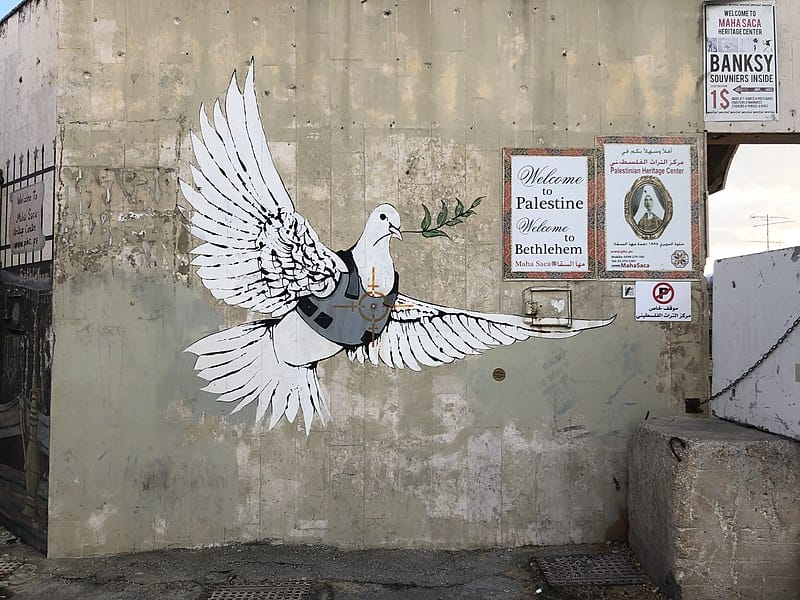
Photographed by Davide Mauro, CC BY-SA 4.0, via Wikimedia Commons
' revelations, Reuters various theories existed about Banksy's identity. From a renowned London street artist to a woman or a collective of artists operating behind the name Banksy – the speculations were manifold.
The facts – What is known about the artist's identity?
The confirmed information about Banksy's origins proves that the artist has his roots in the English city of Bristol . There, in the 1990s, he began leaving his graffiti in the urban landscape as an up-and-coming artist. Bristol's creative scene is the reason why the city has produced so many musicians and artists.
Banksy's career began in the 1990s; he started out DryBreadZ crew with freehand graffiti artbefore switching to stencil techniques. Over time, however, he evolved into an artist with more politically charged works, eventually becoming the street artist we know and admire today.
A masterpiece from the early stages of his career is the large-scale stencil mural "The Mild Mild West," created in 1999 in Stokes Croft, Bristol. The artwork's gentle tone is conveyed by the image of a teddy bear throwing a Molotov cocktail at three riot police officers.
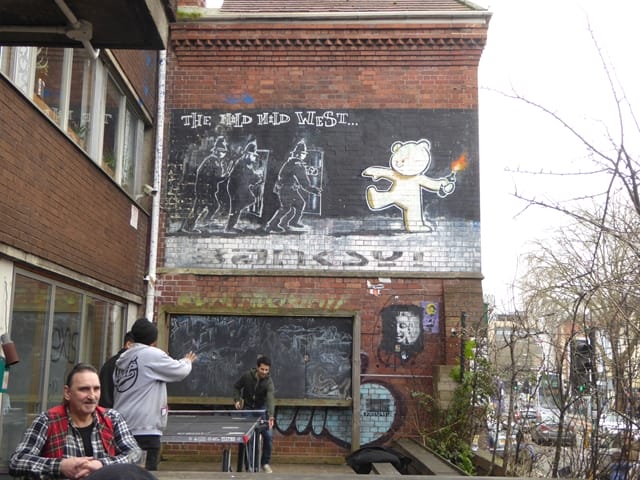
photographed by Oliver Dixon, CC BY-SA 2.0, via Wikimedia Commons
The artist completed the work within three days in daylight, and it can still be admired in the city today, along with other works of art from his pen.
magazine Swindle in 2006, Banksy once said:
I come from a relatively small town in southern England. When I was about ten years old, a boy named 3D was painting all over the streets. I think he'd been to New York and was the first to bring spray paint to Bristol. I grew up with spray paint on the streets, long before I ever saw it in a magazine or on a computer
3D stopped painting and formed the band Massive Attack, which was perhaps good for him, but a great loss for the city. Graffiti was something we all loved at school. We did it on the bus on the way home from school. Everyone did it.”
The only things that are definitely genuine are those that Banksy himself website, in his books and on his Instagram channel @banksy has authenticated
View this post on Instagram
The Reuters investigation: When journalism becomes provenance analysis
Published by Reuters in March 2026, the investigation marks a turning point in urban art reporting. Instead of relying on vague sightings or shaky cell phone photos, the team led by Simon Gardner, James Pearson, and Blake Morrison employed methods typically found in art forensics or provenance research. The investigation reads like a forensic reconstruction, piecing together fragments of legal and factual evidence to establish authorship beyond doubt.
The origin of the search: The ruins of Horenka
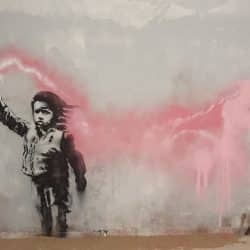
The trigger for the year-long research project was, paradoxically, an act of solidarity in a war zone. In 2022, seven murals appeared in the rubble of Ukraine, particularly in Kyiv suburbs like Borodyanka and Hostomel, which Banksy later confirmed on his Instagram account. These works—including one of a child throwing an adult judoka to the ground—attracted worldwide attention and were interpreted as a commentary on the Russian invasion.
View this post on Instagram
Reuters reporters traveled to these areas and conducted interviews with local witnesses. In Horenka, they encountered a café owner who observed two men creating the mural. Among the photos shown to the witness was that of Robert Del Naja, the frontman of the Bristol band Massive Attack. Del Naja, himself long considered a possible Banksy, was identified at the scene – not as the sole artist, but as part of a team.
The data trap: Entry and border protocols
crucial breakthrough, Reuters' however, came not on the ground, but through the analysis of migration data. The journalists examined Ukraine's entry and border control records for October 2022. They discovered that Robert Del Naja entered the country on October 28, 2022. His travel companion was a man named David Jones.
Although David Jones is one of the most common names in the United Kingdom, the birthdate listed in his passport data correlated exactly with the date recorded for Robin Gunningham in old documents. Research revealed that Gunningham changed his legal identity in 2008 – shortly after the Mail on Sunday first linked him to Banksy.
The transformation was perfect: the hunted artist Robin Gunningham became the statistically invisible David Jones.”
| actor | Role according to Reuters | Evidence |
| Robin Gunningham | Banksy's birth identity | Bristol birth register, Bristol Cathedral School records |
| David Jones | Current legal identity | Passport data, company register, Ukraine border protocols |
| Robert Del Naja | Cooperation partner / “Scout” | Witness statements in Ukraine, shared travel dates with Jones |
| Steve Lazarides | Former manager | Memoirs “Banksy Captured”, confirmation of name change |
| Mark Stephens | Long-time lawyer | Correspondence with Reuters, defense of anonymity |
Known for certain vs. assumptions: Fact-checking
In the heated debate surrounding Banksy's identity, it is crucial to distinguish between verifiable facts and the legend-building that the artist himself has fueled for years.
What is clearly proven?
It is established that the pseudonym Banksy refers to a man from Bristol, born in 1973 or 1974. The connection to Robin Gunningham is now supported by a “smoking gun” incident that is almost three decades old: an incident in New York City in 2000. Gunningham was arrested at the time for painting over a Marc Jacobs advertising poster in the Meatpacking District.
He signed a handwritten confession for “disorderly conduct” to avoid more serious charges. Because this specific act of vandalism was later claimed as his work by Banksy’s inner circle, the signature on the NYPD report serves as a forensic link between the pseudonym and the real person.
Also well-known is the central role of the “Pest Control Office.” Founded in 2008, this organization is the sole authority that issues certificates of authenticity for Banksy's works. Without a Pest Control certificate, a work is virtually unsellable on the legal art market. This gives the artist unprecedented control over its provenance, regardless of whether its identity is known or not.
What else is being speculated about?
Despite the Reuters evidence, the question remains whether Banksy is an individual or a collective. It is speculated that while Gunningham/Jones holds the creative direction, a team of assistants—often referred to as “Team Banksy” —handles the logistical execution of the nightly actions. The involvement of Robert Del Naja is interpreted by some experts as indicating that Banksy is a loose network of Bristol artists and musicians who support one another.
Another point of speculation is the degree of orchestration. Many observers on platforms like Reddit suspect that Banksy himself orchestrated the current wave of revelations. The fact that the Pest Control Office and its lawyer, while calling the Reuters reports “inaccurate,” did not take legal action against the publication of the name fuels the suspicion that the unmasking is part of a larger artistic concept—a “structural stress test” of his system.
What theories exist regarding Banksy's identity?
There are numerous – sometimes outlandish – theories about Banksy's identity. Although some of them have been debunked by the Reuters revelations, the most outlandish ideas and speculations continue to circulate on social media. For entertainment purposes alone, they're worth a look.
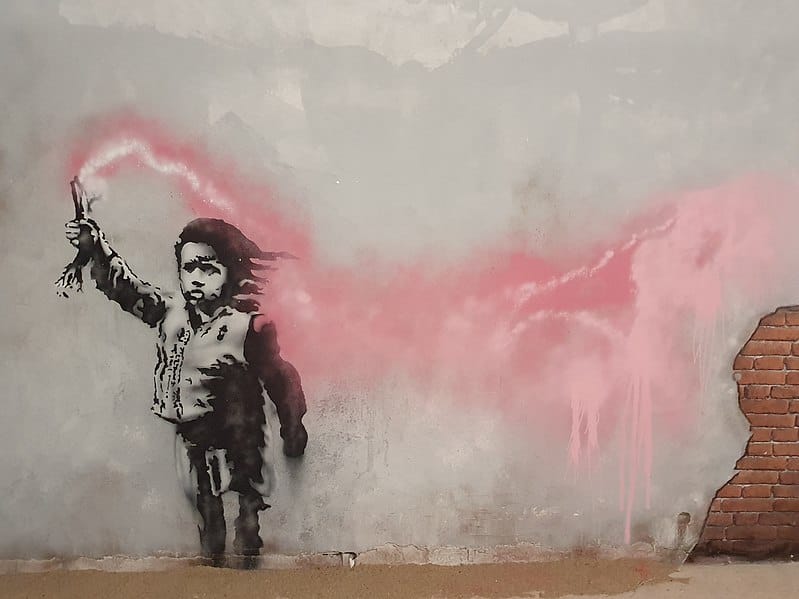
photographed by GualdimG, CC BY-SA 4.0, via Wikimedia Commons
Let's focus on the most popular, persistent, and likely ones.
Theory #1: White, under 50 years old, red-haired
Ulrich Blanché, a renowned art historian, is considered an expert on Banksy. In June 2022, NDR an interview with himbroadcast in which he discussed the mystery surrounding the artist.
Blanché has already written several books about Banksy and concluded from numerous interviews from the 80s and 90s that he is most likely a white man under 50 years old.
It is believed that this man may have been a redhead and worked as a street painter and festival truck painter in the 1990s before disappearing into anonymity. It is possible that he also had a cleft lip and underwent facial surgery, but this information is unconfirmed and could be false.
Theory #2: Robin Gunningham
The most widely accepted theory is that the creator of Banksy's artwork is none other than Robin Gunningham . Gunningham was born in 1973 in Yate, a town near Bristol, and many of his former classmates firmly believe he is the real Banksy.
According to his former school friends, Gunningham was always a gifted artist who frequently produced cartoons. It is believed that he began his career under the name "Robin Banks ," which later evolved into "Banksy .
Banksy himself has confirmed that his love of drawing began during his school days. A photograph of Gunningham, taken in Jamaica, shows him with a spray can and stencils. This has further fueled speculation and led many people to believe that Robin Gunningham is indeed Banksy.
There is a strong rumor that an original work by Robin Gunningham, believed to be the only piece signed by him, was auctioned in 2018. The price of £4,000 seems fair for an otherwise unknown artist. The work is an illustrated record sleeve for the album “Oh My God It's Cheeky Clown” by the Bristol ska band Mother Samosa and shows similarities to Banksy's earlier graffiti style.
The QMUL study
In 2016, criminologists at Queen Mary University of London (QMUL) attempted to establish a link between Gunningham and Banksy's works in London and Bristol using geographic profiling. Researchers at the London university used Banksy's artworks as their data source, specifically 140 artworks in London and Bristol.
The results of the QMUL study showed a statistically significant correlation between the peaks of the geoprofiles and the known addresses associated with Robin Gunningham.
The model's performance is measured by the Hit Score Percentage (HS%) , which indicates what percentage of the search area would need to be searched to locate the perpetrator. A lower HS% indicates higher precision.
Summary of QMUL geoprofiling results (Hauge et al., 2016)
| City | Gunningham-associated place | Function of the place | Hit Score Percentage (HS%) | Classification of the geoprofile peak |
| London | Old Street Area (Millward) | Former residential address of the wife | 0.7% | Highest probability (in the top 1%) |
| London | Great North Road Area (Millward) | Former residential address of the wife | 3.8% | In the top 10% of the geoprofile |
| Bristol | Easton Home | Gunningham's former residence | 5.5% | In the top 10% of the geoprofile |
| Bristol | Baptist Mills Primary School | Former sports venue | 6.8% | In the top 10% of the geoprofile |
The method of “geographic profiling” is frequently used to solve serial crimes. Crime scenes and other factors are stored in a database to determine the possible residence of the perpetrator.
The results of the investigation indicate a high probability that Banksy is indeed Robin Gunningham from Bristol.”
Particularly in London, the addresses of Gunningham's wife, Joy Millward, fell into the highest probability ranges, with the Old Street address exhibiting a remarkably low HS% of 0.7 percent. This means that a search strategy informed by the geoprofile would locate this address almost immediately.
These findings support the theory that Robin Gunningham is the person behind Banksy. The spatial patterns suggest that Banksy's activity was closely tied to his personal and familial geographical anchor points and employed a commuting strategy between his hometown of Bristol and his main activity center in London. The study's authors themselves stated that the analysis supports the theory, although they could not draw an absolute conclusion due to a lack of other serious suspects.
The legal response and its implications
The credibility of the Gunningham hypothesis was subsequently strengthened by the reaction of Banksy's legal team. The planned publication of the QMUL study in the Journal of Spatial Science in 2016 was blocked after Banksy's lawyers intervened (see Artlyst*).
Banksy's legal department reportedly contacted QMUL staff with concerns regarding the nature of the publication, and in particular the wording of a press release, which was subsequently withdrawn. Such an aggressive legal response to a purely academic and statistical analysis strongly suggests that the study established a compelling forensic link.
Had the investigation been irrelevant, legal action would likely have been unnecessary. The intervention signaled that the statistical correlation was perceived as a direct threat to anonymity.
Gunningham was already suspected of being Banksy in 2008
As early as 2008, the tabloid newspaper "Mail on Sunday"that Robin Gunningham was the man behind the name Banksy. Now, profiling software has identified addresses and locations associated with Gunningham that could also be linked to the search for Banksy.
The Mail conducted a year-long research project at the time, speaking with dozens of people, including friends, former colleagues, enemies, roommates, and close relatives of Banksy. The starting point of the investigation was a photograph purportedly showing Banksy at work on the Caribbean island of Jamaica.
It shows a man with dark curls, kneeling with a spray can and a stencil in front of him, while wearing a dark blue shirt.
Peter Dean Rickards, who captured the moment, confirmed that it was Banksy after leaking the images to the press – however, this was never officially proven.
He reportedly had a falling out with the artist. "Banksy wandered around Jamaica as if he owned the country," he told the Evening Standard.
The man who claimed to know Banksy confirmed, according to The Sun, that the picture showed Mr. Gunningham.
However, Banksy claimed not to be the man in the photograph, and Gunningham's entourage was uncooperative. Even his alleged parents reportedly denied his existence. Given Banksy's long history of success in covering his tracks, it's possible that the lead the Mail pursued was a diversionary tactic, according to the authors of the 2008 article.
However, the investigation was postponed after Banksy's lawyers contacted the university and raised concerns about how the study, titled "Tagging Banksy," could be used in the press.
Neither Gunningham nor Banksy or his representatives have ever publicly commented on this theory to confirm or deny it.
Early indications from the years around the turn of the millennium
According to reports in The Sun last October, Gunningham lived in Easton, Bristol, with his friend Luke Egan It was during this time that Banksy created the famous Mild Mild West sign, which depicts a stuffed bear holding a Molotov cocktail.
The artwork was placed on a wall opposite Subway Records in Stokes Croft, Easton. While Banksy's art moved to London in 2000, Gunningham resided in a flat on Kingsland Road in Hackney.
Egan's former roommate, a fellow artist, exhibited alongside Banksy at Santa's Ghetto, an art shop that opened in London's West End at Christmas 2001. That same year, Banksy held his first unofficial exhibition in a tunnel in Rivington, Shoreditch, where he spray-painted twelve works onto the whitewashed walls.
Egan continued to maintain that Mr. Gunningham was not Banksy. He stated:
I lived with a man named Robin Gunningham. But he wasn't [Banksy] at the time. I lived with him a long time ago. I don't think Banksy was even around at that time anyway
Nevertheless, Banksy made a name for himself in a warehouse just a few meters from Gunningham's apartment.
Theory #3: Robert Del Naja
Others have Robert Del Naja of Massive Attack as Banksy. Del Naja himself is a graffiti artist and worked in Bristol under the name 3D , whom Banksy has cited as one of his early sources of inspiration.
The theory arose after DJ Goldie allegedly mentioned Banksy's name in a podcast when he spoke about this street artist (as reported by the editorial team of Männersache* ).
He said:
With all due respect to Rob, I consider him a brilliant artist. I think he has turned the art world upside down.
Del Naja's theory was further supported by a supposed link between two incidents in which new Banksy artworks appeared in a city where Massive Attack had performed. Nevertheless, Del Naja has publicly rejected these claims, unlike Gunningham.
Theory #4: Jamie Hewlett
In recent years, other speculations have also surfaced suggesting that the founder of Gorillaz, Jamie Hewlett, may be the creator of the artistic work.
An anonymous forensic expert claimed that documents prove Hewlett has connections to every company associated with Banksy. Further evidence supporting this claim is Hewlett's previous work on the band's music videos.
Despite these facts, Banksy's press spokesman has clearly and unequivocally denied these claims.
Over the past few years, Banksy has made occasional appearances. Most recently, he was spotted installing his latest artwork on the London Underground. A passerby also claimed in 2018 to have seen him near a recently completed piece in Hull.
Despite these encounters, the artist's face has always remained hidden, and his working methods remain a mystery. Whether Banksy works alone or with a team is unclear and continues to fuel speculation.
Theory #5: Creative Plurality – The Banksy Collective Theory
Because of the enormous workload, the geographical spread, and the requirements for a uniform artistic quality, the idea has become established that Banksy is not a solitary artist, but a well-organized collective or art brand controlled by a small team.
Justifications for a collective
The credibility of this theory received a boost during the “Better Out Than In”residency in New York in 2013, where a surprisingly large number of works were created in a short time.
Such a structure could organize the collective: A central person would be responsible for the conceptual direction and ideas, while a team of executors would physically create the artworks and organize the logistics. This is why Banksy would be able to be active in different locations simultaneously and manage such an immense workload.
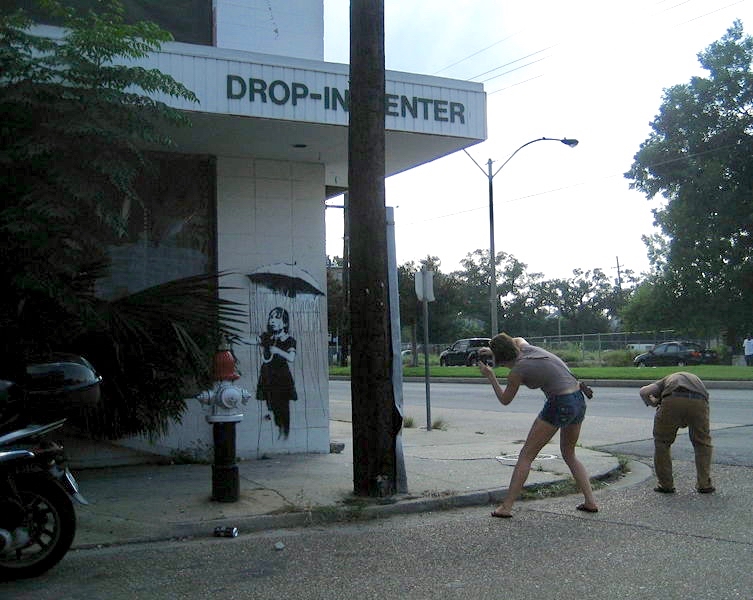
Image source: Information of New Orleans, CC BY-SA 2.0, via Wikimedia Commons
Design and direction of the documentary film
The 2010 film Exit Through the Gift Shop points to an organizational structure that goes beyond a single street performer.
Delimitation and synthesis
The collective theory serves as the most important framework for unifying the conflicting chains of evidence. It is the most likely explanation for the operational and global execution of Banksy's activities.
It reconciles the forensic findings of the QMUL study, which identify Robin Gunningham as the geographical and therefore probably the central artistic origin, with the logistical evidence surrounding Robert Del Naja.
Robin Gunningham is the conceptual mind and creative voice behind this synthesis, while Robert Del Naja (or similar individuals) provide logistical support and mobility. The consistency in style, political stance, and irony across the entire work suggests a single, but highly consistent, conceptual voice.
From an individual graffiti artist, Banksy has evolved into a global brand whose anonymity is managed by a team to achieve the greatest possible economic and philosophical benefit.
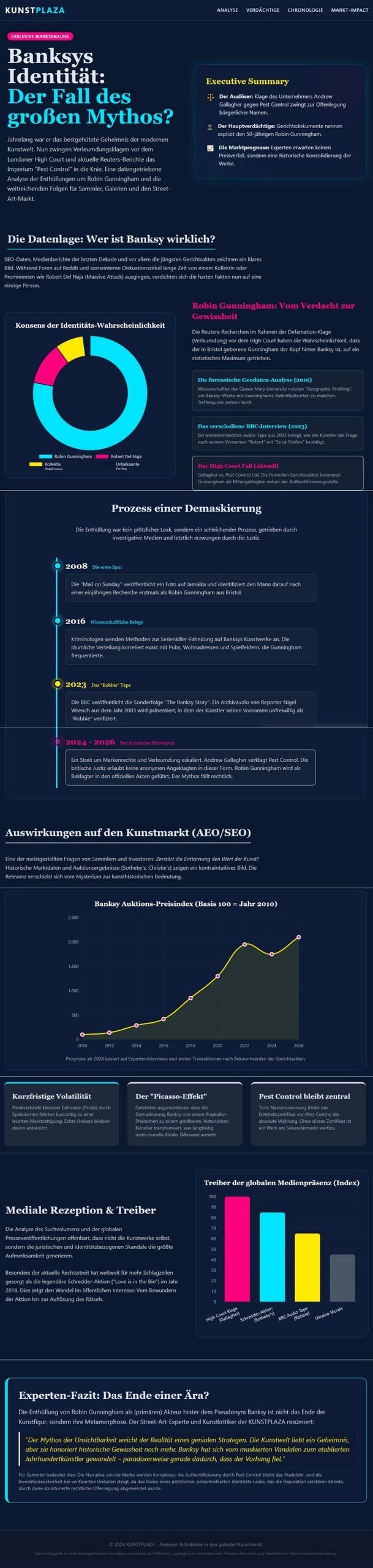
We have summarized the results of our research for you in a clear infographic using an infographic tool:
BBC podcast released excerpt of Banksy's voice in an interview
released BBC podcast some time ago offered deeper insights into the truth about a famous artist. The 2005 telephone interview allowed his voice to be heard publicly, thus solving another piece of the puzzle surrounding the artist. At the time, the podcast gave hope that the truth about the artist would soon come to light.
We assume you are who you claim to be, but how can we be sure?
"asked the presenter.".
The person claiming to be Banksy responded:
Oh, you have absolutely no guarantee for that.”
The conversation with the man, who described himself as a "painter and decorator" and cited the following as his motivation for his guerrilla art, :
"You don't want to be stuck in the same industry your whole life, do you?"
The podcast also featured comments from members of the artist's staff, but they did not reveal any details about their identity.
Legal entanglements: The Gallagher case and the end of the game of hide-and-seek
A key driver for the revelation was not only journalistic ambition, but also increasing legal pressure. For years, Banksy has been engaged in a bitter legal battle with the greeting card company "Full Colour Black" and its owner, Andrew Gallagher.
Trademark law vs. anonymity
The core of the conflict lies in Banksy's famous dictum "Copyright is for losers". Because the artist leaves his works in public spaces and often refused to claim copyright (as this would have required his identification), companies like Full Colour Black attempted to commercially exploit his designs.
When Banksy attempted to trademark his most famous works, the European Union Intellectual Property Office (EUIPO) initially argued that this was done in “bad faith,” as he did not commercially exploit the motifs himself but merely sought to prevent others from doing so. Although Banksy was successful in some appeals, his anonymity remained his most significant weakness in courtrooms.
The defamation lawsuit as a means of coercion
the legal battle over a work of art belonging to the late Queen Elizabeth II could The Guardian, actually lead to Banksy being forced to reveal his real name.
Gallagher's current libel suit against Robin Gunningham and Pest Control Ltd is a strategic move to force the artist to reveal his identity. Under British law, a defendant cannot remain permanently anonymous when defending themselves against libel charges. Reuters' investigation preempted this legal ultimatum, revealing to the public what the court is highly likely to determine soon anyway.
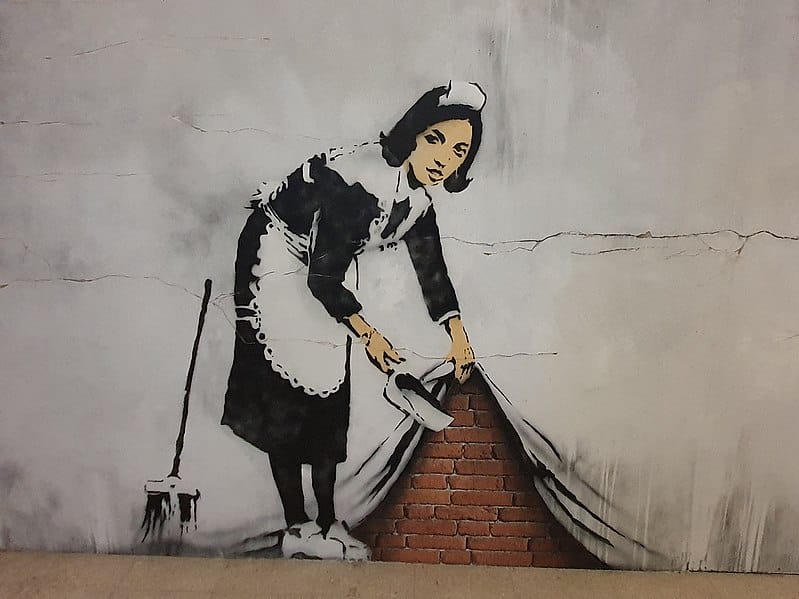
photographed by GualdimG, CC BY-SA 4.0, via Wikimedia Commons
The role of lobbyist Joy Millward
The well-known British parliamentary lobbyist Joy Millward is believed to be the wife of street artist Banksy. She made headlines when her husband, Robin Gunningham, was charged in the Supreme Court. Despite her partner's prominence, Millward, a former Labour Party staffer, skillfully manages to stay out of the public eye.
Joy Millward herself never spoke about the widespread speculation.
Who is Joy Millward?
The lobbyist from the West Midlands reportedly met Gunningham in 2003, shortly before she began working as a researcher for Labour politician Austin Mitchell. They married in Las Vegas in 2006 and have been married for 17 years.
According to insider information, they live a secluded life in a remote community and have little contact with their neighbors.
An informant told The Sun:
Even those they speak to occasionally don't really know who they are. […] Even some of Joy's family members haven't been told who her husband is or what he does.”
The significance of the revelation for the players in the art scene
The unmasking of an artist whose brand was based on invisibility sends shockwaves through the media, but these have different effects depending on the perspective.
The significance for the artist: Between danger and freedom
For the person behind the mask, the revelation is a double-edged sword. His lawyer, Mark Stephens, warned that revealing Banksy's identity exposes him to serious risks. Banksy is not just an artist, but a political activist whose works—from the barrier in the West Bank to the Ukrainian ruins—provoke powerful adversaries. Anonymity has served as a shield against political reprisals and legal prosecution for property damage.
At the same time, the revelation could signify a new form of freedom. Experts like Stefan Koldehoff point out that the decades of secrecy must also have been a burden. The transformation into David Jones was an extreme act of self-denial—Gunningham's existence was practically "buried". The identification that has now taken place could mark the end of this charade and allow the artist to officially manage his legacy, particularly with regard to copyright lawsuits, which often failed without proof of identity.
The significance for the art market: Authenticity trumps identity
In the world of high finance and auction houses like Sotheby’s and Christie’s , the reaction to the Reuters report is surprisingly subdued. Dealers and collectors agree: The market value of a Banksy is not based on the mystery surrounding his identity, but on the power of his brand and verification by Pest Control.
Authenticity determines value, not authorship in the biological sense. As long as the official certificate is present, the work remains a "blue-chip" asset. In fact, clear identification could even stabilize the market in the long term, as it reduces the risk of forgeries through more precise documentation of the artist's life stages.
| Market indicator | Status Quo 2026 | Impact of the revelation |
| Secondary market revenue | Over $248 million since 2015 | Stable, no panic selling observed |
| Role of Pest Control | Exclusive Gatekeeper | More crucial than ever for price stability |
| Auction prices | Millions spent on iconic stencils | Psychological effect negligible |
| Legal status | Ongoing lawsuits concerning trademark law | Identity facilitates legal enforcement |
Meaning for fans: The death of Santa Claus?
For the global fan base, the revelation is an emotional turning point. On Reddit and social media, Reuters' action is often criticized as "doxing" that destroys the magic of art. One frequently quoted comment compares the news to telling a child that Santa Claus doesn't exist.
Many admirers see Banksy as a projection screen for their own yearnings for rebellion and freedom from identity constraints. Reducing the enigmatic figure to a “52-year-old man from Bristol” feels like a disenchantment to this group. Nevertheless, a core group of supporters remains convinced that the art's message—a critique of capitalism, war, and surveillance—remains universal, regardless of the creator's name.
The future of the Enigma: A conclusion from an art market expert
The Reuters exposé in March 2026 was not a random occurrence, but the result of a changed world dominated by algorithms and data analysis, where anonymity has become an unattainable luxury. Robin Gunningham, alias David Jones, managed to dictate the rules of the game for over three decades in an industry that normally thrives on self-promotion.
What remains after the revelation?
- A heightened awareness of the power of provenance. The art market has proven that it doesn't need faces, but certificates. As long as pest control works, Banksy remains the safest investment in urban art.
- A new political dimension. As David Jones, the artist is now tangible, but also vulnerable. His future work will be scrutinized by this new reality. Will he still be able to criticize the system now that he is officially part of its legal framework?
- The enduring myth. The story of Robin Gunningham, who became David Jones, is in itself a Banksy work. It is a tale of disguise, of disappearing into the crowd, and of the futile attempt to remain invisible in a totally networked society.
For collectors and fans, fundamentally little changes, and yet everything does. The artworks on the walls of London, New York, and Ukraine now bear a name that many already knew, but that no one dared to utter. The enigma has been deconstructed, but the brilliance of the stencils remains undisputed. Banksy has achieved the impossible: he became famous by disappearing. That he has now been found is merely the final act of a performance that has forever altered art history.
Current market trends indicate a slight increase in demand for original and certified prints following the Reuters report, suggesting a greater confidence in the long-term documentation of a life's work. Anonymity may have created the myth, but the truth seems to cement its value.
Sources, expert support and further information:
- Inside the Rock Poster Frame: Shepard Fairey interviews Banksy for Swindle magazine, https://insidetherockposterframe.blogspot.com/2009/08/shepard-fairey-interviews-banksy-for.html
- Banksy's official website: https://www.banksy.co.uk/
- Banksy's official Instagram channel, https://www.instagram.com/banksy
- NDR Kultur: Banksy: Only what he authenticates on his website is real, https://www.ndr.de/kultur/Banksy-Echt-ist-nur-was-er-auf-seiner-Website-authentifiziert-,banksy214.html (article has since been removed)
- ZDFheute: Banksy unmasked? Expert warns: “This could be dangerous”, https://www.zdfheute.de/panorama/banksy-identitaet-robin-gunningham-reuters-recherche-100.html
- Queen Mary University London (QMUL) - M. Hauge, M. Stevenson, K. Rossmo and S. Le Comber: Tagging Banksy: using geographic profiling to investigate a modern art mystery (published in the Journal of Spatial Science), https://www.tandfonline.com/doi/full/10.1080/14498596.2016.1138246
- Artlyst: Banksy Identity Revealed Through Geoprofiling Study At Queen Mary University London, https://artlyst.com/news/banksy-identity-revealed-through-geoprofiling-study-at-queen-mary-university-london/
- Daily Mail: Scientists say the Mail on Sunday got Banksy's identity right: Hi-tech tools confirm our discovery that graffiti artist is Robin Gunningham, https://www.dailymail.co.uk/news/article-3478606/Scientists-say-Mail-Sunday-got-Banksy-s-identity-right-Hi-tech-tools-confirm-discovery-graffiti-artist-Robin-Gunningham.html
- The Sun: Inside hunt to unmask Banksy & three clues that led to public schoolboy Robin Gunningham being 'named' as graffiti icon, https://www.thesun.co.uk/news/24239697/unmask-banksy-graffiti-robin-gunningham/
- The Sun: All the clues Robin Gunningham is Banksy and how he lives mysterious life with elusive wife Joy Millward, https://www.thesun.co.uk/news/26064504/clues-robin-gunningham-banksy-wife-joy-millward/
- Männersache: Who is Banksy?, https://www.maennersache.de/wer-ist-banksy-85800.html (Website now offline)
- Editorial Network Germany: BBC podcast publishes Banksy's voice in interview excerpt, https://www.rnd.de/kultur/banksys-stimme-bbc-podcast-veroeffentlicht-interview-ausschnitt-von-2005-UWEB7TZJFZMXPO6LO276VKB5PE.html
- The Guardian: Legal row could finally force mystery artist Banksy to reveal his real name, https://www.theguardian.com/artanddesign/2024/mar/09/legal-row-banksy-reveal-real-name-art-images-authenticity

Owner and Managing Director of Kunstplaza . Publicist, editor, and passionate blogger in the fields of art, design, and creativity since 2011. Graduated with a degree in web design from university (2008). Further developed creative techniques through courses in freehand drawing, expressive painting, and theatre/acting. Profound knowledge of the art market gained through years of journalistic research and numerous collaborations with key players and institutions in the arts and culture sector.
You might also be interested in:

Featured Art
Design and Decor Highlights
-
 Floor lamp "Globe XL" made of polished metal spheres with a satin black lampshade, anthracite
345,00 €
Floor lamp "Globe XL" made of polished metal spheres with a satin black lampshade, anthracite
345,00 €
VAT included.
Delivery time: 2-4 working days
-
J-Line Bol "Crackelé" candle holder made of glass with gold elements
Original price was: €19.5012,50 €The current price is €12.50.
VAT included.
Delivery time: 2-4 working days
-
Handmade tapestry wall hanging "The Virgin" 95/135, stretched on a frame and sound-absorbing
644,00 €
VAT included.
Delivery time: 10-17 working days
-
Colorful polyresin dog sculpture "Doberman", pop art style
235,00 €
VAT included.
Delivery time: 4-6 working days
-
J-Line Modern Metal Christmas Tree "8 Levels", Black, 188 cm tall
385,00 €
VAT included.
Delivery time: 5-8 working days
-
Luxurious 3D wall mural "Memphis" made of MDF + resin, handcrafted
395,00 €
VAT included.
Delivery time: 4-8 working days
-
Modern design table lamp "White Gold Emma"
115,00 €
VAT included.
Delivery time: 2-3 working days