There are countless artists constantly searching for the perfect double-sided tape, but you won't find much information about it online. Especially when this tool fails miserably—for example, when a painting or sheet of paper floats down onto the dusty museum floor during an exhibition—a well-known adage taught in art schools comes to mind: "Your work is only as good as the material that holds it together in the shadows."
In the professional art world, the wheat is quickly separated from the chaff when it comes to adhesives. The chemical composition of many commercially available double-sided tapes almost inevitably leads to problems. They contain solvents and acids that off-gas over time. The end result is yellowing that eats through expensive watercolor or cotton paper like ghost images, along with an adhesive strength that deteriorates and hardens after one to two years.
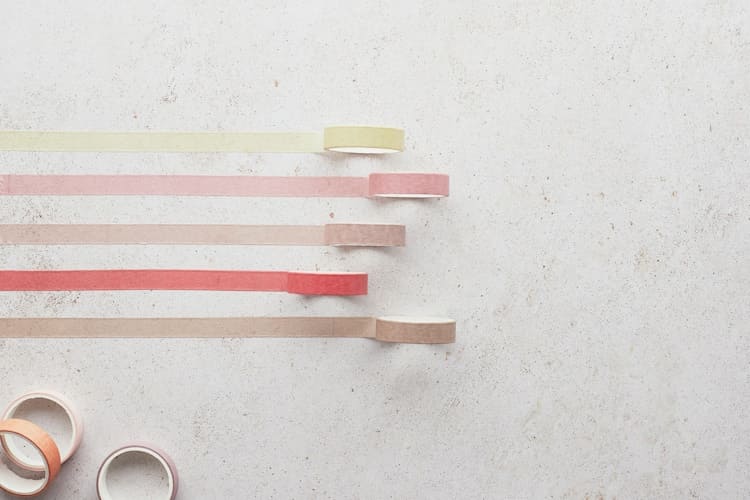
Professional artists often rely on specialized, acid-free, and age-resistant adhesive tapes. Photo by Olivie Strauss @olivie_strauss, via Unsplash
For professional artistic applications, specialized, acid-free, and age-resistant adhesive tapes are used. They do not use harsh solvents, but rather acrylic adhesives. However, even this is not immune to criticism from conservative artistic circles.
This is a topic that has sparked heated ideological debates within the international framing community, where gallery owners, framers, and artists exchange ideas. The current disputes revolve around the installation of original artworks. A recurring theme in these case studies is the attempt to mount artworks in passe-partouts.
A professional frame maker, known online under the pseudonym "greenTiff" , recently summarized the problem in an online forum as follows:
Acid-free double-sided adhesive tape is often touted as a solution, but it does not meet the strict standards of archival quality
Instead, the expert suggests the classic method using linen tape and the T-hinge technique . "The fewer connection points, the better, to avoid damage to the artwork," is his practical motto. Art needs room to breathe. A picture that is attached all around with double-sided tape will warp the paper because it naturally expands and contracts with humidity.
The US guide “Mastering Art Display” (published in December 2023 on All Flooring Now), on the other hand, highlights the pragmatic side: For short-term exhibitions or robust canvases, double-sided adhesive tape scores particularly well due to its “Time Efficiency” and the possibility of “Non-Invasive Mounting”, provided that attention is paid to archival quality.
Artists employ various techniques to avoid or at least mitigate the dangers of strong adhesives, as seen in the work of Simon Hurley . The American mixed-media card designer is a remarkable example of creative material management. Traditional white foam tapes would ruin the illusion of floating pieces in his multi-layered paper creations. Therefore, Hurley insisted on using only clear foam double-stick tape to discreetly and three-dimensionally layer his delicate, die-cut pieces and avoid unsightly white edges.
Three-dimensionality in textile art
Standards for contemporary work with textiles and mixed media are highly diverse. The focus is on the concealed fixing of fabrics and textures to fixed structures, rather than the usual framing. According to the textile art scene (as reported in the trade journal TextileArtist ), double-sided tape is an indispensable mounting tool. It allows the edges of the fabric to be neatly positioned around embroidery hoops or wooden supports before being sewn or glued.
Adhesive tape is the "third hand ." It holds for a moment while the creative process is still underway. The challenge lies in developing an adhesive tape that can hold heavy materials but doesn't leave sticky residue in the fibers when the position needs to be changed again. Many people prefer to paper-based "artist's tape" , which can be removed without leaving any residue, rather than traditional foam tape.
Adhesive tape in exhibition practice
Workarounds are common in professional exhibition installations. In 2023, gallery technician and artist "cree8vision" a clever sandwich trick from the Chelsea gallery scene in New York on the r/ContemporaryArt subreddit: artists often use strong double-sided tape, which is very aggressive and not exactly kind to delicate artworks.
To avoid this, the artists at cree8vision a layer of painter's tape directly to the back of the artwork, as this is easy to remove. The strong double-sided adhesive tape is only applied to this protective covering. This creates an extremely strong bond with the wall, which can be easily removed from the artwork without leaving any residue.
The holding force in the background
The reality in the studio is rarely as tidy as an artist's Instagram account. Sometimes, the magnificent compositions on the wall wage a practical battle with the materials behind them. In this case, double-sided tape is both a blessing and a curse. It allows for floating mounts, quick fixes in mixed-media pieces, and clean edges in textile art.
Artists who think long-term not only invest in high-quality paints and canvases, but also research materials that work in the background. Because in the end, it is often an inconspicuous half-millimeter of adhesive tape that makes the difference between a timeless work of art and one that sinks into insignificance in the middle of the opening.
Owner and Managing Director of Kunstplaza . Publicist, editor, and passionate blogger in the fields of art, design, and creativity since 2011. Graduated with a degree in web design from university (2008). Further developed creative techniques through courses in freehand drawing, expressive painting, and theatre/acting. Profound knowledge of the art market gained through years of journalistic research and numerous collaborations with key players and institutions in the arts and culture sector.
We use technologies such as cookies to store and/or access device information. We do this to improve your browsing experience and to display (non-)personalized advertising. If you consent to these technologies, we can process data such as browsing behavior or unique IDs on this website. Refusal or withdrawal of consent may adversely affect certain features and functions.
Functional
Always Active
Technical storage or access is strictly necessary for the legitimate purpose of enabling the use of a specific service expressly requested by the subscriber or user, or for the sole purpose of carrying out the transmission of a message over an electronic communications network.
Preferences
The technical storage or access is necessary for the legitimate purpose of storing preferences that were not requested by the subscriber or user.
statistics
Technical storage or access that is solely for statistical purposes.Technical storage or access that is used solely for anonymous statistical purposes. Without a subpoena, the voluntary consent of your internet service provider, or additional recording by third parties, the information stored or retrieved for this purpose cannot generally be used to identify you.
marketing
Technical storage or access is required to create user profiles, to send advertising, or to track the user on one or more websites for similar marketing purposes.








 Vintage chest of drawers in factory design, wood + aluminum
1.485,00 €