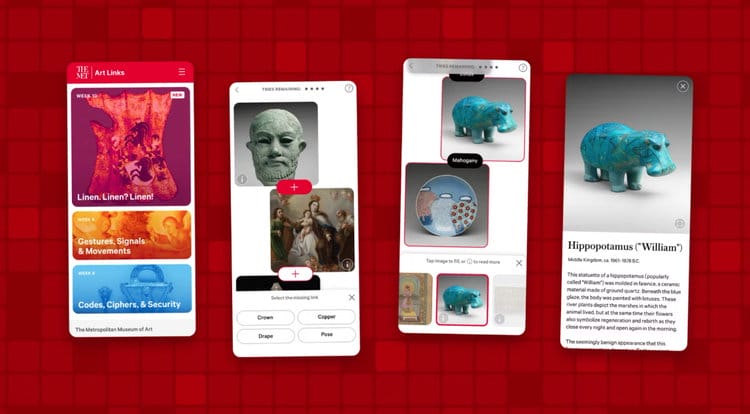
In recent days and weeks, media reports have been overwhelmingly focused on digital art and the art world's use of new technologies. While things had quieted down regarding crypto art and NFTs, the Metropolitan Museum of Art a remarkable blockchain game. Art Links invites players to identify commonalities and interesting connections between artworks in the Met's collection.
The renowned auction houseChristie'sheld its first-ever auction dedicated exclusively to works created by artificial intelligence.In a world premiere event in New York, approximately 20 AI-generated artworks were auctioned. Titled"Augmented Intelligence," the auction focused solely on this form of AI art.
Artists from around the world are vehemently protesting this auction, as they see their livelihoods acutely threatened. They perceive it, above all, as another breach in the dam leading to the normalization of an art market devoid of human creativity.
In this context, the supposedly defunct NFT art form fertile ground for a possible revival in the Digital Art Arena. Let's put these events into perspective and hear from industry experts.
The Metropolitan Museum of Art has launched “Art Links,”TRLab , this mobile, browser-based game allows players to collect NFT badges and win personal and digital rewards.
Art Links – The Metropolitan Museum of Art's Blockchain Game . Image source: Press release from The Met
The game launched on January 23, 2025, and has offered weekly challenges over a 12-week period. Participants earn points by finding art-based "chains" and have the chance to win prizes such as museum exhibition catalogs and exclusive tours.
“Art Links” is available on the Met website at artlinks.metmuseum.org .
This online game is an exciting premiere for The Met and a unique experience in the museum field,”
Max Hollein and Marina Kellen , French Director and Chief Executive Officer of the Met, explained * .
By bringing together artworks from collections across the museum – from modern and contemporary art to Asian and Egyptian art – players can expand their engagement with and understanding of culture and creativity in a fun and engaging way. Art Links is an example of how The Met continues to connect audiences with ideas and with each other, while exploring new technologies
Audrey Ou , co-founder and CEO of TRLab, added:
As a company at the forefront of art and technology, we are committed to providing audiences with new ways to discover, engage with, and immerse themselves in art and culture. Partnering with The Met for its first Web3 experience reflects our belief that the future of art lies in deepening the connections between creators, collectors, and fans. We combine digital innovation with artistic expression to create truly transformative experiences
The Met, as one of the world's leading museums, is thus living up to its pioneering role and is likely to inspire other players in the art world to follow suit. This gives the topic of Web3 a significant boost in attention and is likely to appear on the agenda of many museum directors in the near future.
NFT art in 2025: Is the hype finally over or is it experiencing a rapid revival?
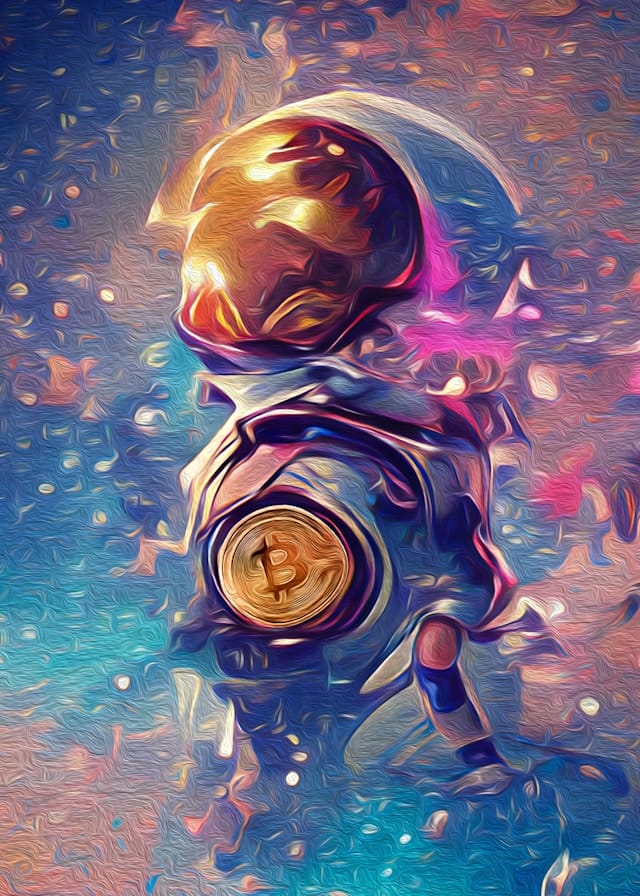
What is the true state of the market for NFTs and crypto art? Photo by Mo @mo_design_3d
The acronym NFT (short for Non-Fungible Token), once a term understood only within cryptocurrency circles, has become a familiar concept. In 2021, the market for NFT art experienced a massive boom, something unimaginable just a few years prior. Reports of digital artworks selling for millions of dollars caused a sensation and attracted both seasoned collectors and interested newcomers.
But the initial enthusiasm inevitably began to wane. As we've completed the first few weeks of the new year 2025, a crucial question arises: Was the boom in the NFT art sector a temporary hype, or merely the prelude to a fundamental shift in the way art is created, collected, and valued?
Recap: Where did the development of NFT begin?
Non-fungible tokens (NFTs) are digital assets recorded on a blockchain that provide proof of ownership or authenticity for a specific object, such as a fully digital art form. NFTs were invented in 2014, but only gained significant attention around 2017, followed by a huge surge in 2019.
Unlike cryptocurrencies such as Bitcoin or Ethereum , which are interchangeable or "fungible," NFTs are distinguished by their uniqueness and cannot be replaced by an identical physical object. Each NFT contains metadata that differentiates it from other tokens. This makes it ideal for verifying digital ownership, provenance, and rarity, thus positioning it as an essential component of the digital art and collectibles market.
In the following video, CAI Director Julien Delagrange* digital art, NFTs and their significance for the art world and clarifies three fundamental questions in this context:
Julien Delagrange, born in Belgium in 1994, is an art historian, contemporary artist, and director of the CAI and the CAI Gallery. Drawing on experience from the Centre for Fine Arts (BOZAR) in Brussels, the Jan Vercruysse Foundation, and the Ghent University Library, he combines art historical analysis with creative practice in his work. His artworks and art criticism explore contemporary art and strive for innovative perspectives within the art world.
The NFT market presents a mixed picture
Looking at the current state of the NFT art market , particularly in the United States, a complex picture emerges. The tumultuous highs of 2021 have passed, replaced by a more mature, albeit volatile, landscape at lower levels. The overall volume of NFT sales has undeniably declined. Many projects launched during the peak have faded into obscurity, leaving investors holding depreciating assets. However, this does not necessarily signal the end. Rather, it suggests a natural adjustment and a period of necessary evolution.
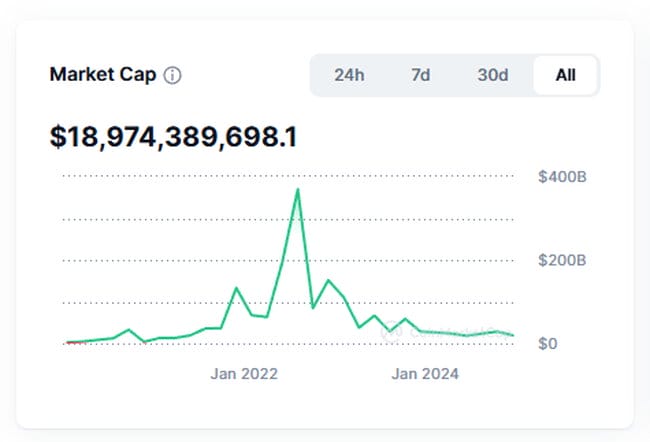
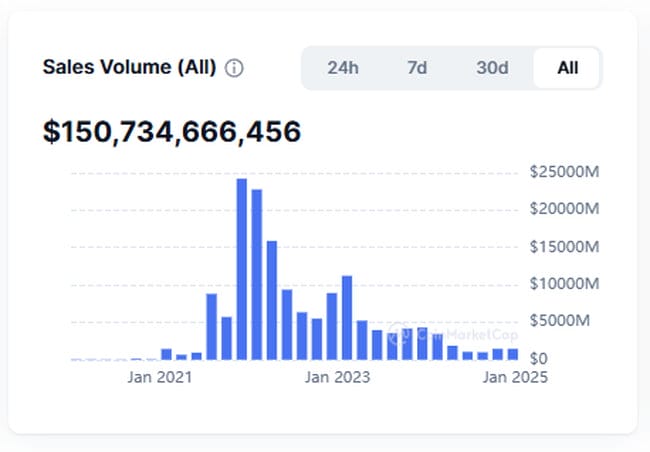
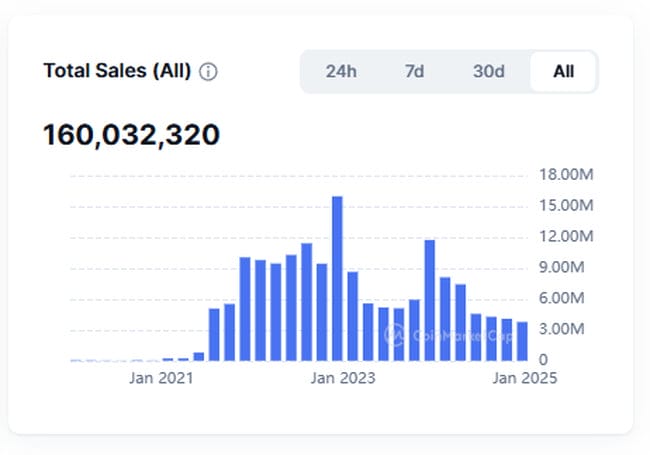
The following three charts from CoinMarketCap, the world's most referenced website for tracking crypto asset prices, indicate consolidation and even, more recently, a slight recovery in the NFT market:
Global NFT market capitalization by 2025 Source: CoinMarketCap
NFT trading volume worldwide until 2025 Source: CoinMarketCap
NFT sales worldwide through 2025 Source: CoinMarketCap
As we can see, the NFT sector peaked in May 2022 with an impressive market capitalization of $414 billion, currently stands at $35 billion, and has seen an increase of $18 billion since June. Sales volume has also increased since then, reaching a total weekly turnover of $187 million in December 2024. Although these figures suggest that the market is far from its peak, there are nevertheless indications of resilience and adaptation.
Digital currencies continue to be a practical means of digitally storing assets and enabling fast transactions. Numerous established cryptocurrency exchanges, wallets, and platforms exist for the straightforward exchange of (crypto)currencies – such as sol/usdt . This creates a solid foundation for NFTs and digital products based on blockchain or crypto assets.
challenges
One of the biggest hurdles facing the NFT art market is the challenge of countering the widespread perception that it is merely a speculative investment. The initial boom was at least partly due to the promise of quick returns. This led to an increase in low-quality projects that benefited from this trend and ultimately damaged the market's reputation.
Fraud , market manipulation , and wash trading have further eroded trust and deterred potential buyers. However, this cleansing process has also opened up new opportunities. By weeding out weaker projects, authentic artistic talent and innovative applications are coming to light.
The market is becoming increasingly demanding and expects more than just visually appealing works. Collectors now value utility, community engagement, and especially verifiable authenticity.
Another significant obstacle is accessibility . Newcomers can find it challenging to navigate the complex web of blockchain technology, understand transaction fees, and securely manage digital wallets. Overcoming these technological barriers is crucial for expanding the NFT art market beyond its current, relatively limited audience.
Technological innovations are driving the further development of the NFT market
the OAX Foundation* , which aims to provide a holistic view of the digital asset industry, the development of NFTspoints to untapped potential. The organization cites a number of technological developments as evidence, illustrating the increasing sophistication of the NFT sector over the past year:
Digitally-Linked Assets (DLAs) combine physical products with digital experiences via blockchain, thus expanding the concept of NFTs. They offer not only proof of authenticity for products but also exclusive rewards and access to virtual experiences, strengthening customer loyalty and interaction. Through their programmability and transparency, DLAs transform static digital art into an integral part of product ownership and foster brand engagement in new ways.
NFTX is revolutionizing the NFT market by combating illiquidity through fungible tokens (vTokens) that represent NFTs. This introduction of fungibility enables a simpler and more accessible trading experience and increases market efficiency. NFT holders can release liquidity without having to directly sell their assets, attracting new participants and lowering barriers to entry. Overall, NFTX is creating more dynamic and flexible markets for NFTs.
Bitcoin ordinal numbers enable the creation of unique digital assets directly on the Bitcoin blockchain by integrating data into individual satoshis. This innovation has attracted developers and users previously focused on Ethereum-based NFTs, thus diversifying the NFT landscape. Additionally, ordinals introduce a novel method for tokenizing assets, increasing Bitcoin's versatility and driving demand for block space—a crucial factor for the network's long-term sustainability. Despite discussions about potential block congestion, ordinals open up creative possibilities for Bitcoin and enrich the entire NFT market.
Yat Siu is optimistic about whether NFTs can reach new record levels. He compares NFTs to owning a Picasso. Although the current market is facing challenges, he sees these as part of a natural growth cycle. He believes the future of NFTs lies in their evolution into status symbols and useful tools, potentially even surpassing the peak of 2021.
However, the expert believes that the clarification of fundamental issues such as licensing fees, scalability, and public trust is crucial for their continued success. The NFT market is maturing as speculation is increasingly replaced by benefit assessments, creating a clearer basis for evaluating the long-term potential of projects and helping market participants better assess opportunities and risks.
Critical factors for long-term market success
The long-term success of NFT art is closely linked to its ability to leverage the unique advantages of blockchain technology . Beyond simple ownership verification, blockchain provides artists with unparalleled control over their work and innovative monetization strategies.
The immutable nature of the blockchain ensures the authenticity and provenance of digital artworks. This is particularly important in an age where digital copies can be easily reproduced, giving collectors confidence and protecting artists from copyright infringement.
Smart contracts allow artists royalties into their NFTs, ensuring they receive a share of future sales. This creates a sustainable revenue stream that benefits artists and incentivizes the production of high-quality work.
NFTs can be divided into shares, allowing multiple people to become co-owners of a single artwork simultaneously. This opens the art market to a broader investor base and makes valuable pieces more accessible.
NFTs can be designed to evolve over time, respond to external data, or even integrate generative elements . This gives artists the opportunity to create dynamic and interactive experiences that blur the lines between art, technology, and performance.
NFT artists are breaking new ground
Particularly in the US, NFT artists continue to push the creative boundaries for crypto art. Image by Jonathan Borba @jonathanborba, via Unsplash
Despite market fluctuations, a dynamic community of NFT artists in the US continues its efforts to redefine the boundaries of digital art. These creatives are not simply reproducing traditional art forms in digital format; they are actively exploring the unique opportunities presented by blockchain technology.
Artists like Refik Anadol are pioneers in the use of artificial intelligence and data to create impressive generative artworks that respond to real-world situations.
Beeple , known for having sold its NFT “Everydays: The First 5000 Days” for $69 million, continues to produce visually captivating and thought-provoking digital art that engages the viewer on multiple levels.
Artists like FEWOCiOUS use NFTs to create vibrant online communities that encourage collaboration and offer collectors the opportunity to actively participate in the creative process.
Artists like XCOPY create visually stunning and conceptually profound digital works that challenge conventional notions of beauty and value. These artists, along with many others, are not only contributing to art production; they are shaping a new artistic ecosystem that is decentralized, transparent, and accessible to all.
What happens next? An outlook
In 2025, the NFT art market will be shaped by several crucial trends. Institutional acceptance of NFTswill increase as traditional art institutions increasingly enter the digital space, thereby further legitimizing this art form (see The Met's Art Links).
User-centric NFTs will gain importance by offering tangible benefits such as exclusive access and memberships. Integration with the metaverse opens up new possibilities for trading digital assets in immersive environments. Furthermore, the focus on sustainability will grow through the development of environmentally friendly solutions in blockchain technology, increasing their appeal to environmentally conscious collectors.
The blurring of lines between physical and digital art invites creative collaborations and creates hybrid works that connect both worlds. Despite past volatility, the potential of the NFT market remains fascinating; greater maturity and stronger integration with the traditional art world are to be expected.
Artists and collectors who prioritize quality and community, and who utilize the possibilities of blockchain, will become part of a new artistic movement that democratizes creation and expands the repertoire of creative expression.
The hype may be dying down, but the potential for use is perhaps only just beginning to unfold.”
AI art has arrived in the art market – What does the Christie's auction mean for the future of the art industry?
Which brings us to the third major topic surrounding digital art: Is AI art still art? And what does this development mean for flesh-and-blood artists?
While a group of artists protested vehemently and demanded the immediate cancellation of the planned auction in a forceful open letter, the auction house remained unmoved and instead saw the situation as an opportunity to tap into a new business area. These differing perspectives vividly illustrate the tension between artistic ideals and commercial interests .
The artists who have joined forces feel their work is threatened; they see the impending auction as a form of exploitation of their creative labor. In their letter, they appeal to the auction house to take responsibility and question the practices of the art market, which often disregard the dignity of art and its creators. Their voice is filled with concern for the future of the art world.
On the other hand, the auction house interprets this situation as an opportunity to potentially attract new customers and develop innovative business models. Instead of taking the artists' appeal seriously and opening up possible dialogues about the ethical dimensions of the art market, it focuses on how it can expand its portfolio and increase revenue.
This attitude could be considered short-sighted, as it may fail to recognize that long-term success is based on trust and respect within the art community.”
It is a multifaceted conflict that not only affects the interests of artists and auction houses, but also raises fundamental questions about the value of creativity and the importance of artistic statements in an increasingly commercialized world.
Art historian Henrik Hanstein , who acts as spokesman for the Association of European Auctioneers, expressed understanding for the artists' concerns WDR
"Who is the artist here?"
questioned the managing director of the Cologne auction house Lempertz.
And who owns the copyright? The computer, the programmer, or the artist whose data the AI used? We are all facing a puzzle here.”
“The artists are of course becoming victims in this matter.”
Hanstein warns.
Many need a lifetime to make a name for themselves.”
Nevertheless, the artists have always embraced new technological possibilities with enthusiasm.
Karin Lingl of the Kunstfonds Foundation already expressed concerns in the summer of 2024 regarding the impact of AI-generated art on the market. Many artists fear that this technology could devalue art, which is why 85 percent are calling for mandatory labeling of such works.
Sources, technical support and further information:
The Met:The Metropolitan Museum of Art Launches New Blockchain Game , https://www.metmuseum.org/de/press-releases/met-art-links
MenaFN:NFT Art In 2025: Is The Hype Over Or Just Beginning? , https://menafn.com/1109217295/NFT-Art-In-2025-Is-The-Hype-Over-Or-Just-Beginning
OAX Foundation : The State of NFTs in Q4 2024 , https://www.oax.org/2024/12/20/The-State-of-NFTs-in-Q4-2024.html
Julien Delagrange / CAI : The Truth About Digital Artists, NFTs & the Art World Answering 3 Essential Questions , https://www.contemporaryartissue.com/the-truth-about-digital-artists-nfts-the-art-world/
WDR:Controversial Christie's auction: Is AI art still art? , https://www1.wdr.de/nachrichten/christies-auktion-ki-kunst-protest-100.html
Kunstfonds Foundation : Germany's first study on the impact of AI on visual arts , https://www.kunstfonds.de/aktuelles/details/deutschlandweit-erste-studie-zu-auswirkungen-von-ki-auf-bildende-kunst
ZEIT online:Auction at Christie's: It's called freedom , https://www.zeit.de/kultur/kunst/2025-02/christies-auktion-ki-kunst-protest-kuenstler-unterschriften
Owner and Managing Director of Kunstplaza. Journalist, editor, and passionate blogger in the field of art, design, and creativity since 2011. Successful completion of a degree in web design as part of a university study (2008). Further development of creativity techniques through courses in free drawing, expressive painting, and theatre/acting. Profound knowledge of the art market through years of journalistic research and numerous collaborations with actors/institutions from art and culture.
In this magazine section, you will find numerous reports and articles about the use of artificial intelligence (AI) in art,design and architecture.
It's not just about the question of how AI can be used in these areas, but also about the impact this has on creative creation.
For while some experts believe that the use of AI will lead to a revolution in art and design, there are also voices from within the industry itself that are skeptical of AI art and AI-powered image generators.
An early example from 2016 of the use of AI in art is the project “The Next Rembrandt” . Here, software was developed that created a new painting in the style of the Dutch painter based on data analysis – without human intervention.
The result was surprisingly realistic and clearly demonstrated the potential of this technology even back then.
What does this development mean for traditional crafts? Will they become obsolete or can new opportunities be created?
These questions occupy many people both within and outside the industry alike.
In any case, the connection between art and artificial intelligence offers us exciting insights into possible future scenarios.
We warmly invite you to embark on an adventure of discovery with us!
We use technologies like cookies to store and/or access device information. We do this to improve the browsing experience and to show (non-)personalized ads. If you agree to these technologies, we can process data such as browsing behavior or unique IDs on this website. The refusal or withdrawal of consent may adversely affect certain features and functions.
The technical storage or access is necessary for the legitimate purpose of storing preferences that are not requested by the subscriber or user.
Always active
Die technische Speicherung oder der Zugang ist unbedingt erforderlich für den rechtmäßigen Zweck, die Nutzung eines bestimmten Dienstes zu ermöglichen, der vom Teilnehmer oder Nutzer ausdrücklich gewünscht wird, oder für den alleinigen Zweck, die Übertragung einer Nachricht über ein elektronisches Kommunikationsnetz durchzuführen.
Vorlieben
Technical storage or access is required for the lawful purpose of storing preferences that have not been requested by the subscriber or user.
Statistiken
The technical storage or access that is used exclusively for statistical purposes. The technical storage or access that is used exclusively for anonymous statistical purposes. Without a subpoena, voluntary compliance by your internet service provider, or additional records from third parties, information stored or retrieved for this purpose alone cannot usually be used to identify you.
Marketing
Die technische Speicherung oder der Zugriff ist erforderlich, um Nutzerprofile zu erstellen, um Werbung zu versenden oder um den Nutzer auf einer Website oder über mehrere Websites hinweg zu ähnlichen Marketingzwecken zu verfolgen.






 Round rug "Miami", dark green, Ø 160 cm
105,00 €
Round rug "Miami", dark green, Ø 160 cm
105,00 €