Art is more than just an expression of creativity – it is a mirror of society, its customs, symbols, and desires. A surprising yet persistent motif in art history is tobacco.
Whether in paintings , literature or contemporary installations – tobacco and smoking have inspired artists and helped to illustrate complex themes such as pleasure, vice and human nature.
But why has tobacco found its firm place in the art world, and how does its meaning change in modern artistic works?
Tobacco in classical art: A symbol of luxury and transience
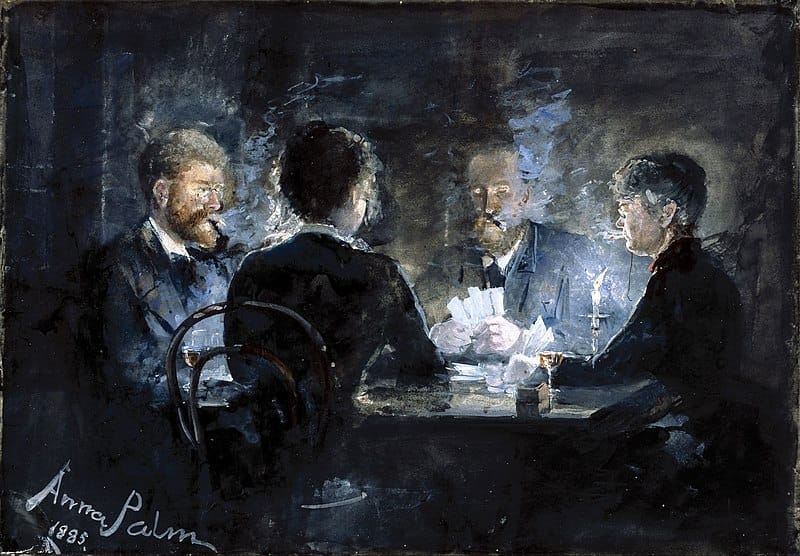
In the 17th and 18th centuries, tobacco was considered a luxury item that only the wealthy could afford. This is reflected in many still lifes and paintings of the time. Artists such as Pieter Claesz and Willem Claeszoon Heda painted elaborately arranged scenes in which pipes, smoking accessories, and tobacco were depicted as symbols of wealth and the transience of life.
Male Irish farmer standing in a doorway smoking a pipe (Photoglob Zürich, reprinted by Detroit Publishing Co.) Image source: Photoglob Zürich, reprinted by Detroit Publishing Co., CC BY 2.0, via Wikimedia Commons
Smoking itself became a symbol of leisure and enjoyment – but also of transience, as the smoke quickly dissipates and dissolves.
Over the centuries: Smoking has become a symbol of leisure and enjoyment. Photo by JJ Jordan @jjjordan, via Unsplash
Today, tobacco as a recreational drug remains a controversial topic, sparking discussions about its enjoyment and health risks. In modern art, its symbolism has shifted, moving away from pure luxury towards more critical perspectives.
People causing a nuisance by smoking in the street. Colored etching by H. Heath, 1827. Image source: Wellcome Images, CC BY 4.0, via Wikimedia Commons
A good example of the change in tobacco culture is Break Tobacco , whose products find their place in contemporary interpretations.
From Dandies and Poets: Tobacco in Literature and Poetry
Tobacco has secured a firm place not only in painting but also in literature . Poets like Charles Baudelaire and Oscar Wilde associated smoking with intellect and rebellion. For Wilde, who described cigarette smoking as "the perfect form of pleasure ," tobacco symbolized the connection between creativity and a decadent lifestyle.
Oscar Wilde in a typical pose with a cigarette, circa 1892
The cigarette in the poet's hand thus became the trademark of an entire generation that broke away from conventions and embraced free, often provocative expression.
Tobacco also appears repeatedly as a motif in modern literature illustrate freedom and vice
A woman sits naked on a chair and smokes. Photogravure. Image source: Wellcome, CC BY 4.0, via Wikimedia Commons
In film and television, tobacco plays a similar role: the smoking protagonist in a noir film embodies mysticism and aloofness, while the harried detective in the smoky office paints a picture of harsh reality.
Contemporary Art: Critical Examination and New Perspectives
Modern art has an ambivalent relationship with tobacco. While it was once considered a glamorous and seductive motif, it is now often viewed critically. Artists use tobacco and smoking as metaphors for consumerism, addiction, and societal constraints .
Stable diffusion – “two red guards smoking in the street” Image source: Tullius Detritus, CC0, via Wikimedia Commons
Installations and sculptures that work with cigarette butts and tobacco leaves encourage reflection on the use of stimulants and their place in society.
Street art in Gatineau, Quebec, Canada Image source: Hodnett Canoe, CC BY-SA 4.0, via Wikimedia Commons
In street art and modern installations, tobacco often appears as part of a larger commentary: What does pleasure mean in a world that simultaneously glorifies health and enjoyment? These explorations are not only part of art, but also reflect the social and cultural issues of our time.
5 Pointz artwork, photographed by Selina Chan, April 2013. Image source: 50mmPhotography, CC BY-SA 4.0, via Wikimedia Commons
Graffiti on Ulica Morska 11A in Gdynia. CC BY-SA 4.0, via Wikimedia Commons
Tobacco has remained a captivating motif in art for centuries, touching on many facets of the human experience: pleasure, transience, rebellion, and critique of consumerism. From the Baroque period to contemporary art, its meaning has evolved, yet it remains a constant element of artistic representation.
What was once considered an expression of luxury and enjoyment of life is now often part of a critical examination of our society and its values.
This makes tobacco a sought-after artistic motif that will continue to be interpreted in a variety of ways in the future – always in the tension between tradition and modernity.
Owner and Managing Director of Kunstplaza . Publicist, editor, and passionate blogger in the fields of art, design, and creativity since 2011. Graduated with a degree in web design from university (2008). Further developed creative techniques through courses in freehand drawing, expressive painting, and theatre/acting. Profound knowledge of the art market gained through years of journalistic research and numerous collaborations with key players and institutions in the arts and culture sector.
We use technologies such as cookies to store and/or access device information. We do this to improve your browsing experience and to display (non-)personalized advertising. If you consent to these technologies, we can process data such as browsing behavior or unique IDs on this website. Refusal or withdrawal of consent may adversely affect certain features and functions.
Functional
Always Active
Technical storage or access is strictly necessary for the legitimate purpose of enabling the use of a specific service expressly requested by the subscriber or user, or for the sole purpose of carrying out the transmission of a message over an electronic communications network.
Preferences
The technical storage or access is necessary for the legitimate purpose of storing preferences that were not requested by the subscriber or user.
statistics
Technical storage or access that is solely for statistical purposes.Technical storage or access that is used solely for anonymous statistical purposes. Without a subpoena, the voluntary consent of your internet service provider, or additional recording by third parties, the information stored or retrieved for this purpose cannot generally be used to identify you.
marketing
Technical storage or access is required to create user profiles, to send advertising, or to track the user on one or more websites for similar marketing purposes.



 Upholstered stool "Gamby" with velvet cover in an elegant black and gold color combination
59,00 €
Upholstered stool "Gamby" with velvet cover in an elegant black and gold color combination
59,00 €


