
Key movements in abstract art and their most important artists
In our article "Abstract Art – All About the Non-Representational Art Movement," we explored abstract art as a concept, an influential art movement, and how to engage with it. We learned that "non-representational art" or "non-objective art" is a collective term for art movements of the 20th century that emerged after 1900.
The most significant common denominator in abstract works is the departure from nature and real objects as motifs, and consequently the break with the academically steeped traditional principles of classical realism.

by Steve Johnson @steve_j, via Unsplash.com
In short: The principles of abstract artists are based on the rejection of any representation. Their consciousness and creative drive are said to be driven purely by aesthetics for its own sake.
The roots of abstraction in pictorial design even reach back to ancient Greece, where Plato already expressed the urge for non-representational design using geometric shapes and patterns.
Naturally, this type of creative art has not remained unchanged in its original form to this day, but has undergone a natural evolution and development. This can be visualized like the branching of an old tree with a proud trunk and deep roots.
Over the decades and centuries, numerous sub-forms, variations, parallel movements and counter-trends have emerged, all of which are interconnected and have often cross-pollinated each other.
Therefore, we would like to take you on a brief journey through the most important and formative phases of abstract, concrete, and modern art . Wherever possible, we strive to highlight significant turning points, connections, and causal relationships so that you can gain a coherent understanding.
If you were missing one or two pieces of the puzzle after reading our last post on this topic, you might find them here.
Let's start at the very beginning…
Show
table of contents
Abstract painting in the Stone Age
There is a consensus among art historians that abstract art was already used in the form of prehistoric engravings about 70,000 years ago.

Image source: Gobierno de Cantabria, CC BY 3.0, via Wikimedia Commons
This is evidenced, for example, by two boulders engraved with abstract geometric patterns, which were found in Blombos Cave in South Africa. Then, tens of thousands of years later, there were the abstract reddish dots and hand stencils discovered in the paintings of El Castillo Cave dating from 39,000–34,000 BC.
Abstract symbols were also the predominant form of Paleolithic cave art and were found about twice as often in excavations as figurative paintings.
Classical realism up to the late 19th century
Almost until the end of the 19th century, the principles and methods of artists in painting and sculpture were strongly influenced by academic standards and doctrines.
A departure from the traditional model of classical realism was frowned upon and met with disregard. The major art academies of Europe seized the power of interpretation and proclaimed that the paramount duty of art was to provide a recognizable scene or object.
Important representatives of Romanticism with an influence on abstract art:
- Joseph Mallord William Turner (1775-1851): English painter, watercolorist, and draughtsman. Arguably the most important visual artist in England during the era . His avant-garde Expressionism evolved into abstraction.

Multiple Artists [CC0], via Wikimedia Commons
Trend towards abstraction in Impressionism
In the last quarter of the 19th century, the tide gradually turned, and the conservative corset began to crack. As the first subversive force, Impressionist art (1870-1880) demonstrated that the strict academic style of naturalistic painting was no longer the only authentic way to create significant art.
The Impressionists' technical palette was generally not very naturalistic, although Impressionist art usually remained firmly and clearly derived from the real world. The intra-Impressionist movements of Neo-Impressionist Pointillism and Post-Impressionism impressively highlighted the power of color.
one considers the use of bright yellow in works by Vincent van Gogh , it almost seems as if the artist is capturing the light itself in it.

Looking at Claude Monet's last work of water lilies, it becomes clear that even within the Impressionist era, an increasing trend towards abstraction emerged.

Later, in the first decades of the 20th century, further techniques – such as the stylistic use of color, the abandonment of three-dimensional representation and the recourse to simple geometric forms – would fuel the pursuit of abstraction and provide its artists with new tools.
Important representatives of (Post-)Impressionism with an influence on Abstract Art:
- James McNeill Whistler (1834-1903) was a British-based painter and printmaker from the USA. He was particularly known for his semi-abstract color painting.
- Claude Monet – an important French painter, moved between naturalism and abstraction in his paintings after 1890.
- Vincent van Gogh – Dutch painter and draftsman; he is considered one of the founders of modern painting.
- Paul Gauguin – an influential French painter. His post-Impressionist work strongly influenced the Nabis and Symbolism; he was a co-founder of Synthetism and became a pioneer of Expressionism .
- Henri de Toulouse-Lautrec – French painter and graphic artist of the Post-Impressionist movement
- Paul Cézanne (1839-1906) – French painter whose work is associated with various styles. He consistently sought to renew traditional methods of composition based on Impressionist principles. His still lifes and landscapes are considered important starting points for abstraction.
- Paul Serusier (1864-1927) – French Post-Impressionist painter. Founder of the symbolist artist group Nabis and strongly influenced by Gauguin.
Art Nouveau movement/Art Nouveau
The development of abstract art was also influenced by the Art Nouveau movement (around 1890-1914). Art movements associated with Art Nouveau include the Reform Style (following the Reform movement) and the Secession Style (following the Vienna Secession).
The term Jugendstil (Art Nouveau) was coined by Georg Hirth in Munich at the end of 1895, through an illustrated cultural magazine called "Jugend" (Youth). This art movement can be understood as a reaction, primarily by young artists and craftspeople, against the backward-looking historicism of the time. It also served as a critique of the perceived soullessness of early 20th-century industrialization.
However, it was the French term Art Nouveau that prevailed internationally. This originated from the gallery La Maison de l'Art Nouveau, which the Hamburg art dealer Siegfried Bing had opened in Paris at the end of the 19th century.
Typical features of Art Nouveau include, on the one hand, long, curved lines that take the organic forms of plants as their model, but also flat, linear geometric ornaments with a tendency towards asymmetrical design.
Independent, unbiased and free thanks to your click
Links marked with a symbol are affiliate links. We only recommend products we use (or would use) ourselves. If you visit affiliate links in our content, we may receive a commission on your purchase (at no extra cost to you). This helps fund the free editorial content we provide to you ( more details here ).
Links marked with a symbol are affiliate links. We only recommend products we use (or would use) ourselves. If you visit affiliate links in our content, we may receive a commission on your purchase (at no extra cost to you). This helps fund the free editorial content we provide to you ( more details here ).
The most important representative of the Art Nouveau movement is the Viennese golden boy Gustav Klimt .


From German Expressionism to the cornerstone of painting
The use of color and form was of paramount importance for the development of abstract art. Impressionism paved the way for a greater use of color as a stylistic device, but it was German Expressionism that made it an indispensable cornerstone of painting.
Wassily Kandinsky's book "Concerning the Spiritual in Art" (1911) became a foundational work of abstract painting. Kandinsky suffered from synesthesia, which explains his unusual sensitivity to color. He not only saw the colors but also heard them (perception with two senses). He lived, in a sense, a fusion of visual art and music .
It is no wonder, then, that the emotional effect of form, line and especially color in painting fascinated him so excessively and would shape his entire oeuvre.
Like many other abstract artists, Kandinsky believed that music embodied abstract art in its purest sense, with its ability to be expressive without representing the real world. Kandinsky would refer to his works as "compositions.".
At the same time, however, he repeatedly warned that the desire for abstraction should not be used for mere decoration – without jeopardizing the seriousness of art.
Of all the arts, abstract painting is the most difficult. It requires that one can draw well, that one has a pronounced sense of composition and color, and that one is a true poet. The latter is essential
Kandinsky was quoted.


Abstract painting “Heavy Red” (1924) by Wassily Kandinsky, giclée print on canvas
German Expressionism is characterized by its saturated color palette and the correspondence of colors to human emotions. In general, experimenting with color and evoking emotions was a primary interest of abstract artists.
Most German Expressionists, such as Ernst Kirchner, Karl Schmidt-Rottluff, Max Ernst, Alexei Jawlensky, Oskar Kokoschka, Franz Marc, August Macke and Max Beckmann , were not abstract painters in the strict sense.
However, their vibrant palette – together with Kandinsky's theoretical writings – alarmed and encouraged other artists with a more abstract inclination to pursue this with full force.

It is generally accepted that artists such as Piet Mondrian, Wassily Kandinsky, and Kazimir Malevich were instrumental in establishing abstract art. However, some of the earliest known works come from the pioneering artist Hilma af Klint . Initially, she created traditional figurative works, but her radical paintings arose from her interest in spiritualism.
Spiritualism was an extremely popular movement at the time in artistic and literary circles, which held the belief that communication with the spirits of the deceased was possible. Together with a group of four other women, later known as "The Five ," Klint conducted séances and meditated. Through this, she became convinced that a spirit named Amaliel had commissioned her to create paintings to decorate a temple.
The artist reported that Amaliel guided her hand and worked with immense devotion, creating a total of 193 paintings for this project by 1915. Aware of the radical nature of her work, Klint shrouded it in secrecy and stipulated that it could not be made public until 20 years after her death.
Despite this regulation, her work only received attention in 1986 and is now finally being properly appreciated: The Klint exhibition in 2019 at the Guggenheim Museum in New York was the most visited exhibition in the history of the institution up to that point.


Fauvism
The parallel Parisian avant-garde style of Fauvism (1905-08) only marginally emphasized the effect of color – for example with works such as “Red Studio” (1911, MoMA, NY) by Henri Matisse .
Here, too, the rejection of three-dimensional perspective is a defining characteristic. Fauvism depicts objects with intense, arbitrary color.
Henri Matisse was arguably the most famous Fauvist, and works like his "The Green Stripe" (1905) are still cited as prime examples of the characteristic style of this art movement. The work is a portrait of his wife with green and yellow skin against a multicolored background. Famous Orphist painters include Robert Delaunay , whose "Simultaneous Windows on the City" (1912) and "The First Disk" (1912-1913) consist of multiple patches or segments of different colors. Georgia O'Keeffe is known for her colorful, tightly cropped abstract flower paintings.
Alongside Matisse, Marlow Moss an artist who clearly embraced abstraction during this period. The critic Charles Darwent, writing in The Guardian , described her as "a faithful follower" of Mondrian. Although some consider her an imitator of the father of Neoplasticism, it could also be argued that the influence was reciprocal. Her works from the period following the rediscovery of Mondrian show his influence, but it was Moss who first incorporated double lines into her griddled works in 1931.
A year later, Mondrian followed this approach and created "Composition with Double Line and Yellow" . Largely forgotten in the history of abstract art, Moss's work has rightly experienced a kind of revival in recent years.
Cubism and the dissolution of depth of field and perspective
The birth of Cubism (1908-14) can be seen as a direct reaction to the decorative beauty and aesthetics of Impressionism. Pablo Picasso (1881-1973) and Georges Braque (1882-1963) developed this new style in several stages with this awareness.
Picasso's semi-abstract work "Les Demoiselles d'Avignon" from 1907 (now in MoMA, NY) was still part of the first phase of the prototype of Cubism.

Dario Mastromattei [CC BY-SA], via Wikimedia Commons
The next step was Analytical Cubism (see “Nude Descending Stairs No. 2” from 1912 by Marcel Duchamp (1887-1968)).
The final phase of Synthetic Cubism was significantly more collage-oriented. Its basic concept was based on evolving from the visually appealing but trivial art of Impressionism to a more intellectual art form. The primary goal of Cubists was to explore new methods for representing reality.
A characteristic feature of Cubist works was the dissolution of the academic method of representing reality through the use of linear perspective (depth) to achieve the usual three-dimensional effect of a painting.
In contrast, Cubists kept everything on a two-dimensional, flat plane, on which they laid out different "views" of the same object.
Although most Cubist works still originate from objects or scenes with real-world references and therefore cannot be considered completely abstract, the movement's rejection of traditional perspective completely undermined natural realism in art, thus opening the door wide to pure abstraction.
Important representatives of Cubism with an influence on abstract art:
- Francis Picabia (1879-1953) – French painter with influence on Cubism, Dadaism and Surrealism.
- Carlo Carra (1881-1966) – Known for his early cubist and futurist painting.
- Albert Gleizes (1881-1953) – Cubist painter, co-author of Du Cubisme, the first bound book on Cubism.
- Jean Metzinger (1883-1957) – was inspired by analytical Cubism; published “Du Cubisme” together with Albert Gleizes.
- Roger de la Fresnaye (1885-1925) – Uses the geometric simplicity of Cubism to make concrete, politically motivated statements
- Juan Gris (1887-1927) – Spanish painter and leading theorist of Cubism
- Constantin Brancusi (1876-1957) – a cubist-inspired abstract sculptor, was also influenced by African and Oriental art.
- Raymond Duchamp-Villon (1876-1918) – used Cubist tools to represent movement
- Jacques Lipchitz (1891-1973) – important French-American sculptor of the 20th century.
Orphism
This abstract painting style of the early 20th century was also Orphic Cubism and aimed to combine Cubist composition with color and music.
The term was derived from the mythical singer and lyre player Orpheus and was significantly shaped by Guillaume Apollinaire in 1912 after color-intensive works by Robert Delaunay .

Orphism is characterized more by bright patches of color than by figurative objects. Above all, circular forms in vibrant colors are the most prominent features of this art movement .
Important representatives of Vorticism:
- Robert Delaunay – French avant-garde painter who also wrote theoretical works on art
- Franz Kupka – Czech painter. Color always played a crucial role for Kupka.
Vorticism
Vorticism heavily influenced by Cubist terminology. The term derives from the Latin word "vortex," meaning "storm" or "whirlpool."
Founded by Percy Wyndham Lewis (1882-1957), Vorticism explicitly saw itself as a specifically English contribution to modernism. Similar to Cubism, it positioned itself as a counter-concept to realistic representations in art. Furthermore, Vorticism any moral imperative and insisted on the autonomy of the artwork.
Important representatives of Vorticism:
- Richard Aldington – English writer and editor of the avant-garde magazine "The egoist".
- Malcolm Arbuthnot – is considered the inventor of “Vortography”
- Lawrence Atkinson – English artist, musician and poet
- Jessica Dismorr – English painter and one of only two women active in the Vorticist movement
- Henri Gaudier-Brzeska – French sculptor
- Cuthbert Hamilton – British artist
- Wyndham Lewis – British writer and painter, co-founder of Vorticism and editor of the magazine Blast.
- Ezra Pound – an American poet – is considered one of the outstanding representatives of literary modernism.
- William Roberts – British painter of Cubism and co-founder of Vorticism
- Helen Saunders – English painter
- Edward Wadsworth – British painter who drew on Futurism and Cubism to develop geometric art to the point of abstraction.
Futurism
The Italian Futurist movement (1909-13) was largely founded by Marinetti (1876-1944) and expressed Gino Severini (1883-1966) and Giacomo Balla
This movement was also influenced by Cubism and, in turn, inspired numerous painters with its emphasis on movement and technology. In sculpture, Futurism had the strongest impact on the development of kinetic art and influenced abstract sculptors such as Naum Gabo (1890-1977) and Alexander Calder (1898-1976).
Tubism
Almost simultaneously, another related art movement emerged. In connection with the art of Fernand Léger (1881-1955), one could no longer speak of Cubism, but of Tubism (tube art) .
In this approach, cylindrical and spherical elements were used instead of the flat, overlapping elements of Cubism. This resulted in numerous paintings with machine-like motifs that reflected Léger's futuristic belief in technology.
Russian Suprematism leads to new geometric forms
The Russian movement for abstract art is known as Suprematism . It was named and founded in 1915 by its leading figure Kazimir Malevich (1878-1935) as an expression of the superiority of feelings and sensory perceptions in art.
Undoubtedly influenced by Kandinsky, Malevich created a series of outstanding abstract avant-garde paintings featuring rectangular, monochrome blocks on a white background. He thus emphasized the flatness of form in artistic works. In this respect, he was likely decades ahead of his time.


officially declared in black and white in his book entitled "The Non-Objective World"
Constructivism & Rayonism
Vladimir Tatlin (1885-1953) is considered the most important driving force behind the founding of the related Russian style of Constructivism . Lyubov Popova (1889-1924), along with Alexander Rodchenko (1891-1956), were also co-founders. This school focused on space, new materials, three-dimensional forms, and the connection between science and art. Lyubov Popova was also an important member of the Suprematist movement.
Another interesting Russian art movement that created a new type of painting was Rayonism (or Luchism). This movement spanned the years 1912-14 and was initiated Mikhail Larionov (1881-1964) and Natalya Goncharova
Abstract sculptors strongly influenced by suprematist/constructivist ideas included Sophie Taeuber-Arp (1889-1943) and Naum Gabo (1890-1977).
The influences of De Stijl
De Stijl was originally a Dutch group of painters, architects, and designers. The name quickly gained wider recognition through the founding of an artists' association and a Dutch design and aesthetics magazine.
This quickly led to the development of an avant-garde art movement primarily dedicated to geometric abstraction. Theo Van Doesburg (1883-1931) is considered the founding father of De Stijl and also assumed its leadership.
The clear protagonist of the movement, however, was Piet Mondrian (1872-1944), known for his series of simple rectangular grids containing only black, white, and primary colors. With his flat grids, he attempted to physically create the concept of infinity.

The concepts of De Stijl had an impact not only on fine art and architecture, but also on the design of furniture and other everyday objects, right up to the present day.
Neo-Plasticism & Elementarism
He called this style Neo-Plasticism (Nieuwe Beelding). As one of the most influential pioneers of concrete art between 1920 and 1944, he developed his precise geometric style as a conscious counterpoint to the emotional chaos and general uncertainty of the first half of the 20th century.
Together with the abstract group Cercle et Carre (1929-31) and the Abstraction-Creation Group, he moved his place of work to New York in 1938.
Neo-Plasticism , Elementarism during his creative period .
In 1930 he also coined the term " Concrete Art " . Unfortunately, he died in 1931, but his ideas were continued not only by students of the Bauhaus design school, but also by the Abstraction Creation group led by the Belgian artist Georges Vantongerloo , the French painter Jean Helion , and Auguste Herbin .
Other members of the group included European abstractionists such as Jean Arp (1886-1966), Naum Gabo (1890-1977), El Lissitzky (1890-1941), Antoine Pevsner (1886-1962) and Barbara Hepworth (1903-1975), as well as Ben Nicholson (1894-1982).
The Swiss ex-Bauhaus architect, sculptor and designer Max Bill (1908-94) was another supporter who made a significant contribution to promoting the genre in Switzerland, Italy, Argentina and Brazil.
Surrealism & organic abstraction
Organic abstraction is another subcategory of abstract art. Similarly, Surrealism, which arose parallel to geometric concretism, with its quasi-naturalistic imagery, is a close relative of abstraction.
The great role models of these styles of biomorphic / organic abstraction were Jean Arp and Joan Miró , neither of whom relied on the technique of automatism.
Her fellow surrealist Salvador Dali (1904-89) also created some extraordinary paintings such as "The Persistence of Memory" (1931, MoMA, NY) and "Soft Construction with Boiled Beans" (1936, Philadelphia Museum of Art).
Jean Arp was also an extremely prolific sculptor who specialized in organic abstraction. The English sculptors Henry Moore (1898-1986) and Barbara Hepworth (1903-1975) followed his example in this regard.
A number of abstract artists from Europe later sought refuge in America, where they encountered and influenced a new generation of native abstract painters.
These influential emigrants included painters such as Hans Hofmann (1880-1966), Max Ernst (1891-1976), Andre Masson (1896-1987), Arshile Gorky (1904-48), Yves Tangy (1900-55) and others.
Despite the controversy surrounding the New York gun show of 1913, the American metropolis developed a strong interest in abstraction. The world-famous Museum of Modern Art (MoMA) was founded in 1929, and the Museum of Non-Objective Painting (later renamed the Samuel R. Guggenheim Museum) in 1939.
Less geometry, more color – abstract expressionism
Although post-war European artists maintained their interest in abstract art through the "Salon des Realités Nouvelles" in Paris, the center of modern art had shifted to New York from 1945 onwards.
From then on, the avant-garde was represented there by the New York School of Abstract Expressionism . This movement emerged from the Great Depression and the Second World War.
Abstract Expressionist painting remains somewhat vaguely defined, and there was never a coherent, postulated program for it. Therefore, the term is often misleadingly and confusingly applied to artists who were neither truly abstract nor expressionist .
He generally describes a form of abstract painting (non-figurative, non-naturalistic) in which color takes precedence over form. And the latter is no longer geometric.
Early works in this style typically filled large canvases, their sheer size intended to overwhelm viewers and draw them into another world. Abstract Expressionists' preoccupation with visual effects, particularly the impact of color, reflected their primary goal: the inclusion and exploration of fundamental human emotions.
Among their icons were undoubtedly the artistic greats Jackson Pollock (1912-56), Mark Rothko (1903-70), Willem De Kooning (1904-97), Clyfford Still (1904-80), Barnett Newman (1905-70) and Adolph Gottlieb (1903-74).
In the early 1940s, Pollock revolutionized painting with his completely abstract works, laying canvases on the floor and pouring and wiping paint. This technique resulted in dense compositions without a central focus and challenged traditional art concepts. His works reflected not only his personal touch through footprints and handprints, but also the dynamic nature of his creative process, which positioned him as a performer.
Pollock's approach emphasized the immediacy of the artistic gesture, making him a key figure in Abstract Expressionism. Inspired by the Surrealist movement and Jungian psychoanalysis, his paintings offered profound insights into his emotions and reflected modern life.


Mark Rothko also strove to express profound human emotions through innovative use of color and form. In his early works, he combined recognizable shapes with mythological and biological sources of inspiration before replacing them with intense layers of color. These thin layers of paint create a pulsating movement and an atmosphere that envelops the viewer.
Rothko's works position the viewer at an interface between the physical and the transcendent world, and he deliberately chose numbers as titles to avoid personal associations. His aim was to facilitate timeless and spiritual experiences and to foster an intimate dialogue between artwork and viewer. Rothko's focus on color as a means of expression has had a lasting impact on the development of abstract art.


The next generation included painters like Robert Motherwell . The name of the movement was solidified by Robert Coates, who worked as an art critic for The New Yorker.
Offshoots of Abstract Expressionism include Pollock's "Action Painting" and Rothko's "Color Field Painting" , as well as the somewhat strange "Abstract Impressionism" of Philip Guston (1913-80).
Action painting, color field painting & Co.
Later, under the umbrella of post-painterly abstraction, abstract expressionism, as a kind of anti-gesturalist trend, gave rise to a number of individual styles. These included: Hard-edge painting , color splash painting , the Washington Color Movement , American lyrical abstraction , and shaped canvas .
Abstract Expressionism also provoked avant-garde reactions from several other artists, including Cy Twombly (1928–2011), whose calligraphic sketches are part drawing, part graffiti . Another example is the Californian abstract sculptor Mark Di Suvero , known for his large-scale iron/steel sculptures.
Informal art, Tachism and the CoBrA group
While Abstract Expressionism dominated the post-war period on the other side of the Atlantic, a new art movement called Art Informel or Informal Art emerged on the old continent at the end of the 1940s.
Though regarded as a European version of abstract expressionism, it was in fact an umbrella movement with a number of sub-variants.
This included Tachisme , a style of abstract painting characterized by spots and splashes of color. Proclaimed as the French answer to the American art movements, this sub-movement was primarily brought to prominence and recognition by the avant-garde American artist Mark Tobey (1890-1976). His calligraphic painting style even anticipated that of Pollock.
Important members of Tachisme were Jean Fautrier (1898-1964), Georges Mathieu (1921-2012), Pierre Soulages (born 1919) and the Portuguese artist Maria Helena Vieira da Silva (1908-92) as well as the American abstract expressionist Sam Francis (1923-94).
The avant-garde group CoBrA also practiced the gestural or “action painting” style of American Abstract Expressionism. CoBrA was founded by painters, sculptors, and graphic artists from the Danish group “Host,” the Dutch group “Reflex,” and the Belgian Revolutionary Surrealist Group.
Among their artists were, at the forefront, Asger Jorn (1914-73), the Belgian writer Christian Dotremont (1922-79), Pierre Alechinsky , Karel Appel (1921-2006) and Pol Bury (1922-2005), who later, however, gave up painting in favor of researching kinetic sculptures.
Optical art through optical illusion – Op Art was born
One of the most distinctive and perhaps visually memorable styles of geometric abstract painting in modern times was the Op Art movement .
Their defining characteristic was the manipulation of the eye by complex, often monochrome, geometric shapes and patterns, stimulating it to perceive colors and forms that were not actually there. One could describe these as cleverly arranged images that deliberately created optical illusions.
Leading members of this movement were the Hungarian painter and graphic artist Victor Vasarely (1908-97) and the English painter Bridget Riley . The movement disappeared again in the early 1970s after a brief period of popularity.
The (for now) final chapter – Postmodernism
Postmodernism, also contemporary art , is generally placed in the period beginning of the 1960s.
From this turning point onward, contemporary art tends to fragment into numerous smaller, more regional, or even more local schools.
According to art historians, this may be because the prevalent attitude of contemporary art movements was to view the great styles of the early 20th century with suspicion.
One exception to this trend is the Minimalism school , which was able to establish a fundamentally new style of geometric abstraction in a sustainable way.
It is particularly exemplified by postmodern artists such as the sculptors Donald Judd (1928-94), Sol LeWitt (1928-2007), Robert Morris , and Walter de Maria . Another important minimalist sculptor is Richard Serra .

Among the well-known abstract painters associated with Minimalism are Ad Reinhardt (1913-67), Frank Stella and the Irish-American painter Sean Scully, whose rectangular forms of color seem to imitate the monumental shapes of prehistoric structures.
Other important representatives of minimalism:
- Morris Louis (1912-62) – American minimalist, explored the soak-stain technique with Helen Frankenthaler
- Agnes Martin (1912-2004) – Minimalist painter, known for her pencil grids on a monochrome background
- Kenneth Noland – Minimalist painter with a close connection to Hard Edge Painting
- Cy Twombly (1928-2011) – Minimalist painter, known for his calligraphic works
- Helen Frankenthaler – Minimalist painter, developed the Soak-Stain technique
- Robert Ryman – American minimalist painter, known for his white monochrome compositions
- Jo Baer – American painter and graphic artist. She is considered an important representative of Minimalism.
- Ellsworth Kelly – American painter and sculptor. Kelly transcended the concept of the rectangular picture with his compositions. He was a leading figure in Color Field painting and Hard Edge.
- Robert Mangold – American painter
- Brice Marden – an American artist who can be associated with minimalism, among other things.
Besides sculpture and painting, the school of minimalism also found its way into architecture and design – with lasting success .
Neo-Expressionism as the latest iteration stage
Among the most recent developments in modern art is Neo-Expressionism. This was partly a reaction against the austerity of Minimalism and, above all, a figurative movement that emerged in the early 1980s.
However, there were also some outstanding abstract painters among the followers, including the Englishman Howard Hodgkin and the German artists Georg Baselitz and Anselm Kiefer .
Among the internationally recognized abstract artists of this period is the British sculptor and Turner Prize winner Anish Kapoor , who is known for his large-scale works made of raw stone, cast metal and stainless steel.

Anselm Kiefer [CC BY-SA], via Wikimedia Commons
Contemporary abstract artists
Numerous contemporary painters and sculptors can be found, for example, in the heart of the art and cultural metropolis of Dresden. The “Abstract Moments” gallery in Dresden, founded in 2005 by a group of artists, has become a hotspot for abstract art in Germany.
The website of the artists features not only oil and acrylic paintings in its constantly growing portfolio, but also graphics, photographs and sculptures .
The gallery's current artists include, among others:
- André Mimor
- Andy Larrett
- Alejandro Rojo
- Annette Freymuth
- Andreas Garbe
- Bozena Ossowski
- C. David Schwartz
- Christiane Middendorf
- Dirk Hille
- Frank Lorenz
- Frank-Ole Haake
- Gia Hung
- Hans-Jürgen Gorenflo
- Holger Mühlbauer-Gardemin
- Ilona Schmidt
- Jean-Jacques Piezanowski
- Jo Zipfel
- Julio Fernandez
- Klaus Boekhoff
- Koroush Namazi
- Lina Roth
- Maciej Cieśla
- Manuela Rathje
- Maja Kühne
- Martina Rick
- Maya
- Raphael King
- Stefan Petrunov
- Torsten Peter
- Uwe Fehrmann
And what comes next?
The future has already begun, as they say. In this sense, the world of modern art will continue to evolve, giving rise to new and significant movements, styles, and artistic directions. Let us look forward to them with an open mind.
Abstract art from our online gallery
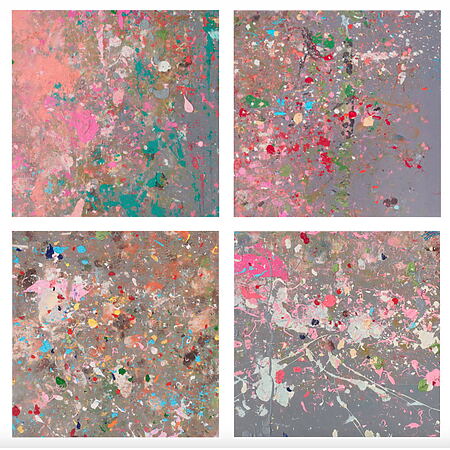
In our virtual art gallery, you also have the opportunity to purchase unique and colorful abstract artworks – directly from the artist or gallery partner.
Each of these paintings was created with passion and exceptional skill by a talented artist. Explore the diversity of the most artistic forms in their most abstract expression and be inspired by images that tell your personal story.
Immerse yourself in a world full of creative inspiration with our extensive range of exquisite abstract masterpieces.




Sources, expert support and further information
Literature:
- Ingo F. Walther. Karl Ruhrberg : Art of the 20th Century: Painting , ISBN-13: 978-3836541145
- Charles Harrison, Francis Frascina, Gill Perry : Primitivism, Cubism, Abstraction: The Early Twentieth Century , ISBN-13: 978-0300055160
- Peter Gay: Modernism: The Lure of Heresy, ISBN-13: 978-0393052053
- Ellen G. Landau : Reading Abstract Expressionism: Context and Critique, ISBN-13: 978-0300106138
- Margit Rowell : Joan Miro: Selected Writings and Interviews, ISBN-13: 978-0306804854
- James E. Breslin : Mark Rothko: A Biography, ISBN-13: 978-0226074061
- Hans Werner Holzwarth: Modern Art. From Impressionism to the Present , ISBN-13: 978-3836555364
- Barbara Hess: Abstract Expressionism: Small Series – Genres , ISBN-13: 978-3822829677
- Lance Esplund : The Art of Looking: How to Read Modern and Contemporary Art , ISBN-13: 978-0465094660
- Wassily Kandinsky: Concerning the Spiritual in Art , ISBN-13: 978-1721770373
- Alfred J. Barr, Jr.: Cubism and Abstract Art (New York 1936). 248 pages. 223 illustrations. Written by the Museum of Modern Art as a guide and catalogue for the exhibition in spring 1936.
Internet:
- Tate Gallery : A Brief History of Abstract Art with Turner, Mondrian and More , https://www.tate.org.uk/art/brief-history-abstract-art-turner-mondrian-and-more
- Daniel Birnbaum / Artforum: Universal Pictures – The Art of Hilma af Klint, https://www.artforum.com/features/universal-pictures-the-art-of-hilma-af-klint-214627/
Affiliate Links Disclaimer : with a - symbol are affiliate links. As a general rule and without exception, we only recommend or link to products that we use (or would use) ourselves and all opinions expressed here are our own. Our product reviews and recommendations are independent and based on research, expert opinions, and/or product testing. If you click on affiliate links in our content, we may receive commissions for your purchases (at no extra cost to you), but we never receive any compensation or payment for the content of our recommendations. This is how we finance our editorial work and the magazine articles we provide to you free of charge (details in our Editorial Standards ). Read the full Privacy Policy .


Owner and Managing Director of Kunstplaza . Publicist, editor, and passionate blogger in the fields of art, design, and creativity since 2011. Graduated with a degree in web design from university (2008). Further developed creative techniques through courses in freehand drawing, expressive painting, and theatre/acting. Profound knowledge of the art market gained through years of journalistic research and numerous collaborations with key players and institutions in the arts and culture sector.
You might also be interested in:


Featured Art



Design and Decor Highlights
-
 Metal wall relief "Santos" with leaf motif and black frame
185,00 €
Metal wall relief "Santos" with leaf motif and black frame
185,00 €
VAT included.
Delivery time: 3-5 working days
-
Sculptural stoneware vase in beige
30,00 €
VAT included.
Delivery time: 3-4 working days
-
J-Line Vintage Table Lamp "British Bulldog", antique bronze look
179,00 €
VAT included.
Delivery time: 2-4 working days
-
J-Line Abstract female figure sitting on rectangular block, matte white
77,90 €
VAT included.
Delivery time: 3-5 working days
-
Ceramic lamp "Nazare" with black hole design
106,00 €
VAT included.
Delivery time: 3-5 working days
-
The Raphia Kauri Mirror (natural white)
154,95 €
VAT included.
Delivery time: 2-4 working days
-
Sculptural ceramic flower pot "Groove", gray (ø 14.5 cm)
25,00 €
VAT included.
Delivery time: 4-8 working days


