In the 1950s, Andy Warhol worked as a commercial artist and sought ways to produce his illustrations more quickly and efficiently. His solution was as simple as it was ingenious: handmade rubber stamps , which he used to introduce recurring patterns and symbols into his work. Particularly for his clients at I. Miller & Sons Shoes, he developed a stamping technique in 1955 that allowed him to create diverse illustrations while quickly varying colors and compositions. This "machine-like" working method, as Warhol later called it, already demonstrated his fascination with serial image production .
What Warhol developed back then is known today as the "blotted-line technique" —a method that combines drawing and printing in a surprisingly accessible way. This technique blends graphic elements with simple printing processes and enabled Warhol to create numerous illustrations on a related theme. Each print becomes unique, although the technique allows for repetition.
The beauty of it is that you only need a few materials – watercolor paper, ink, and transfer paper are all you need. The process itself is incredibly simple: an image is traced onto transfer paper and then pressed onto watercolor paper. This creates that characteristic ink print that makes Warhol's early work so distinctive. His illustrations of birds, butterflies, and flowers for advertising purposes gained their playful yet professional character through this technique.
Warhol posed this question years before his screen prints made him famous. His early experiments with the monoprint technique laid the foundation for an artistic philosophy that would fundamentally question the relationship between original and copy.
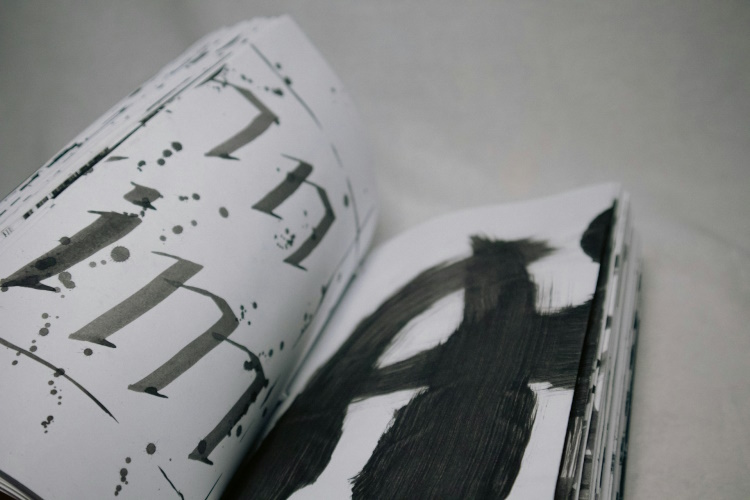
The Blotted-Line Technique: Warhol's Stamping Technique Explained Step by Step. Photo by Josué AS @yehoshuaas, via Unsplash
Initially, Warhol drew inspiration from newspaper advertisements and tabloid photographs, which he copied by hand. However, he soon became more fascinated by photomechanical processes than by expressive brushstrokes. His paintings were intended to resemble commercial products – smooth, impersonal, and reproducible. Mass production and the omnipresence of consumer culture became his central theme. He transformed everyday objects into iconic symbols through serial repetition; the assembly-line mentality of the consumer goods industry was directly reflected in his working method.
His technical approach was strikingly direct. For the famous Marilyn Monroe series, which he first exhibited in November 1962, just three months after the actress's death, Warhol transferred an enlarged publicity photograph onto fine-mesh fabric and printed it on canvas. The subsequent reworking with contrasting pastel tones created that artificial, mask-like effect that made Marilyn a pop icon.
Warhol's work organization was also remarkable. Assistants like Gerard Malanga, Ronnie Cutrone, and George Condo produced countless variations of his motifs according to his instructions. Art as teamwork , as a conceptual process—this idea was radical at the time. The screen printing process itself, in which ink is transferred to the surface through a mesh, provided the desired bold, flat colors and clear contours.
Over the years, Warhol's motifs became less dramatic. Flowers, soup cans, plane tickets – banal objects that he imbued with unexpected colors, thereby humorously distorting them. His early monoprint experiments had taught him how commercial printing techniques could be transformed into artistic statements.
That was his true legacy: to blur the lines between mass production and artistic expression, and in doing so, to show that art can indeed be democratic.”
This is how the blotted-line technique works
When people in Germany talk about stamps, images of official stamps and typical notary stamps made of light wood with a blue ink pad often come to mind. However, if you broaden your perspective and include the artistic and creative field, you'll discover – often under the umbrella term "stamping" – a wealth of exciting techniques and creative approaches.
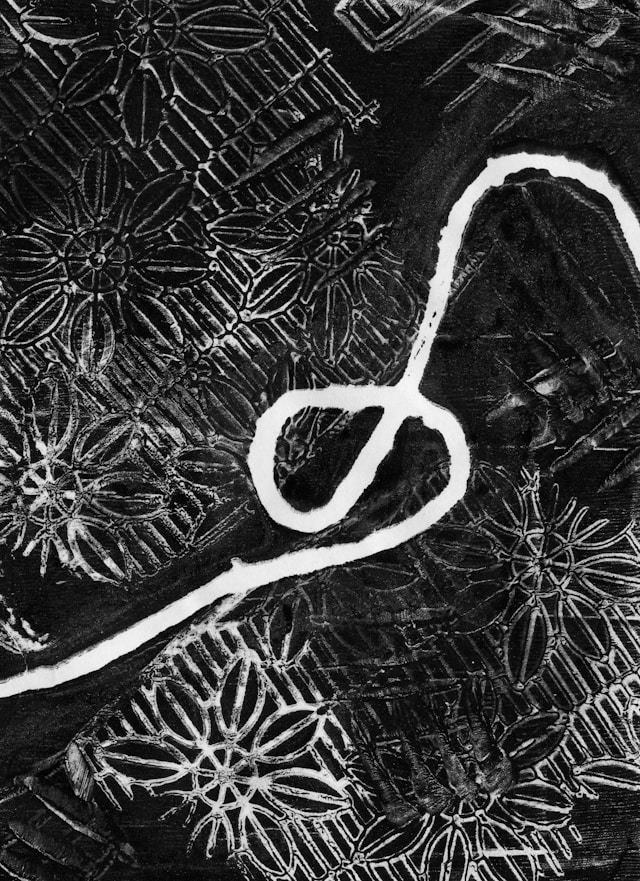
Rubber stamping has long since established itself as a form of stamping in the visual arts. Image by Heather Green @heathergreengreen, via Unsplash
Warhol developed his blotted-line technique while still a student at the Carnegie Institute of Technology and refined it in the 1950s into an efficient tool for his advertising work. The distinctive feature: this method creates characteristically broken lines with random inkblots – an effect that made Warhol's early illustrations unmistakable.
The materials list is surprisingly short:
Tracing paper
Drawing board or absorbent paper
India ink or ink
fountain pen, technical pen or toothpick
Pencil
tape
The process begins with a pencil sketch on tracing paper. This is then attached with tape next to a sheet of more absorbent paper – this allows both sheets to be folded together without slipping.
Now comes the exciting part: Individual sections of the pencil drawing are traced with ink. While the ink is still wet, the absorbent paper is folded over it and gently smoothed. When folded back, the imprint appears – the eponymous "blotted line" . This process is repeated section by section until all the lines have been transferred.
What makes this technique so appealing? The line thickness varies, inkblots and imperfections appear almost automatically. Warhol often colored his prints afterward with watercolors or added depth through gilding.
The tracing paper should be kept – it can be used for further prints. Each new print will look slightly different, which is part of the appeal of monoprinting.
For Warhol, as a commercial artist, this technique was invaluable: he could reproduce a single image in multiple variations and experiment with different colors. He thus offered his clients various versions of the same motif – an early form of his later serial image production.
In the following video, you can see for yourself how a teacher from the Andy Warhol Museum presents the blotted line method, which Andy Warhol often used in his commercial works in the 1950s:
The Andy Warhol Museum is located in Pittsburgh, Pennsylvania, Andy Warhol's hometown, and houses the most comprehensive collection of his artwork as well as archival holdings. It is one of the world's most comprehensive museums dedicated to a single artist and the most important of its kind in North America.
The second video demonstrates Warhol's rubber stamping technique , which Andy Warhol frequently used in his commercial projects and early artworks during the 1950s. This method allowed Warhol to playfully create recurring motifs and symbols such as birds, butterflies, fruits, and flowers.
Tips for modern monoprinting projects
The good news first: Modern monoprinting projects require surprisingly little equipment. A non-absorbent glass or plexiglass board, paste-like paints such as acrylics or water-based inks, a paint roller, and high-quality paper – that's all you need. In addition, you'll need various tools for manipulating the paint, depending on the effects you want to achieve.
An essential technical note: For printing, work in CMYK color mode , as RGB colors can lead to unwanted color shifts. A resolution of at least 300 dpi ensures clear, sharp results.
Three basic techniques result in unique monoprints. The first method involves applying paint to a glass plate and tracing the design onto the back of a piece of paper placed on top. Alternatively, place plant material on the painted plate, cover it with carbon paper, and rub away the paint around the plant parts. The third technique uses stencils, applying the paint directly to the paper.
Gel plates are particularly appealing for creating fine details. They are ideal for material impressions or stencil work. A striking effect is achieved by removing all the plants after the initial "ghost print" and then creating the actual print.
Common beginner mistakes are easily avoided: Don't forget bleed and safety margins. A bleed of about 5 mm around your work area prevents white edges. Key elements like text or logos need a safety margin of at least 3 mm.
The element of surprise is what makes monoprinting so appealing – the result is only revealed when the paper is lifted from the printing plate. This unpredictability transforms each print into a unique work of art and opens up endless possibilities for experimentation.
In the following video, you can observe the creation of a monotype print using the technique Andy Warhol employed as an illustrator. Amy Lindahl , an expert in art integration, STEAM educator, and interdisciplinary CTE teacher, published a short time-lapse video of this process:
Warhol's blotted-line technique was more than just a practical trick for the daily work of a commercial artist. It became the starting point for an artistic approach that would shape the 20th century. Here, what would later become his trademark was already evident: the fusion of industrial production and artistic expression.
What's special about this early phase is how Warhol transformed commercial necessities into artistic possibilities. His clients wanted rapid variations of their motifs – Warhol recognized the potential of serial production in this. His clients needed cost-effective solutions – he developed a technique that worked with the simplest of means. What began as a practical solution became an aesthetic philosophy.
Today, more than 70 years later, the monoprint technique has lost none of its appeal. It represents something that has become precious again in the digitized art world: the unpredictable, the handmade, the unique. Every print tells its own little story – through an inkblot here, an unexpected line there.
Warhol's early experiments still show us today that significant art doesn't have to be created from expensive materials or complicated processes. Sometimes tracing paper, ink, and a little experimentation are all it takes. His message was as simple as it was clear: art should be accessible, achievable for everyone, democratic. This attitude permeates his entire oeuvre—from his first shoe illustrations to his later Polaroid series.
Those who use the blotted-line technique today connect with this tradition of creative pragmatism. They discover the joy of the unexpected and learn that control and chance can be ideal partners in the artistic process.
Owner and Managing Director of Kunstplaza. Journalist, editor, and passionate blogger in the field of art, design, and creativity since 2011. Successful completion of a degree in web design as part of a university study (2008). Further development of creativity techniques through courses in free drawing, expressive painting, and theatre/acting. Profound knowledge of the art market through years of journalistic research and numerous collaborations with actors/institutions from art and culture.
Like any subject area, art also has a wealth of specialised terminology, expressions, abbreviations, and foreign words.
In this section, we would like to introduce you to some of the most important and common terms from time to time.
You will be able to learn and deepen your understanding of a range of information, definitions, liturgical terms, notes, common technical terms and their abbreviations, as well as concepts from art theory, art history, and art philosophy.
The art style or also the direction in artworks refers to the uniform expression of the artworks and cultural products of an era, an artist or an artist group, an art movement, or an art school.
This is a tool for categorising and systematising the diversity of art. It denotes similarities that distinguish it from others.
The term is thematically related to the Art Movement, but it should not be viewed solely within a temporal framework and is therefore much broader.
In this section, we would like to help you gain a better understanding of styles and movements in art.
We use technologies like cookies to store and/or access device information. We do this to improve the browsing experience and to show (non-)personalized ads. If you agree to these technologies, we can process data such as browsing behavior or unique IDs on this website. The refusal or withdrawal of consent may adversely affect certain features and functions.
The technical storage or access is necessary for the legitimate purpose of storing preferences that are not requested by the subscriber or user.
Always active
Die technische Speicherung oder der Zugang ist unbedingt erforderlich für den rechtmäßigen Zweck, die Nutzung eines bestimmten Dienstes zu ermöglichen, der vom Teilnehmer oder Nutzer ausdrücklich gewünscht wird, oder für den alleinigen Zweck, die Übertragung einer Nachricht über ein elektronisches Kommunikationsnetz durchzuführen.
Vorlieben
Technical storage or access is required for the lawful purpose of storing preferences that have not been requested by the subscriber or user.
Statistiken
The technical storage or access that is used exclusively for statistical purposes. The technical storage or access that is used exclusively for anonymous statistical purposes. Without a subpoena, voluntary compliance by your internet service provider, or additional records from third parties, information stored or retrieved for this purpose alone cannot usually be used to identify you.
Marketing
Die technische Speicherung oder der Zugriff ist erforderlich, um Nutzerprofile zu erstellen, um Werbung zu versenden oder um den Nutzer auf einer Website oder über mehrere Websites hinweg zu ähnlichen Marketingzwecken zu verfolgen.



 Floor relief "Haus Metropolitan", sculptural decorative object made of metal
64,95 €
Floor relief "Haus Metropolitan", sculptural decorative object made of metal
64,95 €


