Ancient architecture is definitely worth exploring, and if you're using short breaks for trips within your own country, then Germany's ancient architecture is particularly worth considering. More specifically, today we'll be focusing on the Renaissance in Germany and its influence on building design and architecture.
Our country boasts such a wealth of admirable architectural monuments that you could dedicate each shorter trip to a different era: If you have already explored the architectural legacy of the ancient Romans (see the article "Buildings in Germany – The Beginnings from Antiquity to Romanesque"), perhaps Gothic architecture will be on your agenda for your next holiday (suggested destinations are presented in the article "Gothic Architecture in Germany" ).
Which era you choose to explore naturally depends on your holiday destination; the architectural monuments of the early period can only be visited in western and southern Germany, the Gothic period offers a bit more choice, and if you have already progressed to the Renaissance, you can visit buildings from this era throughout Germany:
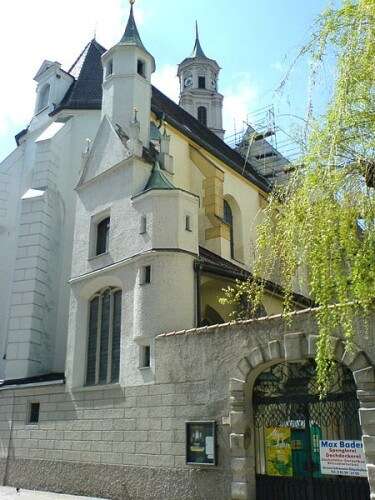
St. Anna Church Augsburg from the view of Annastrasse by ReclaM [CC-BY-SA-3.0], via Wikimedia Commons
While the first models of Gothic architecture came from France, the Renaissance was influenced by Italian "architectural fashion" —the country where the supposed revival of classical forms, from which the Renaissance takes its name, began, the land of ancient buildings.
Historians with an impartial view do not see this revival as a consciously intended process; they speak more soberly of the fact that the high achievements of architecture in the battle-stricken Middle Ages had simply been somewhat forgotten, and that people now wanted to return to the old artistic heights.
The adoption of modern trends in architecture was, then as often still today, first paved by the avant-garde: It was the Fuggers who, in 1509, had their separate family chapel of St. Anna Church in Augsburg expanded in the fashionable Italian style, and suddenly everyone in Augsburg wanted to build in the style of the Italian Renaissance.
The first news of the new architectural style reached Augsburg via trade routes; this trading city was then one of the most important metropolises in Europe with countless trade connections and was also one of the important information exchanges of the time.
However, such fruitful relationships with the world were not the norm, and there were certainly no trade routes across the entire country along which travelers could carry "the latest gossip" to every place.
Thus, even progressive-minded architects in the 16th century to contend with the difficulty that they did not even know the Italian buildings of antiquity from illustrations and that they usually received reports about the current forms of Italian Renaissance architecture second- or third-hand.
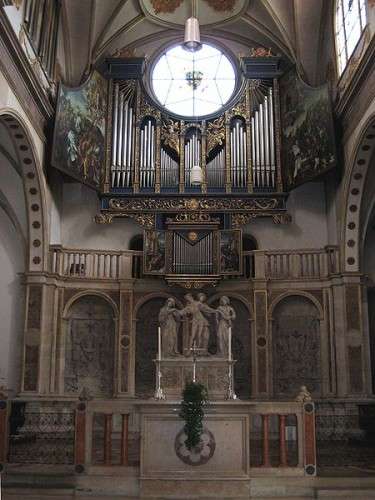
Main altar of St. Anne's Church Augsburg by JD [CC-BY-SA-2.0-de], via Wikimedia Commons
German master builders did not have an easy time implementing the Renaissance
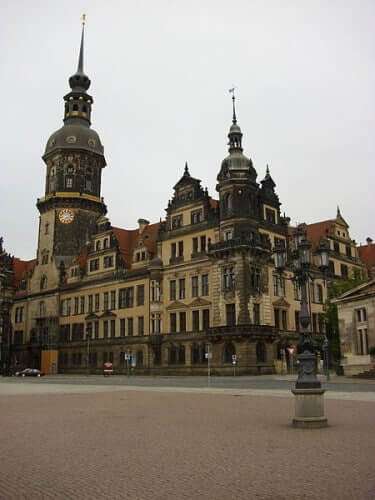
The Dresden Royal Palace east of the Zwinger by Aarp65 [CC-BY-SA-3.0], via Wikimedia Commons
The implementation of these not very precise reports by the hands of German master builders led to many misunderstandings; for example, it was not uncommon for ornaments from textile pattern books to serve as a model for the decoration of a facade.
Architectural historians have observed that in 16th-century Germany this led to a kind of bourgeois "Lego Antiquity" , in which small elements were meant to show progress in architecture, but in their individual tiny forms appeared as if glued onto the conventionally constructed facades.
German builders also had difficulty implementing these current influences for another reason: Even back then, there was an inflexible and therefore progress-hostile bureaucracy, and in Germany, there was a great deal of it.
Even worse, Germany was a patchwork of numerous tiny principalities that frequently and readily waged war against each other. The religious leadership imposed by the Reformation added further conflict potential, leaving citizens virtually powerless between these influences and costing them their lives and property in the conflicts. This resulted in large parts of the country lagging behind in their development.
Only where the ruling princes maintained peace long enough and promoted the Renaissance style as a fashionable form of modern art could impressive Renaissance buildings be erected. Thankfully, there were several such princes scattered throughout the territory of what would later become Germany, and there were master builders whose constant interest in foreign cultural influences made them more astute.
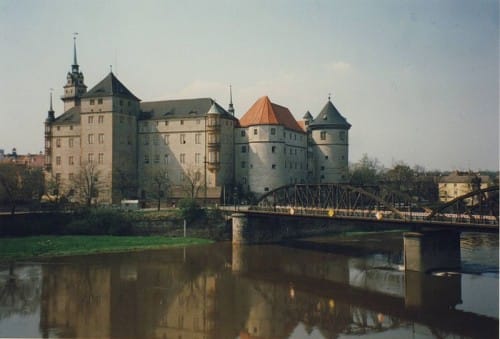
Thus, a connection to the Italian Renaissance was finally achieved, at the latest with the construction of castles , such as the Dresden Royal Palace , Hartenfels Castle in Torgau, Saxony , and the Berlin City Palace, which was built according to its model .
Renaissance buildings can be found in every direction in Germany
Hartenfels Castle on the Elbe River with historic bridge by Dr. Ronald Kunze [GFDL], via Wikimedia Commons
Northern Germany
In northern Germany, Renaissance buildings were rather simple compared to other regions. The architecture did not show a pronounced preference for strict adherence to classical models, as was the case in Italy. Instead, the North German Renaissance was significantly influenced by the Dutch architect Hans Vredeman de Vries (1526-1609).
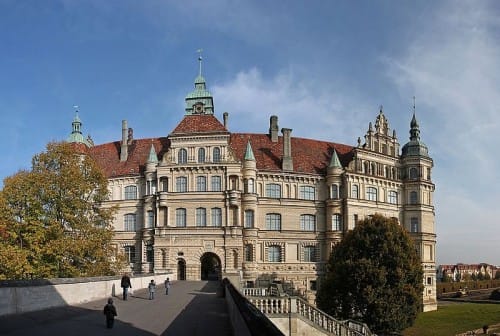
In northern Germany, Güstrow Castle a visit, as is St. Nicholas Church in Stralsund, which boasts a very interesting and elaborate interior.
East Germany
In the east, the castles in Dresden and Torgau are a major attraction, and in Halle an der Saale, Cardinal Albrecht of Brandenburg commissioned several representative Renaissance buildings between 1514 and 1541: Moritzburg Castle, the Cathedral, the New Residence and the Market Church form a unique, and certainly impressive, Renaissance ensemble.
View from the gatehouse of Güstrow Castle. It is considered one of the most important Renaissance buildings in Northern Germany. By Norbert Kaiser [CC-BY-SA-3.0], via Wikimedia CommonsSaxony has even more to offer in terms of Renaissance architecture, as does Thuringia; in both federal states many castles and churches were built in the Renaissance style: the Wilhelmsburg in Schmalkalden, the Gotha Castle, the Rudolstadt town church, the Leipzig town hall, the inner choir of the Freiberg Cathedral and the Schönhof in Görlitz.
The Baltic region also boasts several remarkable architectural masterpieces from the Renaissance period, such as the aforementioned Güstrow Castle and the buildings in Wismar. Construction of the castle began in 1558 as a residence for Duke Ulrich of Mecklenburg, while in 1553 the Dukes of Mecklenburg commissioned the construction of the Fürstenhof in Wismar as a magnificent summer residence in the Italian Renaissance style.
The facade of the Fürstenhof is decorated with semi-sculptural terracotta panels, with figurative friezes separating the three stories. On the street side, the friezes depict stories from the Trojan War, while on the courtyard side, the parable of the prodigal son is portrayed. The entrance portal, made of Danish sandstone, is adorned with grotesque figurative representations popular at the time. The Fürstenhof is considered the northernmost Renaissance castle in Europe.
From 1580 to 1602, the "Waterworks"in the Dutch Renaissance according to the designs of the Utrecht architect Philipp Brandin (c. 1530-1594). The pavilion-shaped building, which ensured the city's water supply until 1897, has a regular dodecagonal ground plan and is supported by twelve herms. These column shafts are decorated with relief-like limestone figures and support a curved copper bell-shaped roof with a hexagonal lantern.
The "Schabbellhaus," built between 1569 and 1571 as a combined residence and brewery according to the plans of Philipp Brandin, is one of the earliest and most important bourgeois Renaissance buildings in Mecklenburg and the entire Baltic region. The street-facing facades of the two-story building and the curved gable with fluted pilasters, which was raised by four stories, are made of red brick framed by white sandstone.
Western Germany
In the west, Heidelberg offers Dutch-influenced Renaissance architecture with its castle, in Wolfenbüttel there is a Welfen castle and the Protestant city church with evidence of the Renaissance style to visit, and an entire Renaissance cityscape can be found in the historic city center of Lemgo and in the middle of Hameln.
In Lower Saxony and North Rhine-Westphalia, you can visit numerous manor houses and castles along the Weser river as further examples of the Dutch-influenced Renaissance; their style is therefore also called "Weser Renaissance"
The Dutch artist Cornelis Floris de Vriendt (1514-75) developed Mannerist decorative forms with his strapwork, scrollwork, and cartilage and auricular ornamentation, which spread throughout Northern Europe from the mid-16th century onwards. The so-called Floris style is particularly evident in Germany on the facades of town halls and burgher houses of the Weser Renaissance (see baukunst-nrw).
Southern Germany and Austria
Southern Germany and Austria became centers of the Late Renaissance (Mannerism). In contrast to the Gothic period, castles were no longer built; instead, princely residences, palaces, or townhouses were constructed.
The works of Mannerist architecture are an impressive testament to bygone eras. The Stallburg, built between 1558 and 1569, and the Amalienburg, completed in 1605 by the talented Pietro Ferrabosco, are just a few examples. Munich, a true center of Mannerism in Germany, is a particularly rich source of fascinating buildings. The serene and gentle tonality of these architectural masterpieces transports visitors to another time and evokes a sense of elegance and beauty.
Jesuit Church of St. Michael, 1583–1597, architect was Friedrich Sustris.
Munich Residenz, 1607–1619. The Antiquarium presents itself as an imposing and unique structure, the largest secular Renaissance hall north of the Alps. Its origins date back to 1385, when a moated castle stood on this site. However, it was Elector Maximilian I who bestowed upon the building its present splendor between 1611 and 1616. Since then, the west facade of the Munich Residenz has shone with an impressive facade, its architectural details painted on the facade. It is adorned with artistic sculptures, including the statue of the "Patrona Boiariae" by Hans Krumper from 1614 and several bronze sculptures.
The important Renaissance buildings in Augsburg have already been mentioned above; besides these Fugger houses, the magnificent Augsburg Town Halland is also worth seeing. Further south, you can visit "authentic Renaissance" in Landshut, where the Landshut City Residence was built by Italian master craftsmen (probably the first guest workers of the early modern period).
In Aschaffenburg, you can visit the Renaissance Johannesburg Castle, which was only built around 1610.
Wherever you travel in Germany during the Easter holidays, you'll always find a Renaissance building nearby that's worth visiting. You can find touristically interesting Renaissance-style architectural monuments here: Quermania: Renaissance architectural monuments in Germany.
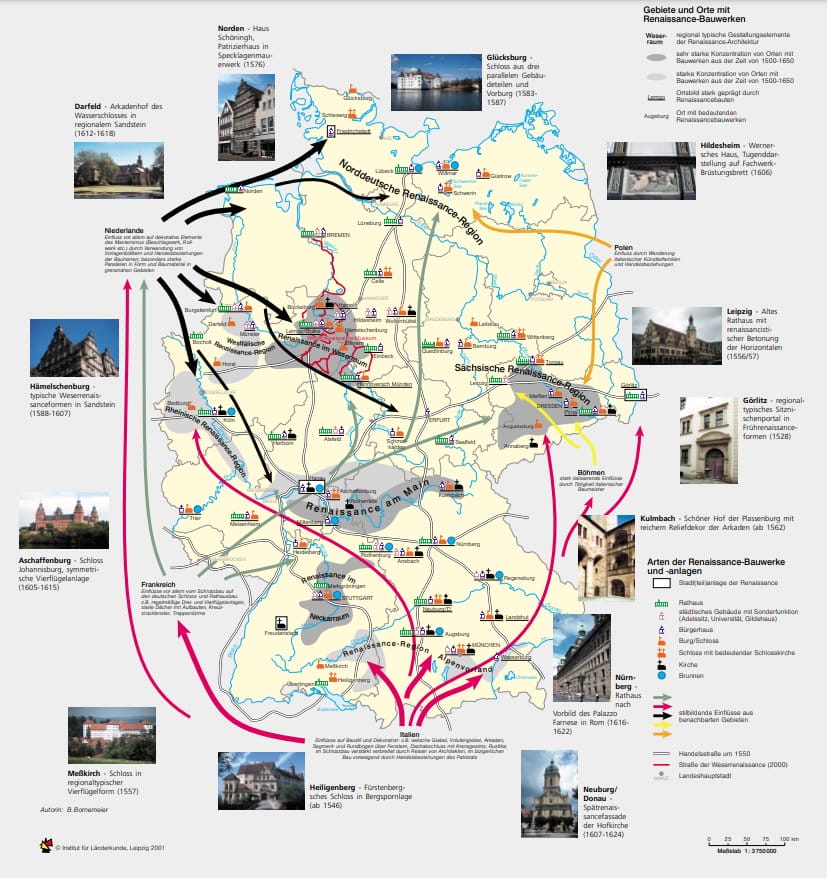
The National Atlas of the Federal Republic of Germany provides a clear overview of the also regional architectural styles of the Renaissance in Germany.
Owner and Managing Director of Kunstplaza . Publicist, editor, and passionate blogger in the fields of art, design, and creativity since 2011. Graduated with a degree in web design from university (2008). Further developed creative techniques through courses in freehand drawing, expressive painting, and theatre/acting. Profound knowledge of the art market gained through years of journalistic research and numerous collaborations with key players and institutions in the arts and culture sector.
In art, artists and artworks are categorized into stylistic periods. These are based on common characteristic features of the artworks and cultural products of a given era.
The division into eras serves as a tool for structuring and classifying works and artists within a temporal framework and a cultural-historical event.
We use technologies such as cookies to store and/or access device information. We do this to improve your browsing experience and to display (non-)personalized advertising. If you consent to these technologies, we can process data such as browsing behavior or unique IDs on this website. Refusal or withdrawal of consent may adversely affect certain features and functions.
Functional
Always Active
Technical storage or access is strictly necessary for the legitimate purpose of enabling the use of a specific service expressly requested by the subscriber or user, or for the sole purpose of carrying out the transmission of a message over an electronic communications network.
Preferences
The technical storage or access is necessary for the legitimate purpose of storing preferences that were not requested by the subscriber or user.
statistics
Technical storage or access that is solely for statistical purposes.Technical storage or access that is used solely for anonymous statistical purposes. Without a subpoena, the voluntary consent of your internet service provider, or additional recording by third parties, the information stored or retrieved for this purpose cannot generally be used to identify you.
marketing
Technical storage or access is required to create user profiles, to send advertising, or to track the user on one or more websites for similar marketing purposes.








 Minimaluxe Dining Chair "Breeze" in Latte (set of 2)
555,00 €
Minimaluxe Dining Chair "Breeze" in Latte (set of 2)
555,00 €