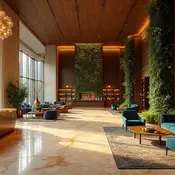
Contemporary architecture arises from the interplay of construction and materiality. While volume and proportions determine the spatial structure, surfaces lend a space character, depth, and visual coherence. Floor and wall surfaces therefore play a crucial role in how interiors are perceived and experienced.
Porcelain stoneware surfaces can influence how a room is structured and perceived
Therole of ceramic surfaces in architecturehas changed significantly. Previously, floor and wall coverings were often selected only in a late project phase and served primarily decorative purposes. Today, surface materials are considered in the early planning stages, as they contribute significantly to the spatial effect.
Porcelain stoneware surfaces can influence how a space is structured and perceived.Color, texture, and formatcan accentuate architectural volumes, emphasize transitions between areas, or strengthen the coherence of a design concept.
This development reflects a general trend in contemporary design, where material choices are closely linked to a project's identity. Through a targeted selection of surface textures, architects canconsciously control the perception of movement, depth, and spatial balance.
Material expression and design versatility
One of the greatest strengths of porcelain stoneware tiles lies in their abilityto enable a wide variety of design expressions. Advances in manufacturing technology have significantly expanded the range of design possibilities, allowing architects and interior designers to work with fine textures, subtle color nuances, and contemporary interpretations of materials.
This versatility makes it possibleto adapt surfaces to very different architectural contexts. In minimalist interiors, understated colors and soft textures can enhance a sense of clarity and tranquility. In more elaborate environments, bolder surfaces and deeper hues bring rhythm and character to the design.
Another crucial aspect isthe precision and consistencythatporcelain stonewareoffers across large surfaces. When the material is intentionally integrated into a project, it creates a harmonious visual language in which floors, walls, and architectural volumes interact naturally.
Technical performance as the basis for architectural design
Besides its design versatility, the architectural value of porcelain stoneware also lies inits technical properties. Contemporary building projects require materials that retain their appearance and stability even under demanding conditions.
Porcelain stoneware is known for itshigh resistance to wear, moisture, and temperature fluctuations. This makes it suitable for numerous applications – from residential spaces and commercial areas to public buildings and hospitality venues.
The ease of maintenancealsocontributes to the architectural relevance of this material. Surfaces that retain their quality over a long period reduce the need for upkeep and allow designers to create spaces that maintain a consistent appearance over time.
Porcelain stoneware surfaces in contemporary architectural projects
In contemporary architecture, porcelain stoneware surfaces are increasingly used as part of a comprehensive material strategy. Instead of merely designing individual areas, they contribute tocreatingvisual continuity within a space
Through its combination of design diversity and technical reliability, porcelain stoneware supports architectural concepts that focus onbalance, clarity, and material consistency. Its role thus extends far beyond mere decoration: surfaces become an integral part of spatial design and significantly shape the atmosphere of contemporary architecture.
Ceramiche Keope: Porcelain stoneware as a material for contemporary design
Since its founding in 1995,Ceramiche Keopeestablished itself as a dynamic player in the ceramics industry, where Italian manufacturing tradition meets modern technological development. As part of the Concorde Group, the company develops surface solutions that combine aesthetic clarity, technical reliability, and environmental responsibility.
Throughcontinuous research and innovation in production processes,porcelain stoneware collections are created that are designed for both interior and exterior architecture and enable a consistent material language across different spaces.
At the heart of this approach isporcelain stoneware– a compact ceramic material created by firing selected clay minerals at very high temperatures. The result is tiles with low porosity, high mechanical strength, and excellent resistance to wear, chemical influences, and environmental factors.
Ceramiche Keopeutilizes these technical properties to create versatile design possibilities. The collections are available innumerous formats and thicknesses, adapting to diverse architectural requirements – from slim 6 mm solutions for renovation projects to robust 20 mm options for exterior surfaces. Large formats create expansive and visually cohesive surfaces, while smaller modules offer greater freedom for decorative compositions and vertical applications.
Surface textures also play an important role in the functional and tactile properties of the collections.Natural R9offers a soft, matte surface suitable for many interior spaces.Ultramattprovides a particularly deep and velvety feel while simultaneously improving slip resistance. For areas with increased safety requirements, surfaces likeGrip R11additional slip resistance without compromising the aesthetic clarity of the surface.
Sustainability is a central componentof Ceramiche Keope's industrial model. The company operates with a closed-loop production system in which fired ceramic waste is fully recycled, raw material residues are reused, and all water used in the manufacturing process is completely reused. Approximately 75% of the energy required is generated internally, while the remaindercomes from certified renewable sources.
Certifications such as ISO17889, WELL Building Standard V2 and Declare confirm this commitment to responsible production processes and sustainable design.
Owner and Managing Director of Kunstplaza . Publicist, editor, and passionate blogger in the fields of art, design, and creativity since 2011. Graduated with a degree in web design from university (2008). Further developed creative techniques through courses in freehand drawing, expressive painting, and theatre/acting. Profound knowledge of the art market gained through years of journalistic research and numerous collaborations with key players and institutions in the arts and culture sector.
Category for interior design,residential design, object furnishings, product and material innovation.
Here you will find everything that makes an interior designer's heart race. We present to you the latesttrendsand developments in the world of home design, as well as innovative products and materials for unique space design.
Our goal is to provide our readers with inspiration and help them creatively redesign or completely transform their living spaces.
We place great importance on ensuring that our articles are not only esthetically pleasing but also include practical tips.
We also introduce you to successful interior designers – from newcomers to the most well-known names in the industry – so you can be inspired by their projects and get to know their working methods.
Whether it's about making the most of a small space or furnishing your home with new furniture in the trendy industrial style: With us, you will find all the information you need on the topic of interior design!
We use technologies such as cookies to store and/or access device information. We do this to improve your browsing experience and to display (non-)personalized advertising. If you consent to these technologies, we can process data such as browsing behavior or unique IDs on this website. Refusal or withdrawal of consent may adversely affect certain features and functions.
Functional
Always Active
Technical storage or access is strictly necessary for the legitimate purpose of enabling the use of a specific service expressly requested by the subscriber or user, or for the sole purpose of carrying out the transmission of a message over an electronic communications network.
Preferences
The technical storage or access is necessary for the legitimate purpose of storing preferences that were not requested by the subscriber or user.
statistics
Technical storage or access that is solely for statistical purposes.Technical storage or access that is used solely for anonymous statistical purposes. Without a subpoena, the voluntary consent of your internet service provider, or additional recording by third parties, the information stored or retrieved for this purpose cannot generally be used to identify you.
marketing
Technical storage or access is required to create user profiles, to send advertising, or to track the user on one or more websites for similar marketing purposes.





 J-Line Majestic Leopard Animal Sculpture in Gold-Colored Polyresin
445,00 €
J-Line Majestic Leopard Animal Sculpture in Gold-Colored Polyresin
445,00 €